
Navigating the AI Chat Companion Landscape of 2025
The artificial intelligence landscape has shifted dramatically by mid-2025, moving beyond simple text generation into a realm of truly multimodal, reasoning-capable assistants. Choosing the right AI Chat Companion is no longer just about who has the funniest jokes; it is about selecting a partner for cognitive offloading, coding, and creative synthesis. The battle lines are drawn between two distinct philosophies: OpenAI’s conversational refinement and Google’s ecosystem integration.
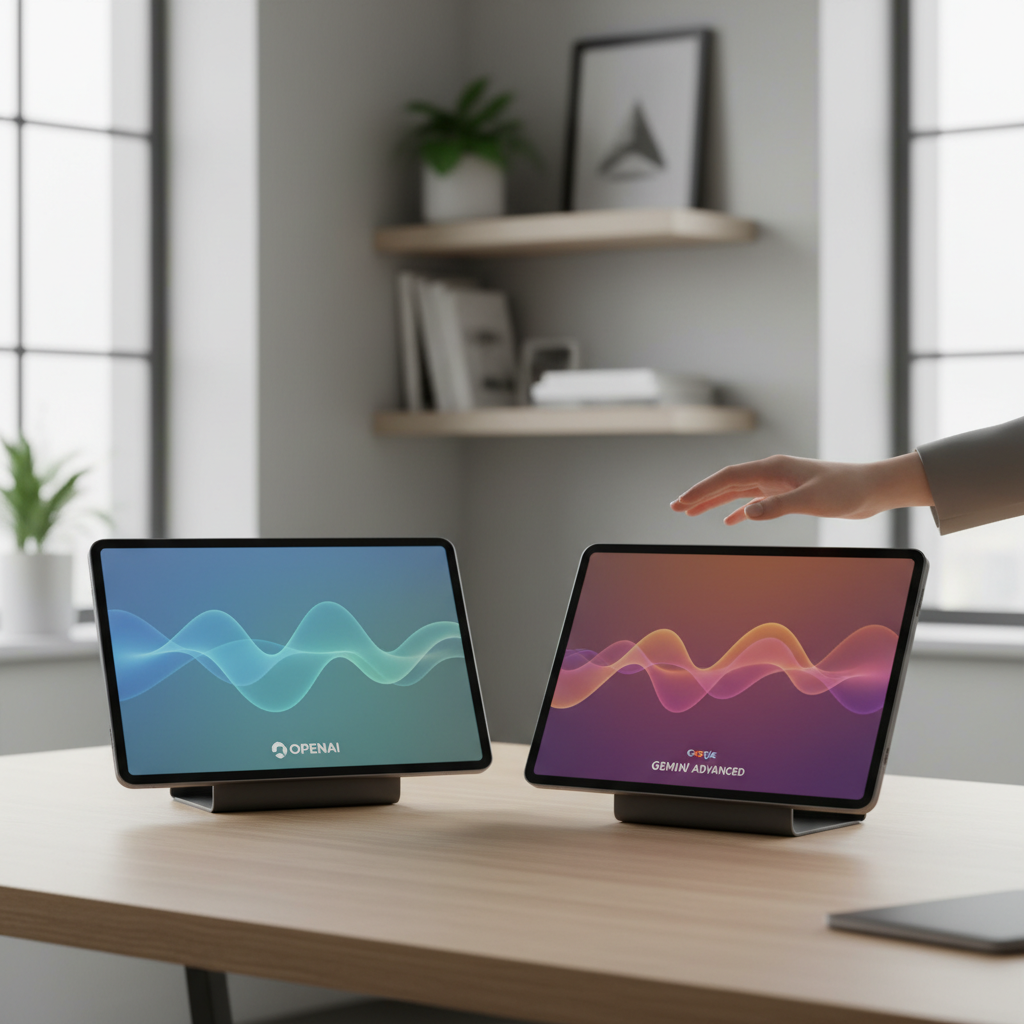
While OpenAI focused on making ChatGPT feel more human and intuitive with the release of model 5.1, Google has doubled down on raw computational power and seamless data connection with Google Gemini Advanced. Understanding the nuance between these titans requires looking under the hood at their architecture, their real-world utility, and how they handle the complexities of modern digital life.
Core Architecture Battles: Gemini 3 vs. ChatGPT 5.1
The technological underpinnings of these models define their user experience. Google’s Gemini 3 has emerged as a reasoning powerhouse. Unlike previous iterations that stitched together different models for text and images, Gemini 3 was built from the ground up as a native multimodal system. This allows it to process video inputs, complex codebases, and audio simultaneously without losing context. For users needing deep analytical work, comparing Gemini 3 and ChatGPT reveals that Google’s offering often edges out in pure logical deduction and long-context retention.
Conversely, ChatGPT (powered by the GPT-5.1 and the specialized 4o architectures) prioritizes the fluidity of interaction. OpenAI has mastered the art of “vibe,” creating an assistant that understands nuance, tone, and intent with frightening accuracy. It feels less like a query engine and more like a collaborator. For creative writers or those using top writing AIs of 2025, this distinction is vital: Gemini acts as a high-powered research assistant, while ChatGPT serves as a creative muse.
| Feature Category | Google Gemini 3 (Advanced) 🧠 | OpenAI ChatGPT 5.1 🎨 |
|---|---|---|
| Primary Strength | Complex reasoning & Multimodal processing | Conversational fluidity & Creative nuance |
| Context Window | Massive (up to 1M+ tokens) | High (128k – 200k range) |
| Visual Analysis | Pixel-perfect counting & chart reading | General interpretation & artistic description |
| Response Style | Factual, concise, data-driven | Warm, engaging, empathetic |
- 🚀 Reasoning: Gemini 3 excels in logic puzzles and scientific data extraction.
- 🗣️ Dialogue: ChatGPT 5.1 provides a superior, human-like conversational flow.
- 👁️ Vision: Google maintains the lead in analyzing video and complex technical diagrams.
- ⚡ Latency: ChatGPT Instant models offer faster responses for everyday queries.
Coding Capabilities and Developer Workflows
For data scientists and software engineers, the choice of an AI Chat Companion often hinges on coding proficiency. In 2025, the debate isn’t just about writing snippets; it is about maintaining architectural coherence across thousands of lines of code. Gemini 3 has leveraged its massive context window to dominate in this sector. Developers can feed entire documentation libraries or legacy codebases into the prompt, allowing Gemini to suggest refactors that respect the project’s specific constraints.
However, OpenAI hasn’t remained static. The introduction of specialized reasoning models (like the o-series) has made ChatGPT incredibly adept at debugging and “rubber ducking” complex algorithmic problems. Furthermore, the integration landscape is fierce. While Gemini lives in Google Studio, the battle of ChatGPT vs GitHub Copilot integration remains a hot topic, as Microsoft (using OpenAI’s models) continues to embed these capabilities directly into VS Code.

The “Vibe Coding” phenomenon—where developers rely on the AI to handle implementation details while they focus on high-level logic—favors models that don’t hallucinate syntax. Benchmarks from mid-2025 suggest a split verdict:
- 💻 Gemini 3: Best for “constraint-based” coding where line count or specific libraries are mandatory.
- 🛠️ ChatGPT 5.1: Superior for explaining why code isn’t working and teaching concepts.
- 🐞 Debugging: Gemini’s ability to “see” the whole project reduces regression errors.
- ⚡ Speed: ChatGPT generates boilerplate code significantly faster.
Ecosystem Integration: The Deciding Factor
An AI model does not exist in a vacuum. By late 2025, the value of a chatbot is determined by how well it plays with your other tools. Google Gemini Advanced has a distinct home-court advantage here. It is natively woven into the Workspace fabric—Docs, Gmail, Drive, and Sheets. You can ask Gemini to “find the email from Sarah about the Q3 budget and summarize the attached spreadsheet,” and it executes this without leaving the chat interface. This creates a friction-free workflow for heavy Google users.
ChatGPT, operating somewhat more independently, counters this with a massive plugin ecosystem and the new “Atlas” browser capabilities. It acts as a universal layer over the web. Its ability to navigate the internet has improved, making web navigation with ChatGPT in 2025 a viable replacement for traditional search engines for many users. It connects with Slack, Trello, and even smart shopping assistants to perform actions in the real world.
| Integration Point | Google Ecosystem 🌐 | OpenAI / Microsoft 🖥️ |
|---|---|---|
| Office Suite | Native in Google Docs/Sheets/Slides | Via Microsoft Copilot (Word/Excel/PPT) |
| Direct Gmail Analysis & Drafting | Outlook Integration | |
| Operating System | Android & ChromeOS deep integration | Windows 11 Sidebar & Copilot+ PCs |
| Third-Party Apps | Limited, focused on Google partners | Extensive Plugin Store & Custom GPTs |
For enterprise users, the choice often comes down to data residency. Microsoft Copilot (leveraging GPT-4o) offers “commercial data protection” where data doesn’t train the model. Similarly, Google ensures Workspace enterprise data remains siloed. However, individual users must remain vigilant about privacy settings, especially regarding ChatGPT vs Gemini data handling policies.
Multimodal Creativity and Daily Assistance
Beyond spreadsheets and code, we use these bots to create. ChatGPT retains the crown for creative writing, roleplay, and ideation. Its output captures emotional depth and stylistic nuance that Gemini often filters out in favor of factual density. For users interested in interactive storytelling or AI chatbot roleplay scenarios, OpenAI’s models offer a more immersive suspension of disbelief.
Visual creativity is another battleground. OpenAI’s integration of DALL-E 3 allows for conversational image editing, while Gemini utilizes Google’s Imagen and Veo models. Gemini’s strength lies in realism and text rendering within images, whereas DALL-E tends to be more artistic and abstract. Furthermore, Gemini’s video understanding is best-in-class; you can upload a video of a broken appliance, and it will identify the specific part and suggest repairs.

When choosing your companion, consider these daily use cases:
- 🎨 Image Generation: ChatGPT for art/concepts; Gemini for photorealistic assets.
- 🎓 Learning: Gemini for sourcing academic papers; ChatGPT for simplifying complex topics.
- 📅 Planning: Gemini connects to Google Calendar/Maps for real-time itineraries.
- 🎙️ Voice Mode: ChatGPT’s advanced voice mode is more conversational and emotive.
- 📱 Mobile Experience: The ChatGPT app offers a smoother UI, while Gemini replaces Google Assistant on Android.
Final Verdict: Performance and Pricing
Cost is the final barrier. In 2025, both platforms offer robust free tiers, but the “Pro” capabilities are gated. ChatGPT Plus remains the standard for access to the latest models and custom GPTs. Google bundles Gemini Advanced with its Google One storage plans, often making it the more economical choice for users who already pay for cloud storage.
Ultimately, if your workflow is chaotic, creative, and requires a companion that “gets” you, OpenAI remains the leader. If your work requires rigorous data analysis, massive context processing, and you live in the Google cloud, Gemini Advanced is the superior tool. Many power users find themselves in a hybrid state, perhaps utilizing specialized tools like ChatGPT Atlas for specific tasks while relying on Gemini for heavy lifting.
Which AI is better for coding in 2025, Gemini or ChatGPT?
Gemini 3 generally outperforms in handling large codebases due to its massive context window and native multimodal understanding, making it ideal for complex refactoring. However, ChatGPT 5.1 is often preferred for quick debugging, logic explanation, and generating boilerplate code thanks to its reasoning capabilities.
Is Google Gemini Advanced free?
No, Gemini Advanced (powered by the Ultra 1.0/Gemini 3 models) requires a paid subscription, typically bundled with the Google One AI Premium plan. However, a capable version of Gemini (Flash models) is available for free with standard Google accounts.
Can ChatGPT access my Google Drive files?
Not natively. ChatGPT requires you to upload files manually or use third-party integrations (via Zapier or custom GPTs) to access Google Drive. In contrast, Gemini is natively integrated and can read Drive files directly if you grant permission.
Does ChatGPT 5.1 have a voice mode?
Yes, ChatGPT features an Advanced Voice Mode that offers incredibly low latency and emotional intonation, allowing for natural, real-time spoken conversations that feel very human-like compared to standard voice assistants.
Which AI model is safer for enterprise data?
Both offer enterprise-grade security. Microsoft Copilot (using OpenAI models) and Google Gemini for Workspace both provide guarantees that commercial data is encrypted and not used to train the public models. The choice depends on whether your company uses Microsoft 365 or Google Workspace.

Aisha thrives on breaking down the black box of machine learning. Her articles are structured, educational journeys that turn technical nuances into understandable, applicable knowledge for developers and curious readers alike.

Comments are closed