
The Clash of Titans: Analyzing the AI Landscape in 2025
Artificial Intelligence has transcended the realm of speculative fiction to become the backbone of modern digital infrastructure. As we navigate through 2026, the rivalry between proprietary giants and open-source champions defines the trajectory of Machine Learning development. The narrative is no longer just about who has the smartest chatbot; it is about ecosystem dominance, privacy control, and computational efficiency.
On one side stands OpenAI, the pioneer that ignited the generative AI revolution with the GPT series. On the other, Meta has fundamentally altered the playing field by democratizing access through its LLaMA series. This dichotomy presents a complex choice for developers and enterprises: opt for the polished, multimodal prowess of a closed system or embrace the flexibility of an open-source AI Model. Understanding the nuances of this OpenAI vs Meta comparison is crucial for anyone looking to deploy scalable AI solutions today.
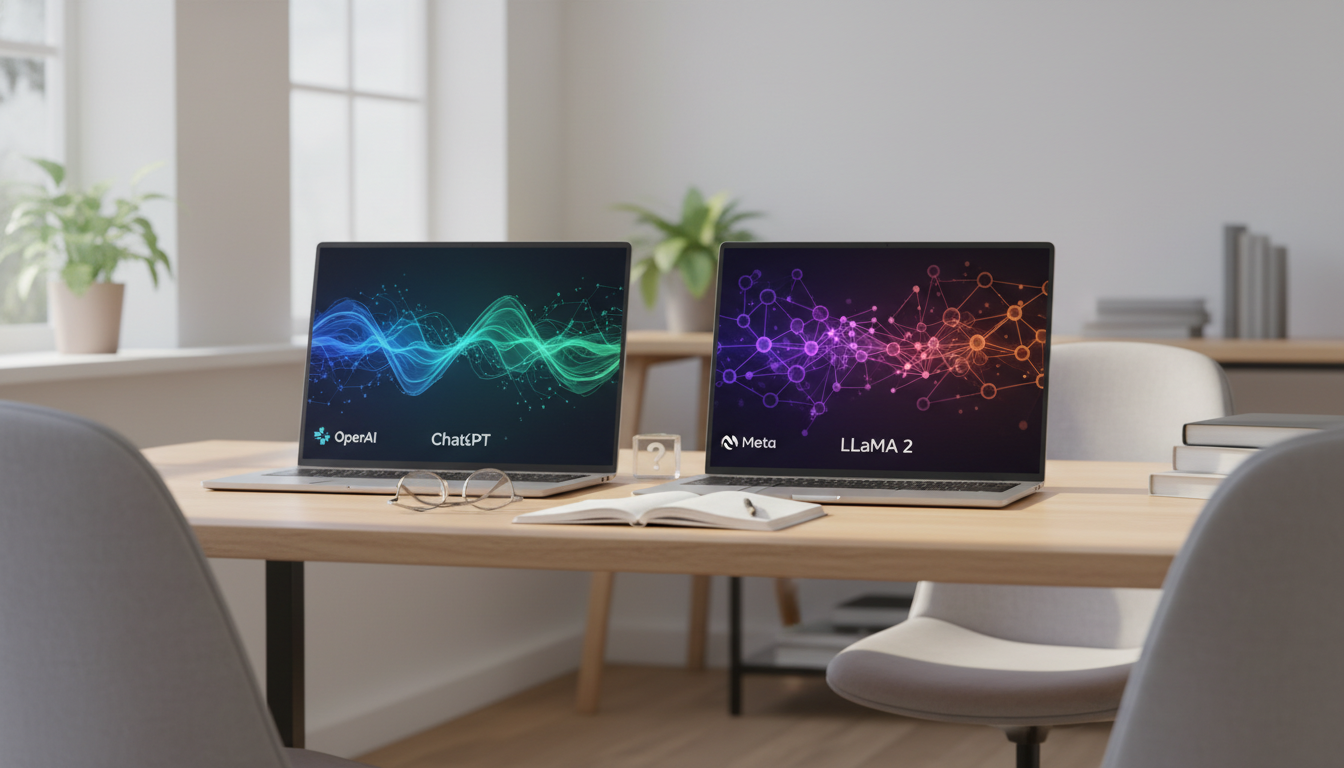
Architectural Warfare: GPT-4o vs. LLaMA’s Evolution
The fundamental difference between these two powerhouses lies in their philosophy of distribution and architecture. OpenAI maintains a “black box” approach. While the exact parameter count of models like GPT-4 remains a closely guarded secret—estimates often float around the 1.76 trillion mark using a Mixture of Experts (MoE) architecture—the performance is undeniable. This immense scale allows ChatGPT to handle nuanced reasoning, complex creative writing, and multimodal inputs (text, audio, image) with a fluidity that set the standard for the industry.
Conversely, Meta’s strategy with LLaMA (Large Language Model Meta AI) has been about efficiency and accessibility. Starting with LLaMA 2 in 2023 and evolving through 2025, Meta provided weights to the public, allowing researchers to fine-tune models on consumer hardware. A 70B parameter LLaMA model, while smaller than GPT-4, often punches above its weight class due to training on trillions of high-quality tokens. This efficiency makes it a prime candidate for organizations prioritizing private data handling and lower inference costs.
Critical Spec Comparison for Developers
To truly grasp the capabilities of these models, one must look beyond the hype and analyze the technical specifications that drive performance. The following table breaks down the core distinctions that define the OpenAI and Meta ecosystems as of late 2025.
| Feature 🚀 | OpenAI (GPT-4/4o) | Meta (LLaMA Series) |
|---|---|---|
| Access Model | Proprietary / API Subscription | Open Source (Commercial use allowed) |
| Multimodality | Native (Text, Audio, Vision, Video) | Text-focused (Multimodal in newer iterations) |
| Reasoning Capability | Superior in complex logic & generalized tasks | High efficiency, rivals GPT-4 in specific benchmarks |
| Privacy Control | Data processed on OpenAI servers | Full control (Self-hosted / On-premise) |
| Customization | Fine-tuning available but limited flexibility | Extremely high (Full weight access) |
Performance Benchmarks: Creativity vs. Control
When assessing raw performance, ChatGPT typically retains the crown for generalist tasks. Its ability to weave complex narratives, generate code across obscure languages, and maintain context over long conversations is unmatched in the commercial sector. For users needing a “plug-and-play” solution that handles everything from image generation via DALL-E to analyzing spreadsheets, OpenAI provides a cohesive ecosystem. This versatility is why it remains the top choice for content creation and drafting where nuance is paramount.
However, LLaMA 2 and its successors shine in specialized environments. Because developers can strip the model down and retrain it on niche datasets—such as legal documentation or medical records—without fear of data leakage, it often outperforms larger models in domain-specific accuracy. Furthermore, tools like Ghost Attention (GAtt) have significantly improved LLaMA’s ability to adhere to system instructions over long turns, narrowing the gap with closed-source competitors.
The Coding and Logic Battlefield
In the domain of programming, the race is incredibly tight. OpenAI has historically led with its advanced reasoning capabilities, making it a favorite for debugging complex architectures. However, the open-source community has rallied around LLaMA, creating specialized variants like “Code Llama” that offer impressive performance with significantly lower latency. For real-time coding assistants, the speed of inference offered by a well-optimized Meta model can be more valuable than the raw power of GPT-4.
Moreover, the landscape in 2025 saw the rise of other contenders like DeepSeek, which challenged both giants in mathematical reasoning. Yet, when strictly comparing the two main market leaders, the choice often comes down to ChatGPT vs Llama based on infrastructure: do you want to pay per token for a managed service, or invest in GPUs to run your own highly optimized logic engine?
Strategic Advantages of Open Source AI
Meta’s decision to open-source LLaMA 2 was a strategic masterstroke that prevented OpenAI and Google from establishing a total monopoly on Artificial Intelligence. By empowering the community, Meta accelerated innovation at a pace no single company could match. Thousands of developers work daily to quantize, fine-tune, and optimize these models, resulting in versions that run on everything from high-end servers to MacBooks.
This approach offers distinct benefits that proprietary models simply cannot replicate:
- 🔐 Data Sovereignty: Companies can host models entirely offline, ensuring sensitive IP never leaves their secure environment.
- 📉 Cost Predictability: Once the hardware is acquired, there are no fluctuating API costs based on token usage.
- ⚡ Latency Reduction: Edge computing becomes possible, allowing for instant responses in applications like gaming or robotics.
- 🛠️ Deep Customization: Modifying the model architecture or weights to create productivity tools perfectly tailored to specific workflows.
- 🌍 Language Diversity: The community has rapidly fine-tuned LLaMA for low-resource languages that commercial APIs often neglect.
The Verdict: Choosing the Right Tool for 2026
As we analyze the ecosystem in 2026, declaring a single winner is impossible because the “best” model depends entirely on the use case. If the goal is to access the pinnacle of current Natural Language Processing reasoning with zero infrastructure management, OpenAI remains the supreme choice. It is the gold standard for general intelligence and multimodal interaction.
However, for enterprises demanding control, privacy, and cost-efficiency at scale, Meta’s ecosystem is unrivaled. The legacy of LLaMA 2 has proven that open weights can compete with closed gardens, providing a robust foundation for the future of proprietary software development. Ultimately, the market is large enough for both philosophies to thrive, driving AI Comparison discussions well into the future. For those exploring alternatives beyond these two, looking into emerging enterprise competitors is also recommended.
Is LLaMA 2 better than ChatGPT for coding?
It depends on the specific setup. While ChatGPT (GPT-4) generally offers superior reasoning for complex logic and debugging, fine-tuned versions of LLaMA (like Code Llama) can be faster and highly accurate for specific languages, especially when hosted locally to reduce latency.
Can I run Meta’s AI models on my own computer?
Yes, this is a key advantage of Meta’s approach. Utilizing quantized versions of the models, it is possible to run powerful iterations of LLaMA on consumer hardware with high-end GPUs or Apple Silicon, offering total privacy and offline functionality.
Why does OpenAI cost more than using open-source models?
OpenAI charges for access to their API based on token usage to cover the immense computational costs of hosting and running their massive proprietary models. Open-source models are ‘free’ to download, but you bear the cost of the hardware or cloud infrastructure required to run them.
Does ChatGPT have better multilingual support than LLaMA?
Generally, yes. OpenAI’s models are trained on a more diverse range of multilingual data out of the box. However, the open-source community frequently releases fine-tuned versions of LLaMA specifically improved for various global languages, narrowing this gap significantly.

Aisha thrives on breaking down the black box of machine learning. Her articles are structured, educational journeys that turn technical nuances into understandable, applicable knowledge for developers and curious readers alike.

No responses yet