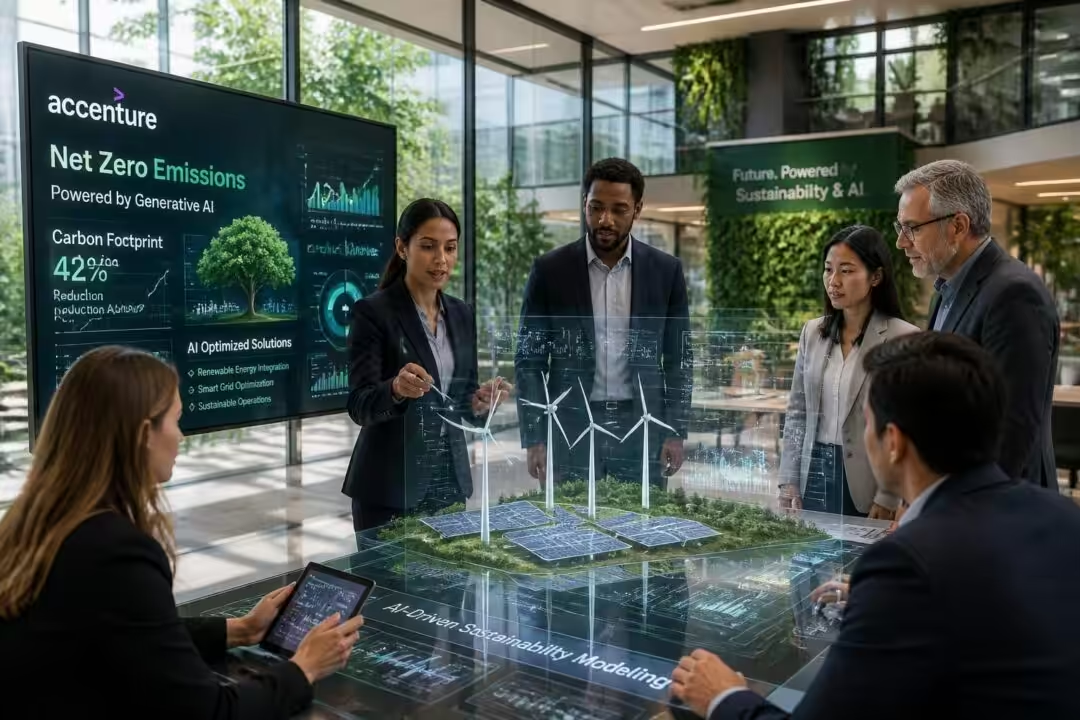
Accenture: Driving Net Zero With Generative AI in Capital Projects
Climate Week NYC 2025 sent a useful signal: even with political noise, many operators kept moving on climate plans. The mood was less “grand pledge,” more “show the math.” That matters because the path to net zero now looks fragmented. Different states, sectors, and regulators move at different speeds. That split can slow standards, but it can also create faster feedback loops for teams that ship real projects. ⚡
For US companies that build things—plants, grids, data centers, ports—the net-zero push is tied to a surge in capital spending. By late 2025, global infrastructure spend was on track to clear $9 trillion. The catch: most big builds still miss their promises. Accenture’s research (including “Blueprint for Success” and “Powered for Change 2025”) frames this as a structural delivery problem, not a lack of climate tech. If 92% of capital projects fail to meet commitments, decarbonization stalls no matter how good the hardware is.
To make this concrete, picture a fictional but realistic firm: Lakeview Chemicals, a mid-sized manufacturer with three US sites. The board wants a net-zero roadmap: electrify process heat, sign clean power contracts, and add carbon capture for a legacy line. The engineers can find vendors for all of it. The real risk is delivery: changing requirements, long-lead equipment, community opposition, and mismatched data across contractors.
Why net-zero infrastructure breaks traditional delivery models
Net-zero builds are harder than classic expansions because they combine new tech with old constraints. A green hydrogen hub needs interconnect studies, water rights, storage safety reviews, and offtake contracts that may not exist yet. A small modular reactor pilot has licensing complexity and public scrutiny. Even “simple” electrification hits grid queues and transformer shortages.
Accenture’s framing is blunt: delivery models are lagging behind the technology. Many net-zero assets get treated as one-off efforts—custom engineering every time. That drives rework and makes learning slow. If each project is bespoke, the organization never compounds knowledge. 🧱
How generative AI fits without turning into theater
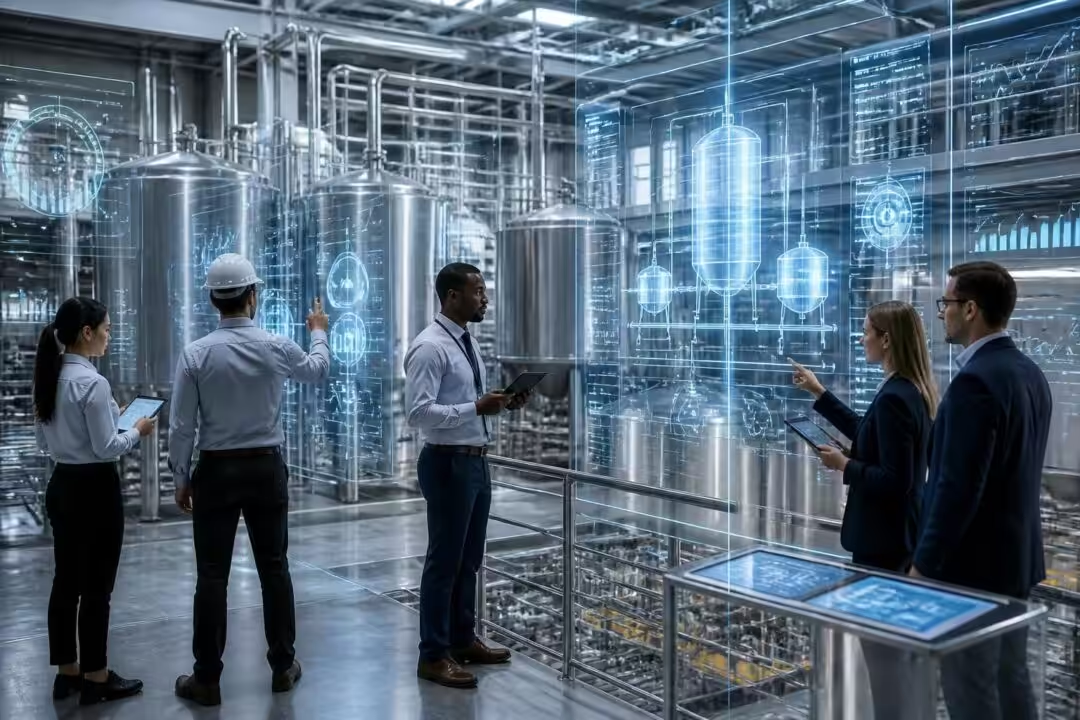
Generative AI becomes useful when it connects to real project data and governance. Think of it as a layer that can read, summarize, compare, and draft across the messy corpus capital teams already have: RFIs, change orders, meeting minutes, design narratives, permitting emails, safety reports, and supplier quotes.
At Lakeview, the project office is buried in documents across SharePoint, email, and contractor portals. A GenAI system tuned to the firm’s standards can draft a “design decision log” from meeting transcripts, flag inconsistencies between a procurement spec and a P&ID revision, and generate a first-pass response to a regulator’s information request—then route to a human owner for sign-off. The speed-up comes from less scavenger hunting, not from replacing engineering judgment.
The key insight is that net zero is now a delivery race. If the organization cannot execute repeatably, it cannot decarbonize at scale. The next step is shifting from pilots to platforms—where GenAI can compound what each project teaches the next. ✅
Accenture’s AI-Driven Blueprint: Modular, Multigenerational Net-Zero Delivery
Accenture’s “Powered for Change 2025” argument centers on a change in posture: stop treating net-zero builds as artisanal work. Start treating them like a product line. That does not mean every plant is identical. It means the organization standardizes what can be standardized—design patterns, contract language, commissioning steps, and data structures—so teams can repeat delivery with fewer surprises. 🧩
This is where “multigenerational” delivery lands. The first wave of projects is rarely cheap. It is the learning set. If that learning is captured in a way the next wave can reuse, the cost curve bends. If it stays stuck in PDFs and people’s heads, every build restarts from scratch.
From bespoke assets to repeatable modules
Accenture points out that a very high share of net-zero assets are still treated as bespoke. In practice, that shows up as custom EPC scopes, unique integration logic, and local workarounds that never get codified. The result is slow design, higher contingency, and fragile schedules.
In green hydrogen, the report highlights a specific payoff: standardization could translate into a 35% cost advantage by 2035, and roughly $60B in net present value by 2050, with cost parity arriving about a decade earlier than in a custom-build world. The numbers are directional, but the mechanism is clear: repeatable designs reduce engineering hours, tighten procurement catalogs, and make commissioning less of a bespoke ordeal.
The digital backbone that makes “repeatable” real
Standardization fails if each contractor uses a different schema and naming system. A practical digital core needs consistent asset IDs, change tracking, and data handoffs from design through operations. GenAI is useful here because it can translate between formats, detect drift, and produce human-readable explanations of what changed and why.
Lakeview’s program team creates a “module library” for electrified boilers, heat recovery skids, and carbon capture tie-ins. Each module includes: validated drawings, a commissioning checklist, a safety case template, and a bill of materials mapped to preferred suppliers. GenAI supports the library by summarizing lessons learned from punch lists and incident reports, then proposing updates to the standard package—pending review.
A field-tested checklist you can steal
For capital leaders trying to operationalize the Accenture model, the work is less about buying a chatbot and more about building a system that can repeat. This short list mirrors what shows up in successful programs:
- 📦 Module definitions: clear boundaries for what repeats (skids, substations, control logic, commissioning scripts).
- 🗂️ Data standards: naming conventions and a single source for asset and document truth.
- 🧾 Contract patterns: standard clauses for change orders, performance guarantees, and data deliverables.
- 👷 Construction feedback loops: a way to turn field issues into updates to the module library.
- 🔐 Security and access: role-based controls so vendors see only what they must.
The throughline is disciplined reuse. Once that discipline exists, GenAI becomes a multiplier instead of a distraction. Next comes the harder part: aligning people, incentives, and governance so the machine actually learns across projects. 🔁
To see what this looks like in practice, it helps to compare real-world patterns across industries and the tools capital teams are testing right now.
Accenture’s AI+Human Engine: How Generative AI Changes Execution, Not Just Reporting
Accenture’s most useful framing is the AI+Human engine. The idea is simple: AI does pattern recognition and drafting at scale, while humans set intent, verify reality, and own decisions. That sounds obvious, yet many organizations still fund tools without funding the operating model around them. The result is pilot purgatory.
The research claims that companies leaning into this AI+Human model are seeing about 2.5x higher revenue growth and 2.4x greater productivity. Those figures should be treated as correlation, not magic. Still, they track with what happens when documentation, procurement, and scheduling stop being manual bottlenecks. 📈
Where GenAI actually helps on net-zero builds
GenAI is strongest where the task is language-heavy, repetitive, and tied to high-stakes coordination. Capital projects are full of that work. Some examples that engineering teams have found credible:
1) Risk sensing from text exhaust. Permitting delays often show up first in emails and meeting notes, not in a dashboard. A GenAI model can classify themes (noise, traffic, water use), track sentiment over time, and alert the community engagement lead before a hearing turns ugly.
2) Supply chain early warning. Lead times for transformers, switchgear, and specialty alloys can swing. GenAI can read supplier updates, compare them to contract terms, and draft mitigation options: alternate specs, staged delivery, or redesign triggers.
3) Change order triage. Many disputes are documentation disputes. A model can assemble a timeline: which drawing revision was issued when, what the RFI response said, and which cost code was impacted. Humans still negotiate, but they do it with a clean record.
What “codify knowledge to make it AI-ready” means
Accenture’s language about knowledge hubs can sound abstract. On the ground, it means building a controlled corpus: curated templates, approved standards, and a tagged archive of lessons learned. It also means deciding what the model is not allowed to do. For example, it should never approve a safety deviation. It can draft, but a credentialed person signs. 🦺
Lakeview sets up a small “project knowledge desk” inside the PMO. Two experienced project engineers rotate through it. Their job is to label documents, maintain the module library, and review AI-generated updates before they become standards. This is boring work, and it is the work that makes AI compound.
Table: GenAI use cases vs. failure modes to watch
| Area | GenAI task | Success signal ✅ | Failure mode ⚠️ |
|---|---|---|---|
| Permitting & community | Draft responses, summarize hearings 📝 | Faster, consistent narratives with citations | Hallucinated facts in public filings |
| Engineering change control | Diff specs and revisions 🔍 | Fewer missed interface changes | Model trained on outdated standards |
| Procurement | Compare quotes and terms 💼 | Reduced cycle time for bid evaluation | Over-trusting summaries, missing exclusions |
| Construction | Turn daily logs into trends 🏗️ | Earlier detection of productivity dips | Garbage-in logs producing false alarms |
| Handover to operations | Create O&M drafts and training guides 📚 | Smoother commissioning to steady state | IP leakage into shared model tools |
The takeaway is not that GenAI “does the project.” It changes the tempo of coordination and reduces avoidable ambiguity. That sets up the next question: how do teams scale beyond a few wins and avoid a graveyard of pilots? 🚦
From Pilots to Platforms: Accenture’s Path to Scalable Net-Zero Infrastructure
Many enterprises ran GenAI pilots in 2024–2026, then hit a wall: legal reviews, data access, and unclear ownership. Accenture’s guidance pushes toward platform thinking. The point is to make learning repeat by design: standardize what works, modularize components, and embed learnings into each delivery phase.
Capital programs are a good fit for platforms because they already run through stage gates. Each gate can generate structured data that the next project can reuse. The shift is cultural as much as technical. Teams have to stop treating each build as a heroic one-off and start treating it as a repeatable production system. 🏭
What a “net-zero delivery platform” looks like in practice
In a practical sense, the platform is a bundle of components:
A common data layer that links scope, schedule, cost, risk, and document control. This can sit across multiple tools, but it needs consistent identifiers.
A model governance layer with clear rules: which model is used for what, how prompts and outputs are logged, and how confidential project data is protected. In regulated industries, audit trails matter as much as model quality.
A reusable module library with validated designs and commissioning scripts. This is where the multigenerational idea becomes operational.
Human roles that keep it alive: product owners for the platform, librarians for the knowledge base, and accountable leaders at each gate.
Why “green technology hubs” change the unit economics
Accenture highlights the need for hubs that cluster power generation, storage, and high-consumption loads. The logic is that hubs reduce integration friction. A hydrogen electrolyzer co-located with renewables and industrial offtake can lower curtailment risk and improve financing. A shared transmission upgrade can serve multiple projects, which can ease community negotiations if benefits are visible.
In the Lakeview example, the company joins a regional consortium near a port with access to renewable PPAs and existing pipeline corridors. The hub model reduces redundant permitting and helps align local job benefits with the build schedule. GenAI supports the consortium by summarizing regulatory filings, tracking commitments made to stakeholders, and drafting consistent updates across partners—under strict review before publication.
Performance claims and what they imply for decision-makers
Accenture cites research suggesting that capital projects using AI are 40% more likely to succeed. The practical implication is not “buy AI and win.” It is that organizations with good data discipline and repeatable execution benefit the most. If the baseline process is chaotic, AI can amplify chaos.
One useful way to pressure-test a platform plan is to ask: will the second project be cheaper than the first for a real reason, or only because contingency got cut? If the platform is working, the cost curve bends because engineering effort drops, procurement catalogs tighten, and schedule variance shrinks.
The next constraint is endurance: supply chains, community trust, and leadership turnover. That’s where a platform either becomes institutional memory—or another tool nobody opens. 🧠
Teams that want more context on responsible deployment should track how large consultancies and partners describe governance and adoption, then map those claims to internal controls you can audit.
Net-Zero Delivery Under Real-World Constraints: Communities, Supply Chains, and Accountability
Net-zero infrastructure lives in the real world: neighborhoods, labor markets, and regulatory calendars. Accenture’s framework calls out “balance urgency with endurance,” which is a polite way of saying that rushing breaks trust and breaks projects. Community opposition, grid interconnection delays, and supplier bottlenecks can erase a year of schedule in a month. ⏱️
The teams that keep momentum treat these constraints as first-class engineering inputs. That means earlier engagement, tighter scenario planning, and a supply chain posture that assumes disruption. GenAI is useful here because it can keep leaders grounded in what has been promised, what has changed, and what tradeoffs are now on the table.
Community engagement as a tracked requirement, not a PR task
At Climate Week NYC 2025, the pragmatic turn was hard to miss. Updated national climate plans sent mixed signals, but the real economy still moved because projects had to pencil out. Community buy-in is part of “penciling out.” A delayed permit is a financing problem, not a communications problem.
Lakeview’s retrofit requires truck traffic changes for six months. The company commits to limited delivery windows and funds a road repair plan. GenAI is used to maintain a commitments register: every promise made in meetings gets captured, assigned an owner, and tracked against evidence. If a new contractor suggests a staging change that breaks a promise, the system flags it before it becomes a headline. 🧾
Agile supply chains without chaos
Accenture’s stance on resilient supply chains is grounded in the last few years: lead times swing, geopolitics reshapes availability, and rare components become single points of failure. The fix is not constant redesign. It is controlled flexibility: pre-qualified alternates, modular substitutions, and contract language that makes data sharing mandatory.
GenAI can draft “alternate path” playbooks tied to specific triggers. Example: if transformer lead time exceeds a threshold, the system pulls prior cases, lists alternate vendors already approved, and drafts a schedule recovery plan. A human scheduler then edits and locks it.
Responsible GenAI: auditability, safety, and IP
Net-zero projects intersect with safety and critical infrastructure. Any GenAI deployment needs guardrails that engineers can defend. That includes:
- 🔒 Data boundaries: keep sensitive drawings and vendor pricing in controlled environments.
- 🧪 Validation: require citations back to source documents for any drafted claim.
- 🦺 Safety controls: prohibit AI from authorizing deviations; it can only draft options.
- 📜 Audit logs: record prompts, outputs, and approvals for later review.
Accenture’s “champion change across the ecosystem” point matters here. If suppliers and EPCs cannot meet data deliverable requirements, the platform breaks. Contracts need to reflect the new reality: structured handover data is part of the scope, and it is inspected like concrete strength tests.
The final insight is simple and uncomfortable: the net-zero build-out will not be won by one breakthrough. It will be won by repeatable execution that survives leadership changes, market swings, and community scrutiny—where generative AI is embedded in the delivery system, not taped onto the side. ✅

I’m a Brooklyn tech journalist who spent a decade covering software, cloud and developer tooling. I started this magazine in 2023 to cover generative AI without the hype or the cynicism: testing tools on my own subscriptions and citing primary sources.