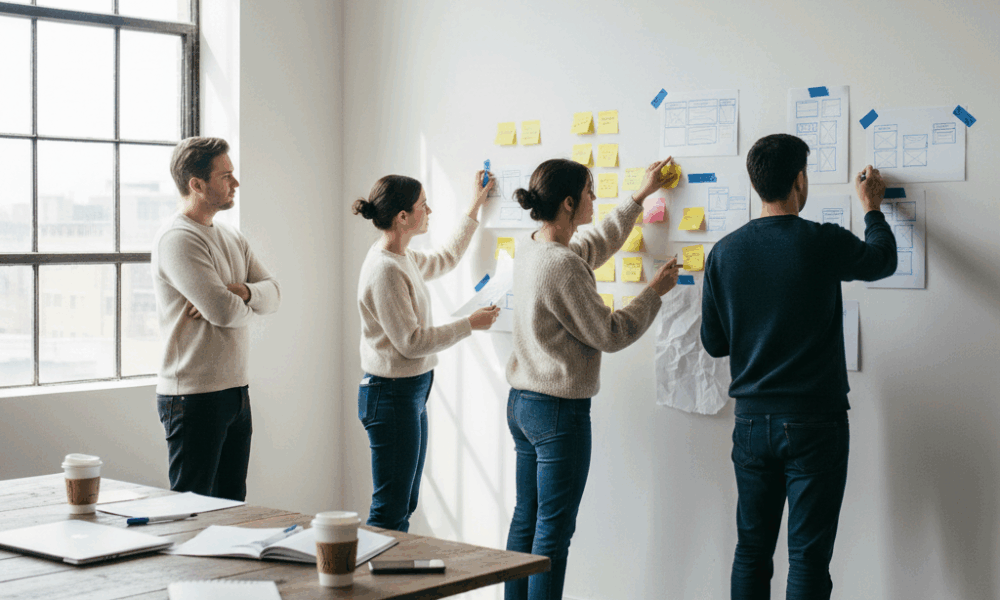
Discover 1000 innovative ideas to inspire your next project: high-yield brainstorming and selection frameworks
When ambitious teams search for inspiration, a flood of options can blur focus. A practical way to harvest ideas at scale is to funnel creativity from broad brainstorming into testable experiments. The approach below has helped product squads, community groups, and student teams transform vague notions into concrete projects with measurable outcomes.
From sparks to short, testable bets
Start wide. Map domains—tech gadgets, art and design, sustainability, education, and social impact—and capture 100+ prompts in each. Then compress scope until the work can fit inside a week. A sustainability prompt like “reduce plastic waste” becomes a micro-pilot: a kiosk trial using biodegradable seaweed packaging at a single café. A food supply concept narrows to a mobile marketplace connecting nearby farmers and households with surplus alerts to cut waste. The question guiding selection: what is the smallest build that reveals whether the value is real?
To keep momentum, a fictional team—Northbridge Labs—uses a 3-track intake: “ship now,” “prototype,” and “parked.” The method avoids endless debate and rewards development of thin slices that clarify direction quickly.
- 🎯 Define a crisp outcome: “validate demand for a 10-minute delivery window.”
- 🧪 Choose one variable to test: price, speed, or convenience—never all three.
- 🛠️ Use off-the-shelf tools first; build custom only when learning requires it.
- 📣 Recruit 10 users for feedback before writing a line of code.
- 📊 Decide the kill/scale threshold in advance (e.g., 40% repeat use in 7 days).
For early discovery, creators often compare assistants to accelerate insight. Balanced roundups like compare Bard and ChatGPT and Gemini vs ChatGPT help select the right AI partner for research, synthesis, and rapid exploration of new concepts.
| Category 🌐 | Seed Idea 💡 | Effort ⏱️ | Validation Tip ✅ |
|---|---|---|---|
| Tech & Gadgets | Voice-aware home lighting that adapts to time of day | Medium ⚙️ | Wizard-of-Oz test with a hidden operator 🧙 |
| Art & Design | Mixed-media mural telling a neighborhood story | Low 🎨 | Run pop-up viewing with QR feedback 📲 |
| Sustainability | Seaweed-based packaging for cafés | Medium 🍃 | Track compost rates and repeat orders 📈 |
| Education | Game-like coding lessons for kids | Medium 🧩 | Measure session completion and smiles-to-taps ratio 😄 |
| Social Impact | Clean-up event + photojournal archive | Low 🤝 | Count returning volunteers and sponsor interest 💬 |
Pro tip: seek diverse inputs
New lenses multiply options. A short scan of ChatGPT Playground tips reveals prompts to reframe challenges; pairing those with miniature lab research methods yields compact experiments that surface truth fast. In creative industries, guides like game UI design 2025 keep visual standards current so early tests don’t suffer from dated execution.

Lean funnels turn possibility into progress. The next section details how to turn a single spark into a low-risk MVP without losing speed.

Design and development blueprint: moving from concepts to MVP with velocity
Shipping quickly is not about rushing—it is about sequencing learning. Teams that trim scope to essentials avoid waste and gain clearer signal from the market. One case: replacing a seven-screen tutorial with contextual tips boosted onboarding completion from 34% to 78%, proving that design choices can be decisive before a single backend optimization.
Small slices, tight loops
An experiment works when success and failure are both cheap. Build a clickable prototype in a day, run five task-based tests, and instrument the one behavior that matters. If the goal is cart conversion, the first slice might only be catalog browsing and payment confirmation with a dummy item. Why build account features if purchase friction is the true bottleneck?
- 🧭 Write the “one-metric story” (e.g., first session to first value in under 90 seconds).
- 🪄 Use AI copilots to draft flows; compare Copilot vs ChatGPT for UX text and test scripts.
- 🔁 Ship, watch, and fix in 48-hour cycles; avoid long branches.
- 🧱 Prefer integration-first platforms to avoid manual tool stitching.
- 📦 Validate cross-device early; see garage-to-global cross‑platform tactics.
| Stage 🚀 | Primary Tool 🛠️ | Key KPI 📊 | Typical Risk ⚠️ |
|---|---|---|---|
| Ideation | Prompt-driven outlines with AI | # of distinct concepts per hour ⚡ | Trend-chasing over user needs 😵💫 |
| Prototype | Clickable mock in Figma/HTML | Task success in 5 users ✅ | False positives from “polite testers” 😅 |
| MVP | Integration-first stack | Time-to-first-value ⏱️ | Scope creep from “nice-to-haves” 🧊 |
| Launch | A/B and logging | Activation + retention 📈 | Overfitting to early adopters 🧪 |
Teams that convert plain-English briefs into clickable demos within days routinely shorten validation cycles. That speed advantage compounds when paired with smart shopping journeys; as a reference, browse ChatGPT shopping features to study frictionless patterns that reduce abandonment.
With a reliable blueprint in place, the next section curates practical concepts your team can prototype this month to keep the learning loop turning.
1000 project ideas distilled: 30 app concepts teams can test this month
While there are thousands of possible directions, the most resilient projects solve one problem for one user type with clarity. The shortlist below focuses on speed-to-signal and responsible development, with privacy and consent in mind.
Curated, test-ready concepts
- 📚 Adaptive study buddy that personalizes pacing and check-ins.
- 📰 AI summarizer for long videos and articles with editable bullets.
- 💪 Wellness coach that adjusts goals to mood and schedule.
- 🏠 Predictive home care that flags likely appliance failures.
- 🛍️ Taste concierge suggesting outfits with transparent data controls.
- 💸 Gamified saving with streaks tied to tiny, daily wins.
- 📈 Micro-investing with clear, conservative risk explanations.
- 🪪 Credential wallet with easy recovery and minimal key exposure.
- 🌱 Purchase-to-carbon mapper offering greener alternatives.
- 🏘️ Fractional ownership for collectibles with plain-language terms.
- 📊 No-code data dashboards for nontechnical storytellers.
- 📝 Real-time collaborative whiteboards with exportable frames.
- 🔧 Drag-and-drop forms with safe role permissions.
- 🎓 Cohort courses with certificate issuing and mobile-friendly playback.
- 📦 Subscription box manager reducing churn with smarter swaps.
- 🤝 Influencer campaign cockpit with fraud detection.
- 🐾 Niche CRM tuned to a single vertical’s workflow.
- 📅 Service booking for salons and therapists with buffer logic.
- 🥘 Pantry-aware meal planning that minimizes waste.
- 🎤 Live tutorial platform with low-lag Q&A.
- 🧠 Habit builder using tiny steps and gentle reminders.
- 🗺️ Local discovery powered by community photos and maps.
- 🎒 Mini-game arcade teaching single concepts in five minutes.
- 🎵 Remote jam sessions optimized for sync over fidelity.
- 🧳 AI itinerary optimizer balancing cost, time, and taste.
- 🏛️ Interactive museum tours with quizzes and curator notes.
- 🔁 Digital declutter assistant with safe quarantine.
- 🌿 Plant ID and care scheduler with expert corrections.
- 🛒 Scan-to-shop with AR previews and return guidance.
- 🎬 Mood-based movie picker with spoiler-safe sharing.
Visual work often benefits from generative assets during testing; explore patterns like DALL·E 3 image generation for quick storyboard frames and consider interface heuristics from game UI design 2025. For comparative reasoning and long-context tasks, balanced reviews such as Gemini vs ChatGPT can guide tool choice per experiment.
| Idea 🚧 | Core Risk 🧩 | Privacy Focus 🔒 | First Metric 📏 |
|---|---|---|---|
| Wellness coach | Over-notifying users | Clear consent for mood data | Daily check-in completion ✅ |
| Credential wallet | Key loss | Human-readable recovery steps | Successful restores 🛟 |
| Scan-to-shop | Returns from mismatches | Minimal data retention | Repeat purchase rate 🔁 |
| Jam sessions | Latency | Ephemeral audio storage | Avg. session length ⏱️ |
| Local discovery | Content quality | Verified reviews | Save-to-visit conversions 📍 |
Strong discovery plus scope discipline keeps teams shipping. The next part explores how AI copilots supercharge creativity and solution design for every one of these ideas.

AI copilots for ideation, research, and solution architecture
AI copilots have become creative multipliers, compressing research, outlining logic, and stress-testing solutions before a sprint begins. A well-configured copilot can draft UX copy in seconds, propose alternative user journeys, and even generate test data sets that mirror edge cases.
Choosing the right copilot for the job
Different copilots shine in different settings. Comparative deep dives like Copilot vs ChatGPT and a Bard-versus-ChatGPT overview help teams align strengths with tasks such as coding assistance, market synthesis, or UX drafting. For cost-sensitive exploration and training small models on niche tasks, resources about affordable AI training can keep experimentation within budget. Methodical reasoning tools like DeepSeek Prover v2 also assist with logic verification in complex flows.
- 🧠 Use copilots for brainstorming counterfactuals: “How else could this break?”
- 📚 Lean on miniature studies; see miniature lab research methods to run micro-trials quickly.
- 🎶 For creative collabs, explore collaborative music creation to prototype sound-driven features.
- 🧭 Track platform shifts via GPT‑5 updates in 2025 to anticipate capability leaps.
| Copilot Type 🤖 | Best Use Case 🎯 | Strength 🌟 | Reference Link 🔗 |
|---|---|---|---|
| General chat model | Research synthesis | Fast briefs from messy inputs | Compare assistants |
| Coding copilot | Boilerplate + tests | Pattern recall ⚙️ | Dev focus |
| Reasoning tool | Logic checking | Step-by-step proofs 🧮 | Reasoning aid |
| Budget model | High-volume ideation | Low cost per query 💵 | Cost control |
| Creative generator | Images & storyboards | Visual variety 🎨 | DALL·E 3 patterns |
Well-chosen copilots keep innovation cycles brisk and grounded. That momentum matters even more when building for sustainability and community outcomes.
Ethical, sustainable, and community-centered projects that scale
High-output creativity achieves more when wedded to responsibility. Teams working on safety, health, and civic tools should design for dignity first. A crisis support app, for example, must foreground explicit consent, one-gesture flows, and professional oversight pathways. Northbridge Labs learned this while piloting a safety alert inside a city program—clear escalation options drove trust and adoption.
Impact without compromise
Sustainability can be practical and local. A café trial with seaweed-based wrappers verified compost behavior and customer acceptance before expanding to a campus network. A neighborhood clean-up turned into a photojournalism archive that brought in sponsors the following year. A hyperlocal market linking farms to apartments reduced surplus waste and gave growers forecastable demand—all with transparent fees and opt-in data sharing.
- 🌿 Build urban gardens from recycled materials to demonstrate circularity.
- 🧩 Ship “assistive” features first—reminders, maps, and checklists—before heavy automation.
- 🛡️ Publish privacy posture in simple language; no hidden switches.
- 🧭 Test accessibility early: large tap targets, captions, and offline modes.
- 🤖 Avoid parasocial traps; review pieces on virtual companion apps to design responsibly.
| Sector 🌍 | Idea 💡 | Expected Outcome 📈 | First Milestone 🏁 |
|---|---|---|---|
| Environment | Seaweed packaging pilot | Lower landfill waste ♻️ | Compost success rate >70% ✅ |
| Civic | Community clean-up + archive | Volunteer retention 🙌 | 50 repeat sign-ups 🔁 |
| Food systems | Farm-to-home surplus alerts | Waste reduction 🥕 | 20% sell-through of surplus 🧺 |
| Safety | One-gesture emergency trigger | Faster response 🚑 | False-positive rate <2% 🧪 |
| Culture | AR museum route | Deeper engagement 🏛️ | Avg. dwell time +30% ⏱️ |
Ethical rigor and practical piloting make innovation durable. With this backbone, teams can explore frontier features safely—for instance, blending curated shopping flows, as seen in conversational commerce patterns, with local inventory to keep benefits rooted in the community.
From inspiration to durable advantage: a repeatable operating system for new concepts
Winning teams treat inspiration as a system, not a mood. They balance wild brainstorming with ruthless prioritization, add AI copilots to create structural leverage, and ship thin slices that earn the right to grow. They also track platform shifts closely; scanning resources like major GPT‑5 announcements helps anticipate what becomes feasible tomorrow, not just today.
A compact operating cadence
- 🧭 Monday: pick one idea and write a single testable hypothesis.
- 🧪 Tuesday: prototype and schedule five user sessions.
- 📊 Wednesday: observe and score task success; log friction.
- 🔁 Thursday: iterate copy, layout, and flows; re-test two tasks.
- 🚀 Friday: ship the slice; decide kill, keep, or scale.
| Pillar 🧱 | Practice 🔧 | Signal 🎯 | Tooling Link 🔗 |
|---|---|---|---|
| Scope | One-metric bet | 90s time-to-value ⏱️ | Prompt patterns |
| Quality | Contextual tips over tours | Onboarding completion 📈 | Model selection |
| Speed | Clickable first, code second | Prototype in 24h ⚡ | Cross‑platform ops |
| Creativity | Storyboard with AI | 3 variants per hour 🎨 | Visual generator |
A cadence like this compounds learning and keeps development aligned with user value. When sustained, it turns scattered ideas into a pipeline of shippable, market-ready solutions.
How can a team avoid chasing trends during ideation?
Anchor every idea to a single user problem and a measurable outcome. Use a one-metric story, predefine a kill/scale threshold, and run miniature experiments with five users to validate substance before investing in polish.
What is the fastest path from concept to learning?
Create a clickable prototype in under a day, run task-based tests with five participants, and measure time-to-first-value. Replace long tutorials with contextual tips to maximize early success.
Which AI copilot should be used for creative work?
Select by task. General chat models excel at synthesis, coding copilots at boilerplate and tests, and visual generators at storyboards. Comparative resources—like Copilot vs ChatGPT and Gemini vs ChatGPT—help match strength to need.
How do ethics shape safety or health apps?
Prioritize explicit consent, one-gesture flows, and professional oversight. Track false positives, publish privacy policies in simple language, and test accessibility early to build trust.

Max doesn’t just talk AI—he builds with it every day. His writing is calm, structured, and deeply strategic, focusing on how LLMs like GPT-5 are transforming product workflows, decision-making, and the future of work.

Comments are closed