
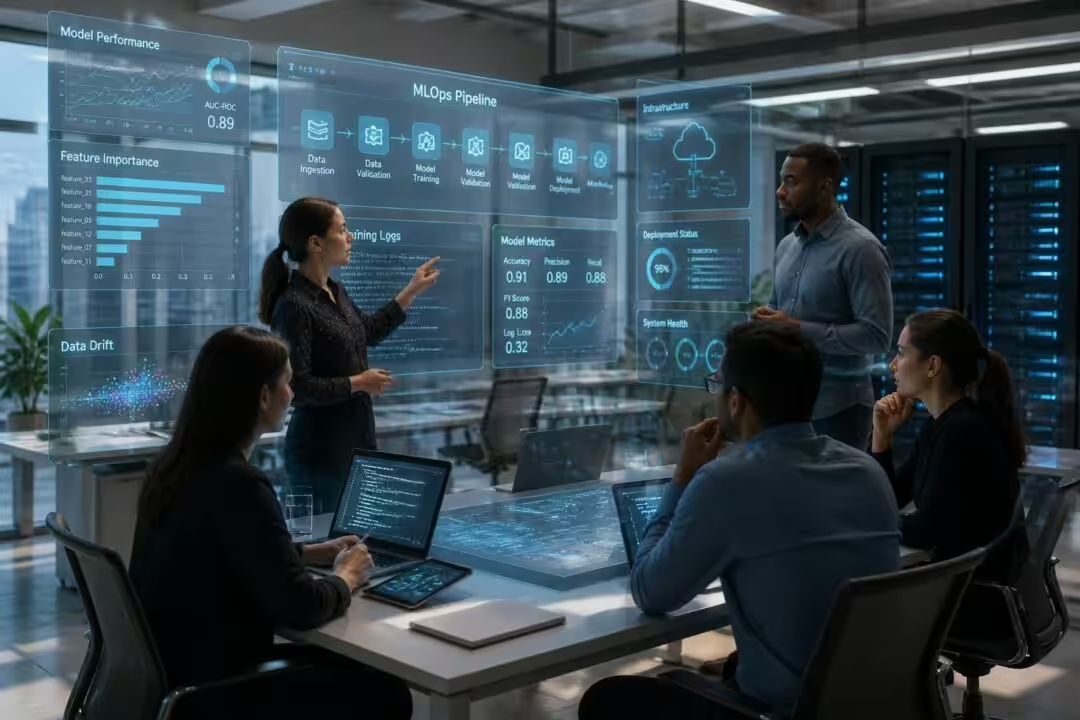
What Is MLOps and Why Machine Learning Operations Matter for Production Systems
MLOps describes the practices that connect model development to live systems. You build models in notebooks and hope they behave the same in production. That rarely happens without disciplined engineering. This section uses a running example: a small analytics startup called CricPredict that ships live cricket score forecasts to a sports site.
From prototype to production: an everyday gap
Maya, the lead ML engineer at CricPredict, trains a model on a laptop. The model hits target accuracy. The product manager signs off. The site integrates the model via an API. But after a few weeks, predictions drift and latency spikes. The root cause is not the algorithm alone. It is the absence of operational practices that tie data, code, and infrastructure into a repeatable pipeline.
MLOps answers a few hard engineering questions: how do you keep models up-to-date, how do you trace which data created which model, and how do you deploy changes without causing downtime? Each of those questions has technical and organizational parts. Solving them requires tools and process changes that make machine learning behave more like software engineering.
Two pillars: system development and operations
Think of MLOps as two linked functions. First, ML system development: experiments, feature engineering, validation, and testing. Second, ML operations: deployment, monitoring, and lifecycle management. If either side is weak, production systems fail. The goal is not perfection. The goal is predictable, repeatable delivery of model-driven features to users.
Concrete signals that MLOps is missing: repeated manual retraining, unknown model lineage, no drift alerts, and ad-hoc deployments. In Maya’s case, a new season introduces an “impact player” rule in cricket. Performance degrades because the feature distribution changed. With basic MLOps, this would have been detected via monitoring and handled by an automated retraining pipeline.
Why teams should care
For you, the stakes are clear. When models fail silently, users lose trust and engineering costs rise. reliable ML systems reduce debugging time, cut cloud bills, and speed feature rollouts. For startups like CricPredict, that translates to predictable uptime during live matches and a clear audit trail when outcomes matter.
Key takeaway: MLOps is the set of disciplines that makes model-driven products manageable at scale. This is the lens used across the rest of the guide. Expectwards: clear accountability, automated workflows, and continuous validation. 📌
Data Pipelines and Feature Stores: How to Feed Models Reliable Inputs
Data problems are the most frequent cause of production issues. Static CSVs that worked in a notebook fail when the world changes. Maya’s team at CricPredict learned this after new match formats and players changed input distributions. Robust pipelines prevent that shock.
Designing a pipeline that lasts
A resilient pipeline has three stages: ingestion, transformation, and storage. Ingestion pulls historical and real-time streams. Transformation standardizes, cleans, and validates incoming records. Storage keeps a single source of truth that teams can reference. Each stage must include checks that catch anomalies early.
For example, ingesting real-time match events might use Kafka for streaming. Batch historical imports come from an SQL warehouse. An ETL step then harmonizes fields like player IDs, timestamps, and venue codes. Finally, a feature store persists computed features such as current run rate and wickets lost. That store decouples training-time feature logic from serving-time lookup logic.
Practical validation and drift detection
Validation should be automated. Implement schema checks, null-rate thresholds, and distribution comparisons against a baseline. When distributions shift beyond thresholds, flag the change. For instance, a sudden surge in a venue’s average score should raise a drift alert and pause automated model rollouts until an engineer inspects the change.
Tools exist for each step, but tool choice is less important than design. Put monitoring near the data ingress point. Make logs human-readable. Ensure metrics such as missing-rate, cardinality changes, and arrival lag are visible to both data engineers and model owners.
Feature stores and reproducibility
A feature store centralizes engineered inputs and records their lineage. It ensures training and serving use the same code path. This avoids the classic “train/serve skew.” For CricPredict, a feature store saved engineered features and versions. When a production problem arose, the team traced predictions back to the exact feature build and raw data snapshot. That cut debugging time from days to hours.
- 🧭 Ingestion checks — validate source health and lag
- 🧼 Transform checks — schema, null rates, and sanity tests
- 🔁 Versioned storage — snapshot raw data and features for reproducibility
- 📊 Drift metrics — track distribution shifts and model impact
- 🗄️ Feature registry — ensure consistent feature semantics in training and serving
These practices make pipelines auditable and testable. They also let automated retraining use the same validated inputs. A final design tip: keep pipelines modular. Separate ingestion from transformation. That simplifies unit testing and reuse.
An insight: solving data problems first drastically reduces downstream pain. The pipeline is the nervous system of any ML product. 🔎
Code, Experiment Tracking, and Versioning: Reproducible ML Engineering Practices
Code that works on one machine often breaks elsewhere. That happens when environments, data, or parameters diverge. MLOps borrows versioning and CI practices from software engineering. Apply them to code, data, and models.
Modular code and pipelines
Maya refactored the old monolithic script into modular components. Each module had a single responsibility: data loading, preprocessing, feature engineering, model training, evaluation, and deployment. This made tests smaller and faster. It also reduced merge conflicts when multiple engineers worked side-by-side.
Project scaffolding helps. Use templating tools to enforce a consistent layout across projects. That reduces setup time for new contributors. Keep configuration separate from code and parameterize paths, hyperparameters, and resource limits.
Experiment tracking and model registry
Tracking experiments makes results comparable. Log hyperparameters, data version, code commit, and metrics to an experiment tracker such as MLflow or Weights & Biases. When the best model is identified, register it in a model registry with a clear lineage.
Example: a failed A/B test at CricPredict revealed a model trained on a mismatched data snapshot. The experiment logs showed the data hash and commit ID, so the team reverted to the correct dataset and reproduced the result quickly. That traceability saved days of guesswork.
Data and model versioning
Version control for code is standard with Git. For data and models, use tools like DVC or cloud-native object versioning. Tag datasets and keep lightweight pointers in the code repository. When an incident occurs, bringing the exact data-model-code triad back to life must be effortless.
Testing is crucial. Add unit tests for preprocessing, integration tests for end-to-end training, and smoke tests for model serving. Hook these tests into CI pipelines so that pull requests run the test suite automatically. That keeps regressions from reaching production.
Final thought for this section: rigorous tracking and modular code convert experiments into reliable artifacts. You reduce time spent hunting for the root cause and increase the speed of iteration. ✔️
CI/CD, Containerization, Monitoring and Automated Retraining in MLOps
Once a model passes tests and gets registered, deployment must be repeatable. Manual pushes create risk. Automated pipelines reduce human error and keep releases frequent. This section reviews CI/CD, containers, and production monitoring.
CI/CD for models: from commit to serving
Continuous integration runs tests on every commit. Continuous deployment pushes validated changes to production. For ML, this includes tests for data, model behavior, and runtime performance. Set deployment gates for drift or performance changes. Use GitHub Actions, Jenkins, or GitLab CI to orchestrate builds.
Containerization standardizes runtime. Docker images encapsulate code and dependencies. Kubernetes helps scale and route traffic. For CricPredict, containers ensured that the same image ran in staging and live match traffic. That fixed “works on my machine” incidents for good.
Monitoring, alerts, and drift handling
Monitoring must cover both system and model health. System metrics include latency, CPU, and memory. Model metrics include prediction distributions, error rates, and feature statistics. Tools like Prometheus and Grafana collect and display these metrics.
When metrics cross thresholds, the system should alert owners and trigger automated steps. For example, a detected drift can queue a retraining job. That job uses the latest validated data snapshot and runs in an isolated environment. If the retrained model meets acceptance criteria, the CI/CD pipeline can roll it out automatically or create a canary deployment for manual review.
Continuous training and rollback safety
Continuous training closes the loop. It pipelines data collection, training, validation, and deployment. Yet automation must be safe. Keep a rollback mechanism and a model shadowing strategy. Shadowing runs new models alongside the active model without impacting users. If the shadow shows better performance, promote it via the pipeline.
Scaling considerations matter. Training large models requires budget controls. Use spot instances or managed training services to reduce cost. Monitor cloud spend and add alerts for runaway jobs.
| 🔧 Component | 🧾 Purpose | ✅ Example tools |
|---|---|---|
| 🗂️ CI | Run tests and build artifacts | GitHub Actions, Jenkins |
| 📦 Container | Freeze runtime and dependencies | Docker, OCI images |
| 🧭 Orchestration | Scale and route containers | Kubernetes, KNative |
| 📈 Monitoring | Metric collection and alerts | Prometheus, Grafana |
| 🔁 CT/CD | Automated retrain and deploy | Airflow, Kubeflow, Prefect |
Closing thought: automation should reduce toil without removing human oversight. Set clear SLAs for when a human must step in. This balance keeps systems fast and safe. 🚦
Governance, Collaboration, and Operational Challenges in MLOps
Shipping ML requires many roles. Data engineers, ML engineers, platform teams, product owners, and compliance staff must coordinate. Governance sets the rules for safe and legal model behavior. Collaboration frameworks make that coordination efficient.
Roles, permissions, and team workflows
Define clear responsibilities. Who owns the data? Who signs off on retraining? Who reviews model explainability reports? Role-based access control prevents accidental data leaks and unauthorized model promotions. For small teams, centralize decision logs. For larger orgs, use automated approval gates.
Collaboration also means shared workspaces. Use shared registries, dashboards, and ticketing workflows so everyone sees the same status. When Maya’s team introduced a shared dashboard, cross-team incidents dropped because product and ops could see drift alerts and capacity constraints immediately.
Ethics, compliance, and explainability
Models influence decisions. They can also encode bias. Adopt bias checks, fairness metrics, and model cards that summarize intended use, limitations, and data lineage. For products that affect livelihoods or legal outcomes, maintain an audit trail and review board. Keep logs for model decisions when required by law.
Legal risk grows with model reach. If a prediction drives financial decisions or betting, regulators will ask for reproducibility and justification. Build those papers into the pipeline. That avoids last-minute audits that halt deployments.
Infrastructure, cost, and scaling trade-offs
Cloud resources are flexible but expensive. Track training and inference costs. Use autoscaling and spot instances for non-critical workloads. Cache expensive features in a fast store. Adopt quota policies to prevent runaway experiments.
- 💡 Enforce quotas — limit experiment hours per team
- 🔒 Access control — separate prod keys from dev
- 📚 Documentation — catalog datasets and APIs
- ⚖️ Ethics checks — run fairness tests before promotion
- 📉 Cost alerts — trigger when spend exceeds thresholds
Governance and infrastructure decisions shape how quickly you can iterate. Good governance reduces risk and speeds approvals. Poor choices slow the team and increase surprises.
Key insight: treat MLOps as a socio-technical system. Tools matter, but clear roles, simple policies, and a culture of shared responsibility determine long-term success. 🔐

I’m a Brooklyn tech journalist who spent a decade covering software, cloud and developer tooling. I started this magazine in 2023 to cover generative AI without the hype or the cynicism: testing tools on my own subscriptions and citing primary sources.