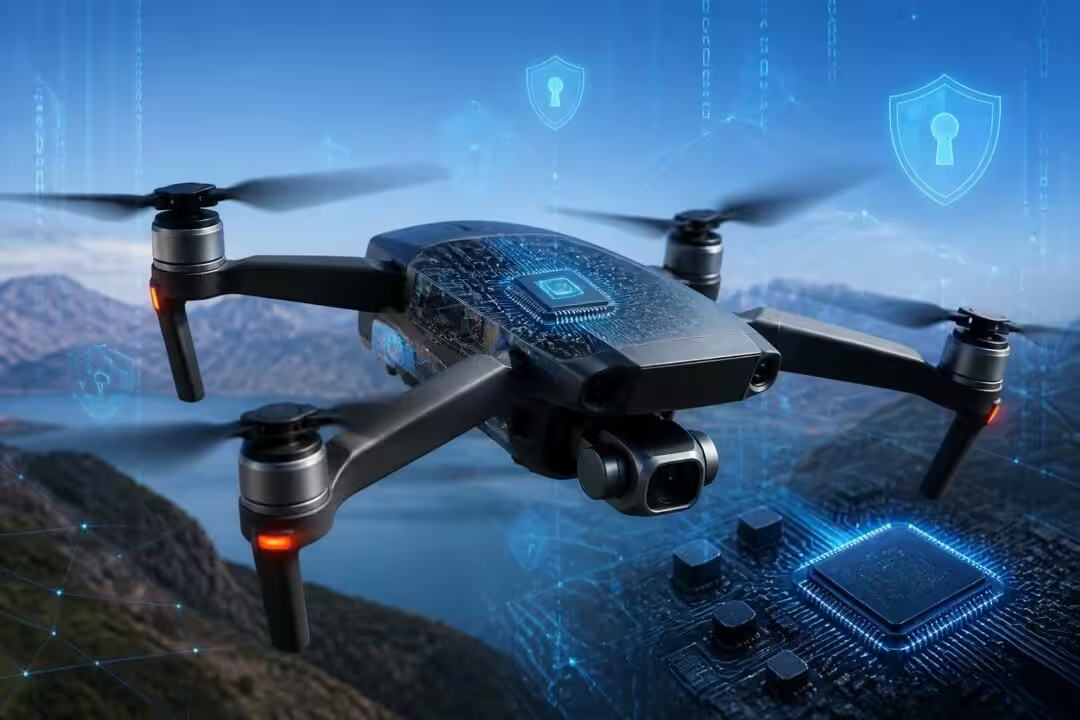
AI mission computers are getting faster, but the real story is how they stay trustworthy under pressure. For UAS teams, the threat model now includes supply-chain surprises, RF interference, and software updates pushed from far away. The Mobilicom–Aitech SA Compute PRO-AT is one of the clearer signals that AI compute and cyber defense are starting to ship as one unit 🛡️.
AI chips and secured autonomy: why UAS cybersecurity is changing
In UAS programs, autonomy usually grows faster than security. A flight stack gets a new model for object detection, then the update path becomes a new attack path. The shift now is toward secured autonomy: treating cyber defense as part of mission compute, not an add-on.
That change lines up with mandates that moved security from “nice to have” to “show the work.” Teams still reference requirements tied to NDAA Section 848, FAA Remote ID, and the EU Cyber Resilience Act when they define procurement checklists. The practical takeaway is simple: if a platform cannot be measured and audited, it struggles to get deployed.
What “secured autonomy compute” means in practice for mission teams
Secured autonomy compute is about keeping perception and control running while the system is under active attack or misconfiguration. That includes secure boot, signed updates, and runtime monitoring that can spot suspicious behavior without grounding the aircraft.
Picture a wildfire response contractor operating a small fleet near critical infrastructure. The drones must keep tracking hotspots, while the operator also needs evidence that telemetry and firmware stayed clean. The value is not the buzzwords; it is the audit trail that helps a program manager defend choices to a regulator, a prime, or an insurer ✅.
Next comes the hardware angle, because the chip stack shapes what kind of defense can run on-board.
Mobilicom and Aitech SA Compute PRO-AT: AI compute paired with real-time cyber defense
Mobilicom Limited and Aitech jointly introduced SA Compute PRO-AT, positioning it as a new category for UAS: a mission computer where cybersecurity software and GPU-class AI compute are shipped together. The integration pairs Mobilicom OS3 cybersecurity software with Aitech mission computers built on NVIDIA-based AI supercomputing hardware.
For buyers, the point is fewer seams. Every seam—middleware glue, separate update channels, mismatched logging—becomes a place where attackers hide. The packaging here is meant to reduce that risk for mission-critical aerospace and defense operations 🚁.
How OS3 + NVIDIA-class compute changes the threat response loop
UAS security breaks down when detection arrives too late. If an anomaly is found after landing, the mission is already compromised. The pitch behind SA Compute PRO-AT is proactive, on-board monitoring that runs next to perception workloads, instead of waiting for a ground station to notice something off.
That matters in dynamic missions where the environment is chaotic. In defense-style exercises, teams see “benign” failures—bad GPS, unstable links, rushed field updates—turn into security incidents because the system cannot prove state. Tight coupling between compute and defense aims to keep the system operationally useful while still being defensible 🧩.
The next question most engineers ask is: what exactly should be evaluated when shopping for secured autonomy platforms?
Secured autonomy framework checks: what to test before deployment
If a vendor says “secure,” the only move is to ask for testable claims. A practical framework focuses on how the box behaves at boot, during updates, and under noisy RF conditions. It also asks how evidence is produced when something goes wrong.
- 🧷 Secure boot and attestation: can the platform prove it started from trusted firmware?
- 🔐 Update integrity: are patches signed, verified, and logged end-to-end?
- 📡 Link protection: what happens when command-and-control is jammed or spoofed?
- 🧠 Compute isolation: can AI workloads be separated from safety-critical control paths?
- 🧾 Forensic logging: can you reconstruct timeline and root cause without guessing?
- 🧰 Field recovery: how fast can a grounded unit return to a known-good state?
A useful litmus test: if an incident response team cannot reproduce the system state from logs, the platform is not “secured autonomy.” It is just a fast computer with a security checkbox.
A field scenario: malware suspicion mid-mission and the cost of weak telemetry
Consider a hypothetical public-safety unit running perimeter overwatch after a storm. A technician loads an urgent update from a portable drive, then the aircraft starts behaving oddly. The team needs a system that can flag abnormal processes, preserve evidence, and keep the operator from making the situation worse.
Without on-board defenses, the typical response is blunt: abort, land, wipe, and hope. With secured autonomy-oriented design, the response can be more surgical—contain, verify, and keep the rest of the fleet flying. That operational difference is what procurement teams are paying for 🔎.
That brings up the market dynamic: why NVIDIA-class embedded compute is showing up everywhere in autonomy stacks.
AI chip market context: why mission compute decisions track the broader cycle
Autonomy platforms rarely live in isolation from chip supply and platform roadmaps. NVIDIA’s stock recently closed around $192.57 (up 1.8%), hovering near its 52‑week high, reflecting sustained demand for AI platforms. That demand spills into embedded and rugged systems, not just data centers 📈.
Other chip names moved sharply in the same news cycle: Rigetti Computing traded around $47.11 after a strong session, while Nexchip Semiconductor closed near CN¥35.32 after a steep drop. These swings do not change how a UAS flies tomorrow, but they do shape how vendors price, source, and commit to long-term support.
Where Intel, AMD, and ASML fit into UAS compute planning
Intel traded near $37.80 and has been highlighting Core Ultra client chips plus the roadmap for Xeon 6+ server parts. AMD closed near $232.89, also close to a 52‑week high, as buyers keep chasing throughput for training and inference. ASML ended around €849.80 and named Marco Pieters as EVP and CTO, a reminder that lithography leadership still underpins the whole supply chain.
For UAS decision-makers, the key is not day-to-day pricing. It is whether suppliers can commit to availability windows, export constraints, and validated builds that survive multi-year programs. That is where “secured autonomy compute” turns into contract language, not marketing copy.
| Area ✅ | What to verify 🧪 | Why it matters for UAS ops 🚁 |
|---|---|---|
| Boot trust 🔒 | Measured boot, hardware root of trust, attestation reports | Stops firmware tampering from becoming silent mission drift |
| AI workload safety 🧠 | Isolation between perception and flight-critical processes | Prevents model code paths from cascading into control failures |
| Update pipeline 🧷 | Signed packages, rollback protections, full change logs | Reduces “urgent patch” risk during field operations |
| Real-time defense 🛡️ | On-board detection, response playbooks, evidence preservation | Keeps missions running while containing suspicious activity |
| Compliance evidence 🧾 | Reports mapped to NDAA/Remote ID/CRA-aligned controls | Makes audits and procurement reviews faster and less subjective |
From here, the most practical next step is to treat secured autonomy like any other system requirement: define acceptance tests, run them on hardware you can actually buy, and insist on logs you can hand to a third party. That is where AI chips stop being the headline and start being the foundation.

I’m a Brooklyn tech journalist who spent a decade covering software, cloud and developer tooling. I started this magazine in 2023 to cover generative AI without the hype or the cynicism: testing tools on my own subscriptions and citing primary sources.