
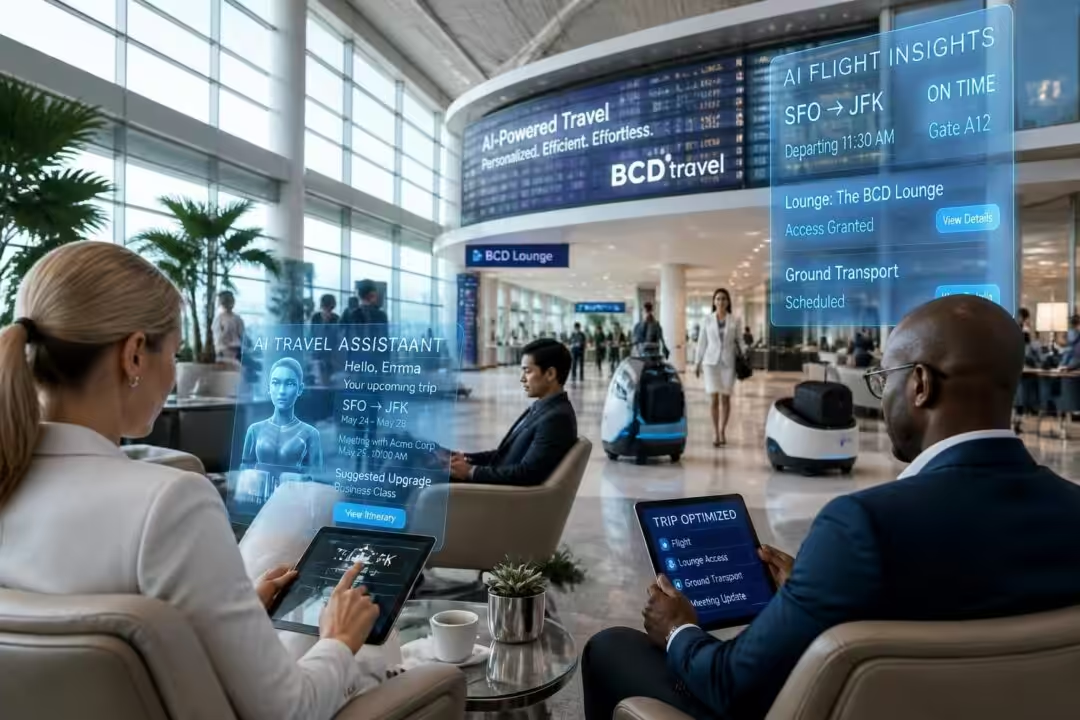
Business travel is getting recompiled. Not with shinier loyalty perks, but with AI systems that sit between travelers, policies, suppliers, and finance—and increasingly decide what gets booked, what gets flagged, and what gets reimbursed. ✈️🤖
| Scan-first map 🧭 | What’s inside | Key takeaways ✅ |
|---|---|---|
| 1) BCD Travel + AI: what’s changing now | Where AI already runs quietly in corporate programs | AI is already used for rate comparison, expense matching, and traveler chat 💬 |
| 2) TripSource Insights and the rise of “ask your data” | Natural-language analytics for travel + finance teams | Plain-English queries cut manual reporting and shorten decision cycles ⏱️ |
| 3) AMGINE investment: automation meets service delivery | What “agentic workflows” mean in a TMC context | Automation works best with human quality checks 🧑💼 |
| 4) Personalization vs. control: the buyer’s dilemma | Cost control, consolidation, compliance, traveler experience | Big wins cluster around efficiency + personalization—if governance is real 🧩 |
| 5) The AI travel program of the near future | Operational, technical, and risk considerations | AI will reshape every trip stage, and even how travel software is written 🧠 |
The timing is not accidental. Travel buyers are squeezing budgets, rationalizing suppliers, and looking for measurable program performance gains—while vendors like BCD Travel push analytics and automation into the daily flow of corporate travel. The practical question is no longer “Will AI matter?” but where it helps, where it fails, and how much human oversight is required to keep trust intact. 🔎
BCD Travel: How AI Is Reshaping Business Travel Programs Right Now
Corporate travel has always been a systems problem disguised as a logistics problem. A traveler wants a flight; procurement wants negotiated rates; security wants duty-of-care visibility; finance wants clean expense lines; managers want approvals that do not turn into a week-long email chain. AI fits here because it can connect messy inputs—emails, itineraries, receipts, policy PDFs—and translate them into actions. The real shift is that AI is moving from “nice-to-have” dashboards into decision pathways where it influences outcomes. ⚙️
BCD Travel’s public messaging over the past year has framed AI as a lever for program performance: compare rates more effectively, match travel and expense data, and support traveler-facing help through chat interfaces. Those aren’t futuristic moonshots; they’re “workflow glue” capabilities that reduce human toil and shorten time-to-answer. The interesting part is how quickly these capabilities become expectations. Once a travel manager can query spend patterns in minutes rather than days, the tolerance for manual reporting collapses.
What AI is already doing in corporate travel (and why it matters)
Across modern travel programs, several AI use cases show up repeatedly because they have clear ROI and relatively bounded risk. First is rate comparison: models can ingest large sets of airline and hotel pricing, normalize it, and highlight anomalies that a human analyst might miss. That matters when budgets are tight and procurement is pushing for predictable outcomes. Second is matching expense data—connecting bookings, invoices, and card transactions to reduce reconciliation headaches. Third is traveler-facing chat, which becomes the front door for “Where is my hotel confirmation?” and “Can I change this flight within policy?” 💬
These systems thrive because travel generates structured and semi-structured data at scale. Itineraries have predictable fields; receipts have totals, taxes, and merchant names; policy documents have repeating constraints. AI can use that regularity to create speed without requiring perfect data. Yet the best implementations treat AI outputs as suggestions, not gospel—especially when changes trigger fees, missed meetings, or compliance exposure.
The Big Idea Report: industry consensus is forming
BCD Travel has promoted a report co-produced with the Global Business Travel Association (GBTA), built on feedback from 700+ travel industry professionals across Europe and APAC. One reason this matters is that it reflects an operational viewpoint, not just vendor optimism. The themes are consistent: organizations are already using AI for the “compare, match, assist” trio; human touch points and quality control checks remain essential for satisfaction; and the next wave will expand AI’s role across all trip stages and even software development practices.
For primary context on GBTA’s role in business travel research and standards, start with GBTA’s own site: https://www.gbta.org/. The value is less in any single prediction and more in the emerging consensus that AI adoption is becoming part of baseline travel program modernization, similar to how online booking tools became non-negotiable in earlier waves.
A simple field example: the “policy gray zone”
Consider a mid-sized US software company expanding sales coverage across APAC. A rep in Singapore needs a last-minute flight to Tokyo for a customer escalation. The booking is “within budget,” but the policy requires preferred carriers unless the schedule difference is more than two hours. A traveler chatbot can answer quickly, but the harder problem is interpreting context: is this a true exception, and will finance accept it later? AI can triage, fetch options, and present a policy-grounded recommendation—but it still needs escalation paths when the choice is materially ambiguous.
The more travel programs lean on AI for speed, the more they must define where humans remain the final authority. That governance question leads directly into analytics and automation platforms that promise to unify travel and finance views.
TripSource Insights: AI Analytics That Lets Travel and Finance “Ask Questions in Plain English”
The most consequential AI shift in corporate travel may not be chat at all. It may be natural-language analytics that collapses the distance between a question and an answer. In July 2026, BCD Travel announced an AI and NLP-powered analytics platform positioned to unify travel and finance data into a real-time view of a company’s program. The headline promise is simple: instead of exporting spreadsheets and waiting on a specialist, teams can query spend and behavior directly, using everyday language. 📊
This matters because travel decisions are often made in bursts—right after a quarterly close, during budget planning, or when a geopolitical event triggers route changes. When analysis is slow, policy becomes blunt: fewer exceptions, less flexibility, more frustration. When analysis is fast, programs can be more precise: target the specific leakage category, renegotiate the supplier that is drifting, or fix the booking flow that produces out-of-policy behavior.
How “ask your travel data” changes day-to-day operations
In practice, plain-language analytics is a control surface. A finance manager can ask: “How much did Frankfurt hotels cost last quarter?” A travel manager can ask: “How many unused non-refundable tickets are sitting open?” The former drives budgeting and rate caps; the latter drives recovery workflows and supplier negotiations. The crucial detail is that these are not exotic data science requests—they are questions business people already ask, but usually through a chain of analysts, ticketing systems, and manual reconciliation.
When those questions become self-serve, the bottleneck moves. The constraint becomes data quality, permissions, and interpretation. A fast answer is only valuable if it is trustworthy enough to act on. That pulls attention toward lineage: where the data came from, how it was normalized, and whether the model can cite the underlying transactions.
What to demand from AI travel analytics (a practical checklist)
Travel and finance leaders evaluating these tools can treat them like any other analytics modernization project, with AI-specific additions. Here is a grounded checklist that tends to separate demos from deployable systems:
- ✅ Source-level traceability 🧾: every aggregate should drill down to bookings, invoices, and card lines.
- ✅ Role-based access control 🔐: travelers, managers, finance, and procurement need different views.
- ✅ Policy context 📌: outputs should reflect what “in-policy” meant for that period, not today’s rule set.
- ✅ Confidence cues 🎯: the UI should signal ambiguity and prompt verification on edge cases.
- ✅ Export and audit readiness 🗂️: answers must travel into quarterly packs, audits, and supplier negotiations.
None of these requirements are glamorous, but they determine whether AI reduces work or creates new reconciliation burdens downstream. Tools that skip traceability often force a “trust fall” on the model, which rarely survives the first contested chargeback or audit question.
Why unifying travel and finance is a bigger deal than it sounds
Travel data traditionally lives in travel management company systems, online booking tools, card platforms, and expense software—each with its own identifiers and timing. Unification is difficult because a trip is a moving target: flights change, hotels get rebooked, refunds land later, and expense lines arrive after the traveler returns. An AI layer can help with entity resolution—matching “the same trip” across systems—even when the naming is inconsistent.
Yet unification is also political. Who owns the canonical view of spend: finance or travel? Who decides whether savings are counted at booking time, at invoice time, or net of refunds? The best AI analytics tools cannot solve those governance questions, but they can force them to be explicit. That clarity is what makes automation possible—especially as BCD expands its focus on operational AI through partnerships like AMGINE.
For a baseline on NLP techniques that underpin these products, the canonical research starting point remains “Attention Is All You Need” (transformers), which shaped modern language systems: https://arxiv.org/abs/1706.03762.
Once analytics becomes conversational, the next obvious move is to let systems take action—not just answer questions. That is where automation platforms and “agentic” workflows enter the travel stack.
BCD Travel’s AMGINE Investment: AI Automation, Email Triage, and Agentic Workflows in Travel
Automation in corporate travel has a specific texture: it is less about flashy generative content and more about handling high-volume, high-variation requests without losing accuracy. BCD Travel’s strategic investment in AMGINE, announced in late July 2026, signals a bet that AI can improve service delivery and operational efficiency—particularly in areas like group air management, email automation, and more agent-like workflows that coordinate tasks across systems. 🤝
Corporate travelers may not care which vendor provides the automation layer, but they do care about outcomes: faster responses, fewer errors, clearer options, and less time spent waiting for a human agent to reply. For travel managers, the benefit is capacity: the same service team can handle more volume without burning out, and the program can keep service levels stable during peak periods.
Email automation: the unglamorous frontier with real ROI
Despite years of digital transformation, email remains a primary intake channel for travel changes—especially for executives, complex itineraries, and urgent disruptions. Email is also where unstructured text, attachments, and implicit intent collide. AI can classify requests (“change flight,” “cancel hotel,” “invoice question”), extract key entities (dates, cities, record locators), and route the ticket to the right queue. Done well, it reduces response time and prevents requests from getting lost.
But email automation is also where AI mistakes become painful. A model that misreads “move to Monday” as “cancel Monday” can cost money and credibility. That is why the Big Idea findings about human touch points and quality checks are not optional. A practical approach is to automate the first 80%—triage, extraction, draft responses—while forcing human review on high-cost actions, unusual routes, or VIP profiles.
Group air and disruption handling: where “agentic” starts to matter
Group air management is a messy corner of corporate travel: multiple passengers, shifting manifests, negotiated fares, special seating needs, and event-driven changes. It is a prime candidate for AI assistance because many steps are repetitive yet prone to human error. An agentic workflow can gather requirements, check fare rules, propose options, and prepare communications—then prompt a human agent to approve and execute.
Disruption handling is even more time-sensitive. When weather or geopolitical events trigger cancellations, travelers flood support channels. AI can prioritize by risk: last flight of the night, connecting international itineraries, travelers with critical meetings. It can also push proactive notifications. The value is not that AI “replaces” agents; it is that it helps the operation behave like an air-traffic control tower—triaging the most consequential cases first. 🚦
A governance pattern that keeps automation from going off the rails
In deployments that succeed, automation is bounded by policy and observability. That means:
- 🧭 Clear action limits: what AI can do without approval (draft, recommend, route) vs. what requires sign-off (reissue tickets, accept penalties).
- 🧪 Continuous evaluation: sampled audits of AI-handled cases, tracked by category and cost impact.
- 🧑💼 Escalation design: one-click handoff to humans with full context, not a reset of the conversation.
- 📈 Outcome metrics: response time, rework rate, traveler satisfaction, and net cost (including fees).
This approach treats AI like a junior operator that can scale throughput but must be trained, supervised, and measured. The payoff is that service teams stop drowning in repetitive work and can focus on high-stakes edge cases. That tees up the next question: how do buyers balance personalization gains with cost control and supplier consolidation?
The more capable the automation layer becomes, the more pressure it puts on corporate policy design—especially the tension between tailored experiences and centralized control.
BCD Travel and AI-Driven Corporate Travel Management: Personalization vs Cost Control
Travel buyers have been consistent about their priorities: cost control, supplier consolidation, and program performance improvements—while keeping travelers productive and safe. AI complicates this in a productive way because it can personalize at scale. It can learn preferences (aisle seat, quiet hotel floors, certain neighborhoods) and propose choices that increase satisfaction. At the same time, it can enforce guardrails more tightly than any human travel coordinator ever could. The tension is not technical; it is organizational. 💼
Personalization tends to win hearts inside a company because it feels like a perk. But cost control wins budget battles. AI can support both, but only if policy is encoded in a way that allows flexibility. Otherwise personalization becomes lipstick on a rigid system—offering the “best” option inside a tiny box that travelers resent.
How AI changes sourcing and supplier consolidation
Supplier consolidation is often framed as leverage: fewer preferred hotels and airlines in exchange for better rates and reporting. AI analytics adds a new dimension: it can show not just spend totals, but patterns—where leakage happens, which traveler segments ignore preferred suppliers, and which routes produce chronic exceptions. That can lead to more targeted consolidation, such as tightening hotel programs in cities with high variance while loosening them where inventory is scarce.
AI also improves negotiation prep. Instead of presenting suppliers with broad “share” metrics, procurement can bring scenario-based evidence: if a hotel chain improves last-room availability in a specific market, the program can shift incremental nights. This makes sourcing less about annual rituals and more about ongoing optimization.
Policy compliance that doesn’t feel punitive
Traditional compliance relies on denial: bookings get blocked or require approvals. AI can offer a softer approach by explaining tradeoffs at the decision point. For example, if a traveler selects a non-preferred hotel, the system can show: “This option is $42/night above cap; here are two compliant alternatives within 0.6 miles.” That framing turns policy into a recommendation engine rather than a scolding gatekeeper. 🧠
However, this only works when the recommendations are genuinely reasonable. If the compliant options are unrealistic—unsafe neighborhoods, long commutes—the system becomes a resentment generator. A mature program uses feedback loops: when travelers repeatedly reject a “compliant” option, that is a signal the sourcing strategy or caps are misaligned with reality.
Efficiency + personalization: where the biggest service enhancements live
One of the most useful claims from the BCD/GBTA research summary is that the largest opportunities for service improvements cluster around efficiency and personalization. Efficiency is measurable: shorter time-to-book, fewer agent touches, lower rework. Personalization is trickier but still trackable through satisfaction surveys, repeat booking behavior, and fewer exceptions.
A concrete example: an AI assistant that knows a traveler typically lands late and prefers hotels with 24/7 check-in can reduce after-hours support calls. Another: a system that recognizes a traveler is headed to a high-risk region can automatically surface visa requirements and company security guidance. These are “small” touches that compound into fewer disruptions.
A caution: personalization can become discriminatory by accident
When personalization is driven by historical behavior, it can silently encode inequities. If certain employees historically traveled less (due to role, geography, or bias), an AI system might under-recommend higher-quality options for them or over-flag their exceptions. That risk is manageable, but it requires deliberate testing: segment-level audits, clear policy baselines, and the ability to override model-driven suggestions.
The programs that get this right will treat AI as infrastructure: constantly monitored, continuously improved, and always subordinate to explicit corporate values and rules. From there, it is a short step to imagining how the full trip lifecycle changes when AI sits at every stage.
AI Across the Business Travel Lifecycle: Booking, On-Trip Support, and Post-Trip Reconciliation
The clearest throughline in BCD Travel’s AI narrative is end-to-end engagement: AI will change how companies interact with travelers before, during, and after trips, and it will also influence how the underlying software is built. That is a big claim, but it becomes believable when the lifecycle is broken into concrete moments where decisions happen and data gets generated. 🧩
Pre-trip: planning, policy, and approvals
Before booking, a traveler needs options that meet schedule needs, preferences, and policy constraints. AI can speed this by summarizing tradeoffs: “This flight is cheaper but arrives at 11:30 PM; this one costs more but avoids an overnight layover.” It can also integrate “soft constraints” like meeting times pulled from calendars, or office locations for ground transport estimates.
Approvals can improve too. Instead of a manager receiving a cryptic request, AI can generate an approval brief: expected cost vs. cap, reason for exception, and alternative options. The point is not to automate approval decisions blindly, but to reduce the cognitive load required to make them responsibly.
On-trip: traveler support that feels immediate (without losing the human backstop)
On-trip support is where chatbots earn their keep, provided they are tied into real systems. A traveler stuck in an airport needs rebooking options now, not a generic apology. AI can pull itinerary data, suggest alternatives, and initiate changes—then hand off to an agent when fees, visa constraints, or complex multi-leg itineraries appear.
Crucially, the “human touch” requirement shows up here. High-stress situations demand empathy and judgment. A chatbot that responds quickly but incorrectly is worse than a slow human. A hybrid model—AI for triage and options, humans for high-stakes execution—fits how travel actually goes wrong. 🌩️
Post-trip: matching, auditing, and finding the money left on the table
After the trip, finance needs clean data. AI can match card swipes to trip segments, categorize expenses, and flag anomalies. It can also detect patterns like unused tickets, duplicate charges, or refunds that never landed. Those “found money” workflows are often ignored because they require manual digging. When a system can answer “How many unused non-refundable tickets exist?” in seconds, recovery becomes operational rather than aspirational.
Another overlooked area is merchant ambiguity. Many hotel folios have confusing line items; some restaurants appear under parent company names. AI can normalize those descriptions, reducing back-and-forth with employees. That saves time while improving compliance.
How AI changes travel software development itself
The BCD/GBTA findings also point to a meta-shift: AI will alter how travel tools are written and maintained. That aligns with what engineering teams already see in other domains—more code generation, faster prototyping, and greater emphasis on integration testing and monitoring. In travel, where edge cases are endless (fare rules, country regulations, supplier APIs), AI-assisted development can increase velocity, but it can also ship subtle errors faster. That makes test coverage and observability the real differentiators.
One practical pattern is “policy as code.” If policy rules are structured and versioned, they can be tested like software, audited like finance controls, and interpreted consistently across chat, booking, and reimbursement. AI can sit on top as the conversational layer, but the rules must be deterministic underneath for governance. ✅
One thread to watch next: who owns the interface?
If travelers start interacting with AI first—through chat, voice, or mobile assistants—the traditional interfaces of booking tools may fade into the background. That raises competitive questions for travel management companies and suppliers alike. The winning experiences will be the ones that combine speed, accuracy, and accountability—and can prove it in audits and cost reviews.
For teams evaluating these shifts, a useful next step is to map the trip lifecycle and mark where AI can safely recommend, where it can safely act, and where humans must remain the default. That single exercise often reveals both the quickest wins and the highest-risk automation temptations. 🔍

I’m a Brooklyn tech journalist who spent a decade covering software, cloud and developer tooling. I started this magazine in 2023 to cover generative AI without the hype or the cynicism: testing tools on my own subscriptions and citing primary sources.





6 Comments
As a designer, I’m curious: does this AI handle visual receipts and sketches, or just text? 😅
Fascinating how AI quietly runs the show. But who checks the checkers? I’d love to see the algorithm’s logic sometimes.
The governance piece is the real UX challenge—automation without trust frameworks just shifts friction.
Agentic workflows in TMC context? Needs robust guardrails, otherwise it’s just automated chaos.
Merci Ellie pour ce tour d’horizon clair! En tant que chef, je vois comment l’IA peut ‘assaisonner’ les voyages pro avec justesse—mais faut garder le contrôle humain, comme pour une sauce.
Bonjour Ellie, thanks for the insights on AI in corporate travel. The human-in-the-loop approach is key.
Les commentaires sont fermes.