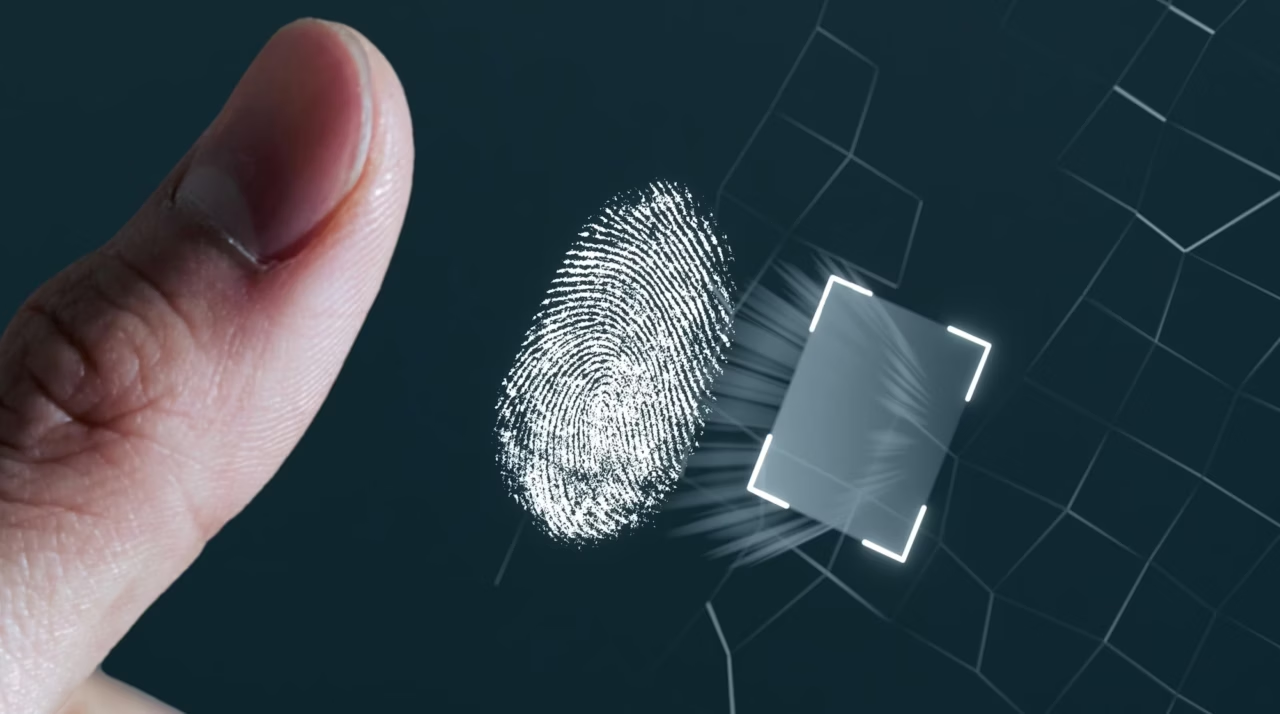
Biometric Authentication Methods: Full Guide — A concise lede: biometric systems now sit at the center of identity for devices, services, and borders, but they introduce a single, unforgiving property: once compromised, a biometric cannot be rotated. This guide lays out the engineering trade-offs, the math behind matching, and the production patterns that make biometric authentication safe and scalable in 2026.
Nut graf: The next sections break down the pipeline (capture → template → match), compare modalities, explain the template-security problem and regulatory risk, and show how modern cryptography — notably Fully Homomorphic Encryption (FHE) — changes the engineering calculus. Links to primary sources (NIST, regulatory texts, major breach reports) and concrete operational patterns are included for teams building real systems.
| Topic 🔎 | Our take ✅ | Read first 📖 |
|---|---|---|
| How biometric methods work 🧭 | Practical pipeline: capture → feature → template → match | NIST FRVT |
| Modalities compared 🧩 | Fingerprints and face lead adoption; iris and vein for high security | Aadhaar (UIDAI) |
| Template security 🔐 | Compromise is permanent — change the architecture, not just policy | OPM breach summary |
| FHE-encrypted matching 🧠 | Zero plaintext exposure enables auditable, post-quantum-safe systems | FHE primer (NIST-era) |
| Deployment checklist 🛠️ | Liveness, multimodal fusion, compliance, and continuous auth | ISO/IEC 30107-3 testing labs |
How Biometric Authentication Methods Work: Capture, Template Creation, and Matching Metrics
Biometric authentication reduces to a short, repeatable pipeline: capture a raw signal, extract a feature representation, encode it into a template, and compare templates with a decision threshold.
Capture uses sensors tuned for the modality: optical or capacitive sensors for fingerprints, RGB + depth cameras for faces, near-infrared imagers for iris, microphones for voice, and telemetry hooks (keyboard, mouse, accelerometer) for behavioral signals. Sensor quality strongly shapes downstream accuracy: a 500‑dpi fingerprint sensor yields richer minutiae than a low-cost 250‑dpi module, and a structured-light face sensor is materially harder to spoof than a 2D webcam.
Feature extraction and template design
Extraction converts raw pixels or waveforms into compact, repeatable descriptors. Fingerprint systems identify minutiae points — ridge endings and bifurcations — and often append texture descriptors (Gabor-filter responses) for robustness. Modern face recognition relies on deep neural embeddings (ArcFace, FaceNet, CosFace) to produce 128–512 dimensional vectors. Iris systems apply Daugman-style unwrapping and 2,048‑bit IrisCodes. Voice pipelines compute MFCC frames and compress time sequences into fixed-length speaker embeddings (d‑vectors, x‑vectors).
Once extracted, templates are normalized for comparison. Many modern large-scale systems favor 128‑dimensional float embeddings normalized to unit length so matching reduces to an inner product or cosine similarity. This simplification is not accidental: it maps directly to efficient arithmetic and, crucially, to cryptographic operations such as inner products under homomorphic encryption.
Matching, thresholds, and the trade-off between security and usability
Matching computes a similarity score between probe and enrolled templates. Set the decision threshold too high and the system blocks legitimate users (high False Reject Rate, FRR); set it too low and impostors get through (high False Accept Rate, FAR). Typical production thresholds vary by use case: a smartphone unlock can tolerate a higher FRR to keep FAR extremely low, while a consumer web login might bias toward a lower FRR to reduce user friction.
Engineers track three metrics: FAR, FRR, and Equal Error Rate (EER). For example, practical numbers in recent systems show fingerprint FAR ≈ 0.001% with FRR ≈ 0.1% on good sensors; modern 3D face systems can reach FAR ≈ 0.0001% under controlled capture. These are order‑of‑magnitude figures and depend on test datasets, capture conditions, and liveness defenses.
Why template format matters
The representation determines everything: storage cost, matching latency, and resilience to noise. A 128‑dimensional float64 embedding is 1,024 bytes; quantization to fixed-point integers reduces size for secure storage and homomorphic processing. Importantly, templates should never be raw images. Storing raw biometric images increases attack surface and is unnecessary for matching.
Teams must also consider the nature of the matching algorithm. Minutiae graph matching excels for partial fingerprints and law-enforcement AFIS use cases. Embedding-based matching (deep-learning) enables compact storage, fast cosine similarity checks, and smooth integration with multimodal fusion strategies.
Practical example — a fintech product decision
Consider Maya, an engineering lead at a fintech startup designing a payments flow. The team needs sub‑0.01% FAR for high-value transfers but also low friction for daily checkouts. Maya chooses a dual strategy: primary 3D face unlock (low FAR), and an adaptive risk step-up that asks for a fingerprint or device possession token for high-value actions. Templates are stored as encrypted embeddings, and thresholds are tuned using production telemetry to keep FRR acceptable during real-world lighting and mask-wearing variability.
Key insight: designing templates and thresholds must be an iterative, telemetry-driven process; sensor choice and liveness capability are as consequential as the matching algorithm itself.
Biometric Modalities Compared: Fingerprint, Face, Iris, Voice, and Behavioral Biometrics
Not all biometrics are created equal. The choice of modality is a function of security needs, user acceptance, capture ergonomics, and spoofing risk. Below is a qualitative comparison that helps teams choose the right tool for the job.
Fingerprint — the pragmatic default
Fingerprints are ubiquitous. High acceptance, inexpensive sensors, and decades of algorithmic refinement make fingerprints the default for mobile unlock and physical access. Typical systems extract 30–80 minutiae points and achieve FAR around 0.001% on 500‑dpi sensors. Spoofing risk exists (silicone molds, gelatin fingers), so presentation attack detection (PAD) matters. Fingerprint sensors with integrated liveness checks (pulse, subdermal features) substantially raise spoofing cost.
Face — convenience and mass adoption
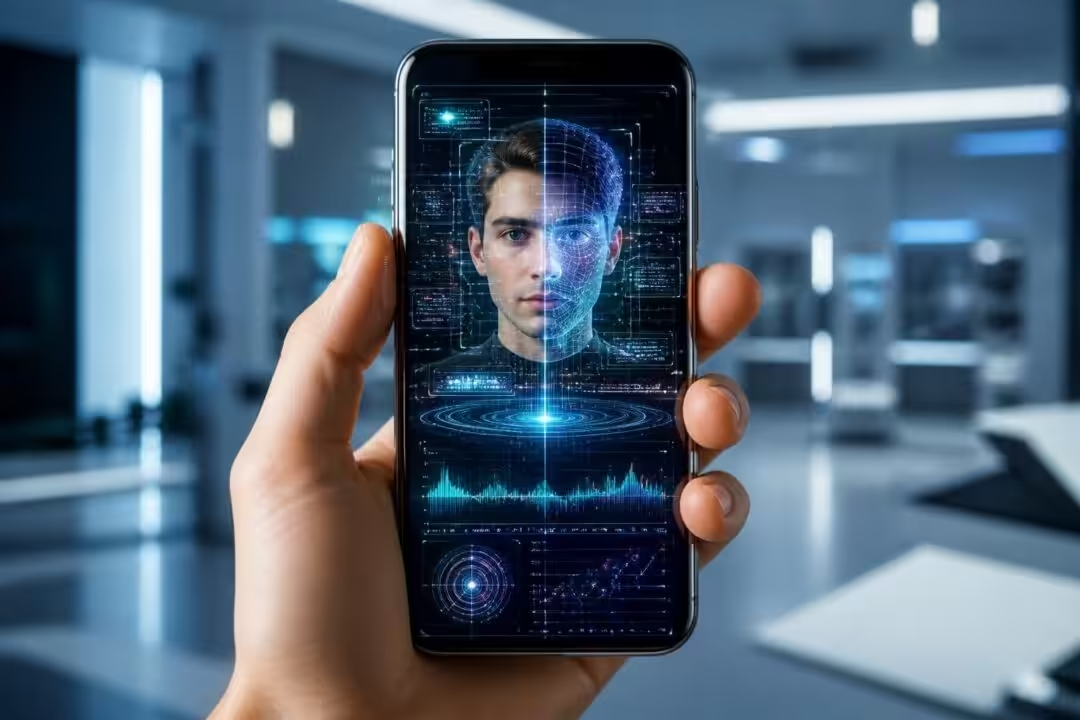
Face recognition scales because it’s contactless. Structured-light or time-of-flight cameras (e.g., on many modern phones) make 3D face recognition far more spoof‑resistant than 2D algorithms. Face systems benefit from vast public datasets and efficient deep models. The downside: faces are visible in public and raw images can be scraped (see Clearview incidents), so template protection and liveness are critical. Apple’s ecosystem and other vendors collectively process billions of authentications daily — a reminder that face recognition is now operational at global scale.
Placement note: the demo above illustrates structured-light capture and passive liveness cues that reduce replay attacks.
Iris and palm vein — niche high-security options
Iris recognition offers one of the lowest collision probabilities and is standard at many borders. It requires dedicated optics and closer capture, which reduces convenience but raises security. Palm vein systems add depth and subdermal vascular features, giving excellent spoof resistance for payments and high-security facilities. Expect cost and user ergonomics trade-offs.
Voice and behavioral biometrics — remote and continuous signals
Voice is attractive for phone-based flows and accessibility but has become easier to spoof as synthetic audio improves. Behavioral biometrics (keystroke dynamics, mouse movement, gait) do not replace one-shot authentication but are excellent for continuous authentication and anomaly detection. They monitor session integrity and can trigger step-ups when patterns diverge.
Modalities in practice — fusion and adaptive flows
Multimodal systems combine modalities to reduce FAR multiplicatively. Pairing face + fingerprint can drop FAR by orders of magnitude, but the penalty is higher FRR if naive AND logic is used. Score-level fusion with learned weights usually delivers the best balance: it keeps the UX smooth while amplifying security. For example, a mobile bank might use face unlock for routine sign-ins and require face+fingerprint for transfers above a threshold.
Case study: a retail chain deployed face recognition for loyalty check‑out. During pilot, ambient lighting and masks raised FRR during peak hours. The engineering team mitigated this by employing score-level fusion with POS-based behavioral signals (purchase cadence) and periodic iris scans for VIP flows.
Key insight: choose modalities for the real environment and pair them with fusion strategies that preserve UX while meeting risk thresholds.
Template Security and the Cost of Compromise: Breaches, Lawsuits, and the Immutable Problem
The defining paradox of biometrics is simple and existential: a biometric cannot be rotated. Passwords can be reset; fingerprints cannot. That permanence makes template security the central engineering and legal problem.
Historical incidents that shaped the risk model
Several high-profile breaches demonstrate the stakes. The 2015 OPM incident exposed fingerprint records for millions of cleared personnel, illustrating national-security ramifications. In 2019, the Suprema/Biostar2 exposure left tens of millions of fingerprint and face images publicly accessible. Clearview AI’s scraped datasets (billions of images) show how raw web images enable template generation for many face matchers. These incidents are well documented and remain cautionary references — search the public reports at OPM and independent reporting.
Regulatory pressure: BIPA and global frameworks
Privacy law has adapted quickly. Illinois’ BIPA imposes stringent consent and retention rules and enables private actions, which generated over $3.6 billion in settlements across major tech companies. GDPR treats biometric data as a special category requiring explicit consent and extra safeguards. In many jurisdictions, biometric data is functionally “sensitive personal data” with elevated penalties for misuse. Teams must build consent, retention, and audit flows into product logic, not as an afterthought.
Why standard protections fail
Encryption-at-rest is necessary but insufficient. If templates must be decrypted for matching, then any compromise of keys or compute lets attackers recover templates. TEEs (Intel SGX and equivalents) can contain plaintext templates, but side-channel vulnerabilities and supply-chain concerns have repeatedly demonstrated practical exploits. Fuzzy hashing and tokenization address symptoms but do not eliminate the core problem: an accessible plaintext template is an everlasting liability.
Practical mitigation patterns
Operational measures still matter: minimize data retention, separate key custody, run regular third-party PAD tests, and implement robust logging and attestation. But these are complements, not substitutes, for an architecture that avoids plaintext template exposure.
For example, a national ID program faced a disclosure of enrollment images. The corrective steps included rotation of affected credentials (impossible for biometrics), a switch to template-only enrollment with aggressive legal protections, and rapid deployment of cryptographic protections to rebuild trust. The episode underlines that legal and technical responses must be coordinated—regulatory compliance without stronger template protection is incomplete.
Warning: compromised biometrics are permanent; every system that relies on the same template becomes vulnerable. The correct architectural response is to eliminate the decryptable template on central servers.
Key insight: the template-security problem is not an implementation detail — it defines acceptable architectures and vendor choices for any serious biometric deployment.
FHE and Encrypted Biometric Matching: How Zero-Plaintext Architectures Work in Production
Fully Homomorphic Encryption (FHE) changes the equation by enabling computations on encrypted templates so the server never sees plaintext biometrics. Instead of relying on operational controls that can fail, FHE provides a mathematical guarantee: even a full server compromise yields only ciphertexts that are infeasible to decrypt.
BFV FHE for biometric inner-product matching
Many modern biometric systems represent templates as 128‑dimensional unit vectors. Matching reduces to an inner product or cosine similarity. The BFV scheme (a common lattice-based FHE) can compute element-wise products and summations on encrypted slots, making it a natural fit: pack a 128‑dim template into a ciphertext, encrypt both enrollment and probe, and compute the inner product homomorphically.
H33 (an example infrastructure provider) configured BFV with polynomial degree N=4096, plaintext modulus t=65537, and a 56‑bit modulus for ciphertexts. That parameter set supports SIMD batching of templates (4,096 slots) so 32 user templates (128 dims each) fit into a single ciphertext. The effect: an expensive homomorphic operation is amortized across 32 authentications.
Why SIMD batching and NTT optimizations matter for latency
FHE historically carried high latency. Real-world systems employ a chain of optimizations to reach millisecond or sub‑millisecond per-auth latency: NTT-domain persistence (store templates in NTT-transformed form to avoid forward NTT per verify), lazy modular reductions, fused INTT operations, and batch attestation. These micro-optimizations compound: when combined, they yield throughput in the millions of auths per second on modern cloud metal instances, according to internal benchmarks.
The video above illustrates homomorphic computation concepts and the idea of computing on ciphertext without decryption.
Encrypted pipeline and attestations
A secure production flow uses client-side capture and encryption. Enrollment: extract embedding on the client, quantize, pack into an FHE plaintext, encrypt with the system public key, and upload ciphertext. Verification: client encrypts probe embedding and sends ciphertext. The server computes the encrypted inner product, evaluates a threshold check homomorphically, and returns an encrypted decision. For auditability, the server can accompany the response with a zero-knowledge proof (e.g., STARK) and a post‑quantum signature (e.g., Dilithium) attesting that the correct computation took place.
That architecture yields several practical guarantees: the server never holds plaintext templates; regulatory auditors see cryptographic evidence of correct behavior; and the system is resilient to both classical and quantum attacks to the extent of the underlying lattice assumptions and signature schemes.
Performance reality and cost rationale
Production-grade implementations show surprisingly competitive economics. Reported stacks demonstrate throughput in the millions of authentications per second with per‑auth latencies in the tens of microseconds when batching is exploited. With aggressive spot pricing on modern metal instances, per‑million-auth costs can fall below a dollar, reversing the intuition that “FHE is prohibitively expensive.” This unlocks a practical option: stronger template security at marginal incremental cost.
Key insight: FHE moves template security from operational controls into math, enabling architectures where a server compromise no longer implies template theft.
Deployment Best Practices: Liveness Detection, Multimodal Fusion, Compliance, and a Production Checklist
Building a production biometric system requires more than a good matcher. It requires an ecosystem of liveness checks, multimodal strategies, privacy controls, and operational best practices. Below is a practical checklist teams can adopt.
Presentation attack detection (PAD) and liveness
PAD is mandatory. Attacks range from printed photos and screen-replays to 3D masks and deepfake videos. Two complementary approaches exist: passive liveness (texture analysis, depth cues, skin reflectance, micro-movements) and active liveness (challenge-response: blink, random phrase, head turn). Passive methods minimize friction; active methods typically increase spoof resistance.
ISO/IEC 30107-3 defines APCER and BPCER metrics for PAD systems. Production targets are often APCER < 1% at BPCER < 5%. Third-party labs (iBeta, BixeLab) provide independent certification and should be part of acceptance tests.
Multimodal fusion strategies
Fusion reduces FAR multiplicatively when modalities are independent. Practical fusion strategies:
- 🔒 Feature-level fusion — Concatenate embeddings; preserves information but increases dimensionality and complexity.
- ⚖️ Score-level fusion — Combine normalized scores with learned weights; practical and flexible.
- 🗳️ Decision-level fusion — Simple voting logic; low information but easy to implement.
For most deployments, score-level fusion with adaptive weights (tuned by user context, device quality, and environmental signals) provides the best compromise between security and user experience.
Regulatory and privacy controls
Legal obligations vary by jurisdiction. Incorporate the following:
- 📝 Explicit consent flow for biometrics (BIPA/Europe/GDPR style).
- 🗑️ Retention and destruction schedule with automated enforcement.
- 🔒 Data minimization — store only encrypted templates and metadata needed for audit.
- 📜 Transparent notices and a published security whitepaper for auditors and regulators.
FHE architectures improve the compliance posture because templates never exist in plaintext. Still, consent and documentation remain non-negotiable; cryptography plus a poor consent UX is still noncompliant.
Operational checklist (practical items) — an emoji-coded list teams can act on
- 🔧 Deploy client-side extraction—templates are created and dropped in client memory only.
- 🧾 Log attestation proofs and ZKPs alongside decisions for audit trails.
- 🛡️ Integrate ISO 30107-3 certified PAD and schedule retesting annually.
- 📊 Monitor FAR/FRR per cohort and tune thresholds dynamically by risk tier.
- 🔁 Plan for incident response that treats biometric compromise as permanent; prioritize cryptography and legal outreach.
Example flow: Enrollment captures a liveness token and a client‑side embedding, encrypts it with BFV, and uploads ciphertext. Verification returns a Dilithium-signed attestation and a STARK proof that the encrypted match was computed correctly. This combines cryptographic guarantees with operational transparency for customers and regulators.
Key insight: deployment is a systems problem — liveness, fusion, cryptography, telemetry, and legal controls must be designed together, not bolted on.

I’m a Brooklyn tech journalist who spent a decade covering software, cloud and developer tooling. I started this magazine in 2023 to cover generative AI without the hype or the cynicism: testing tools on my own subscriptions and citing primary sources.