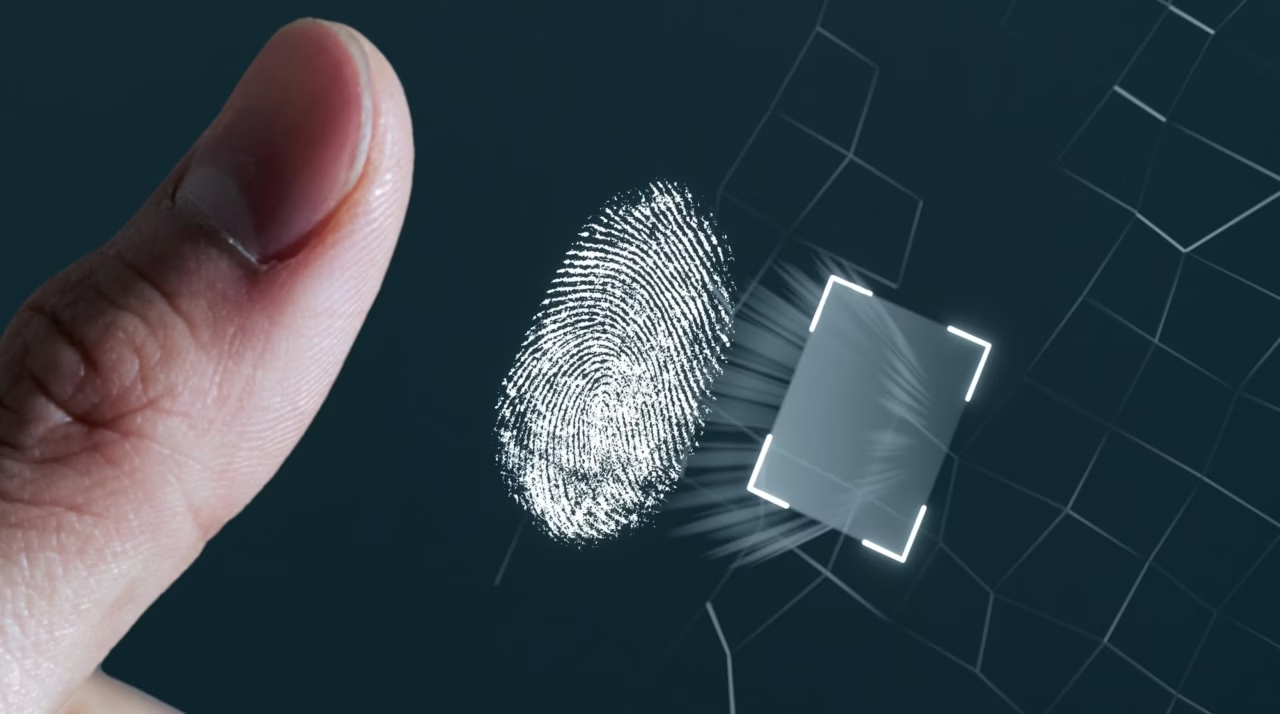
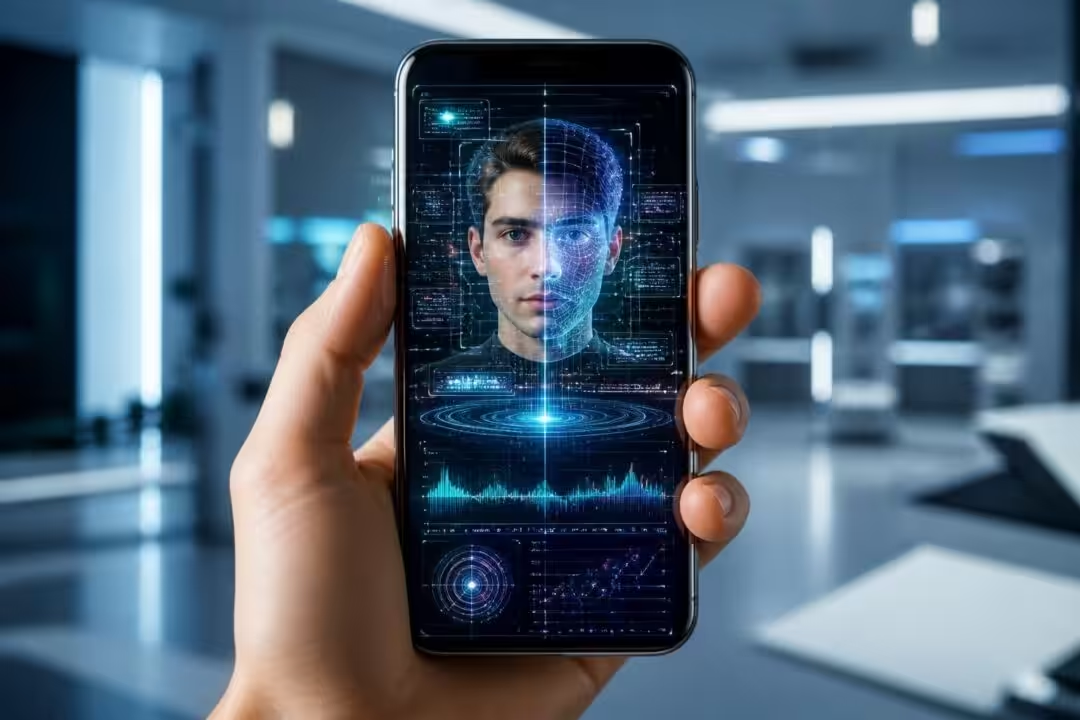
Deepfakes stopped being a “platform problem” the moment they showed up inside live video calls and phone lines. The breakthrough now is real-time, on-device detection: checks that run where the camera and microphone are, not after the damage is done. ⚡
| Roadmap 🧭 (sections) | What changes now 🔧 | Key takeaways ✅ |
|---|---|---|
| 1) Real-time on-device deepfake detection: what “breakthrough” actually means | Detection moves from cloud forensics to low-latency endpoint inference. | Edge checks can block scams during calls, not after. |
| 2) How deepfakes work in 2026: diffusion video, voice cloning, and live face swaps | Generators are cheap, fast, and increasingly “artifact-free.” | Attackers need seconds of audio; defenders need layered controls. |
| 3) Detection methods: artifacts, biometrics, classifiers, provenance (C2PA) | Best results come from ensembles + provenance, not one model. | Authentication scales better than playing whack-a-mole. |
| 4) The Scam.ai Halo + Qualcomm angle: why silicon partnerships matter | NPUs make detection feasible at scale without shipping video to servers. | Latency, privacy, and cost profiles improve—accuracy must hold. |
| 5) Shipping reality: false positives, UX, policy, and best practices for teams | Detection becomes a product surface, not a hidden backend tool. | Define escalation paths; add out-of-band checks for money moves. |
What makes this moment different is timing. Deepfakes used to be handled like malware samples—captured, analyzed, and labeled after circulation. Now the highest-value attacks are synchronous: a “CFO” asking for a wire, a “candidate” interviewing on Zoom, an “executive” authorizing access. Real-time verification is becoming table stakes because humans default to trusting live media, even when they intellectually know better. 🔒
Deepfake Detection: Real-Time On-Device Breakthrough Explained for Engineers and Product Teams
“Real-time” and “on-device” sound like marketing until the constraints are spelled out. Real-time means detection has to run fast enough to matter in an active workflow—during a live call, while recording, or at the moment an identity check is being completed. On-device means the system can’t assume a GPU cluster, stable bandwidth, or permissive privacy policies. It has to fit within mobile thermal limits, battery budgets, and the memory footprint of an app that users will delete if it feels heavy.
The practical shift is where trust is evaluated. Cloud-based detectors are useful for platforms moderating uploads, but they miss the moment when money changes hands or credentials get handed over. On-device inference moves detection closer to the decision point: “Should this video participant be treated as authentic?” or “Should this voice instruction be accepted?” That proximity is the difference between a warning banner and a prevented breach. 🛡️
Latency budgets, privacy, and why “edge” is not a vibe
Latency is the first gate. A detector that takes several seconds per frame might still be “accurate” in a lab, but it is functionally irrelevant in a live meeting where speech, lip movement, and social cues are happening in real time. Consumer expectations are unforgiving: if a call glitches, users blame the app, not the attacker. The working target is often milliseconds, not seconds, especially if analysis must happen continuously rather than on occasional snapshots.
Privacy is the second gate, and it matters even more for regulated industries. Sending raw video or audio to a server for classification can conflict with internal policies, customer contracts, or jurisdictional constraints. On-device detection can keep biometric data local, exporting only minimal signals such as a risk score, a confidence interval, or a cryptographic attestation that a check occurred. That design lines up with what many security teams want anyway: fewer sensitive streams flowing into central logs.
Then there is resilience. Network outages, congestion, and captive portals are normal in the real world. A cloud-only detector fails open—or fails noisy—precisely when it’s needed. Edge execution is less fragile. It also scales differently: compute costs are amortized across endpoints rather than carried entirely by a single vendor’s infrastructure. That economic argument is why so many “AI features” are moving to NPUs, and deepfake defense is following the same gravity.
A concrete scenario: the “Northbridge Bio” finance call
Consider a fictional mid-size biotech, Northbridge Bio, closing a licensing deal under deadline. The treasury manager receives an urgent video call from what appears to be the CFO, complete with familiar voice cadence and a face that matches public interviews. The request is simple: approve a wire within the hour to secure a tranche. The attacker’s advantage is tempo and social pressure.
A real-time on-device detector changes the cadence. Instead of waiting for post-incident forensics, the meeting client can surface a high-risk authenticity flag while the request is being made. That single interruption gives the organization time to invoke policy: switch to a callback number, require a second approver, or use a pre-established challenge phrase. Detection doesn’t need to be perfect; it needs to be good enough to trigger the right human and procedural brakes at the moment of maximum leverage. The insight is blunt: the best deepfake defense is often a well-timed pause. ⏸️
That pause only works if teams understand what they are up against. The next piece is the generator side: how cheap, fast, and multi-modal deepfakes became—and why older “spot the glitch” advice is aging out.
How Deepfakes Work Now: Diffusion Video, Voice Cloning, and Live Impersonation Risks
Deepfakes are synthetic media designed to mimic real people convincingly—faces, voices, or entire scenes. The term started as a niche label in 2017 internet culture, but it now covers a broad set of AI-generated impersonation techniques that are used for harassment, fraud, disinformation, and identity abuse. What changed most is not just visual quality; it is accessibility. Tools that once required custom training pipelines can now be run with consumer hardware, and the friction keeps falling.
The technical lineage matters because it explains why certain detectors work and others fail. Early face swaps leaned on autoencoders: systems that learned to compress and reconstruct a face and could be repurposed to map one identity onto another’s expressions. GANs made results sharper by pitting a generator against a discriminator, pushing the synthetic output toward realism. The current era is heavily influenced by diffusion models, which iteratively denoise from random noise and can produce strikingly natural textures and lighting. The leap is not merely cosmetic: diffusion-based outputs can erase the obvious artifacts that many detectors were trained to catch.
Audio deepfakes: seconds of sample, hours of damage
Voice cloning is the most operationally dangerous modality for many organizations because it fits existing fraud playbooks. A convincing voice is enough to move money, reset credentials, or pressure staff—especially when paired with a plausible pretext. Modern text-to-speech and voice conversion systems can approximate a target voice from short clips, sometimes just seconds, then speak any script. Commercial services and open-source options both contribute to a low barrier for attackers, which makes “we don’t have celebrities” a weak comfort.
Call centers and internal help desks are particularly exposed because they already handle identity questions over audio. A cloned voice can exploit human tendencies: agents want to be helpful, calls are time-boxed, and verification steps can be socially engineered. Defense therefore needs both machine judgment and process discipline: detector signals must be able to trigger a higher-friction verification flow, not merely generate an alert that no one sees. 📞
Video deepfakes: the rise of real-time face swaps in meetings
Video is catching up to audio in real-time usability. Face manipulation can be combined with lip-sync and pose transfer to create an impostor that looks plausible at typical webcam resolutions. The most consequential development is live operation: attackers no longer have to publish a fake clip and hope it spreads; they can conduct a targeted interaction, in private, with a specific victim.
The psychology here is brutal. In a live call, participants are juggling context—screensharing, notes, deadlines—and they overweight the “presence” effect. Even minor authenticity cues can be ignored if the content of the call feels urgent. That’s why the new generation of defenses emphasizes interception: live risk scoring, liveness prompts, and cross-checks between audio and lip movement. If the mouth moves but phonemes don’t align consistently, or if facial dynamics look statistically off over time, a system can raise suspicion even when the video looks “fine” to a human.
Threat landscape: from non-consensual imagery to enterprise fraud
The most widespread harm remains non-consensual intimate imagery, which scales on social platforms and causes lasting personal damage. But enterprise risk is escalating because deepfakes slot neatly into high-value attacks: executive impersonation, vendor payment diversion, and fraudulent onboarding. Political disinformation is also evolving; rather than “one viral clip,” campaigns can be nudged by targeted synthetic content sent into community channels where trust is higher.
Northbridge Bio’s scenario is not exotic. It is the corporate version of a bank-transfer scam, upgraded with a face and a voice. The next question is how detection works in practice—what signals matter, what fails under pressure, and why provenance standards like C2PA are increasingly part of the same conversation. The key point: deepfakes are multi-modal, and so is defense. 🎭
To understand why certain “breakthrough” claims are credible, it helps to look at the toolset detectors are built from—artifacts, biometrics, model classifiers, and authentication frameworks that sidestep the arms race.
Real-Time Deepfake Detection Technologies: Artifacts, Biometrics, Classifiers, and Provenance Standards
Detection is often described as “finding fakes,” but in deployed systems it is closer to risk assessment under constraints. A detector rarely gets perfect information. It sees compressed video, packet loss, aggressive noise suppression, and the quirks of whatever camera pipeline is in use. The best systems therefore combine multiple families of signals, each covering the other’s blind spots.
Artifact analysis: still useful, increasingly fragile
Artifact-based methods look for inconsistencies that are common in generated media: odd lighting transitions, blurred boundaries around a face, mismatched reflections in eyes, or subtle temporal jitter at mask edges. Frequency-domain and spectral cues can also reveal statistical patterns that differ from camera-captured content. These approaches can be fast, which makes them attractive for on-device pre-screening.
The problem is that generator quality keeps improving, and many artifacts are now either absent or pushed below human perception. Worse, some artifacts are introduced by ordinary video pipelines—compression blocks, rolling shutter effects, low light denoising—creating false positives if a detector is too eager. That’s why many vendors treat artifact checks as an early filter rather than the final verdict.
Biometric and physiological cues: harder to fake, not impossible
Biometric signal approaches look for “life” signals that real faces naturally exhibit: blink patterns, micro-expressions, and subtle skin color changes from blood flow that can be estimated via remote photoplethysmography (rPPG). Intel’s FakeCatcher popularized this direction publicly, describing real-time detection that leveraged PPG-like signals and reporting high benchmark accuracy in controlled settings.
Physiology-based methods are compelling because they tie detection to constraints of the physical world. Yet they can be weakened by low-quality cameras, aggressive compression, makeup, lighting flicker, or even a user walking outdoors. They can also be attacked: once a signal becomes a target, generators can be trained to mimic it. Still, as part of an ensemble, biometrics provide valuable “second opinion” evidence that is difficult to spoof consistently across frames. ❤️🩹
Neural classifiers and the generalization problem
Classifier-based detection trains neural networks to distinguish real from synthetic by learning patterns across large datasets. Architectures such as EfficientNet, Xception-style networks, and Vision Transformers have all shown strong results on benchmarks. Research prototypes optimized for consumer devices often compare smaller EfficientNet variants to balance speed and accuracy, sometimes using large datasets on the order of hundreds of thousands of images to stabilize training.
The central weakness is generalization. A detector trained heavily on one generation family can fail when a new model arrives that doesn’t share the same fingerprints. That’s the arms race in practice: improvements in detectors teach attackers what to avoid. Production systems respond with model diversity (training across many generators), frequent updates, and ensembles that reduce reliance on a single brittle cue. The cost is complexity: more models mean more compute and a tougher tuning problem for false positives.
Provenance (C2PA) and watermarking: changing the trust model
Provenance frameworks take a different approach: rather than trying to spot synthetic media, they verify authentic media. The most important standard here is C2PA (Coalition for Content Provenance and Authenticity), supported by major players across software and media. The goal is a cryptographic chain of custody from capture through edits and publication. When a newsroom, brand, or creator signs media at capture, recipients can later verify whether that file has credible origin metadata using Content Credentials tooling. A primary reference is the C2PA standard itself: https://c2pa.org/.
Watermarking is adjacent: systems embed imperceptible signals into AI-generated outputs at creation time. Google DeepMind’s SynthID is one well-known example in this category, helping identify content generated by participating models. Watermarking’s limitation is straightforward: malicious actors can choose tools that don’t watermark, or they can attempt transformations that degrade the mark. Regulation is increasing pressure for labeling in some regions, but technical enforcement remains uneven.
What “good” looks like in a real product
A realistic on-device pipeline often uses a lightweight model to screen continuously, then escalates to heavier checks selectively. It might also fuse modalities: compare audio to lip motion, check head pose consistency, and evaluate whether biometric signals remain stable over time. The final output should rarely be a binary “fake/real.” A better UX is a graded decision: allow, warn, require re-verification, or block based on context.
- 🧪 Low-friction mode: show a subtle “authenticity uncertain” badge for casual calls where the downside is low.
- 💸 High-stakes mode: require an out-of-band confirmation when risk is elevated and money, credentials, or legal approvals are involved.
- 🧩 Multi-signal fusion: combine visual artifacts, temporal consistency, and physiological cues to reduce single-point failure.
- 🧾 Provenance-first publishing: sign official media with C2PA so audiences can verify what is real, not just debate what is fake.
- 🛠️ Continuous updates: rotate models as generators evolve; treat detection like endpoint security, not a one-time feature.
this is the technical context that makes silicon partnerships interesting. If the heavy lifting can happen efficiently on an NPU, ensembles and multimodal checks become practical in everyday apps rather than reserved for cloud backends.
Scam.ai Halo and Qualcomm: What On-Device Deepfake Detection Looks Like When It Ships
At Computex 2026, Scam.ai unveiled a model it calls Halo and paired the announcement with a strategic partnership with Qualcomm. The headline is not merely a new detector; it’s the bet that deepfake defense belongs in the endpoint stack—integrated with the same on-device AI hardware used for speech enhancement, camera tuning, and generative features. That’s a meaningful shift in where the industry expects trust decisions to happen. 🚀
Halo is positioned as a real-time detector that can flag manipulated video, synthetic faces, and AI-generated audio across live and recorded streams. The ambition is broad, and that breadth matters. Many existing systems perform well in one modality but stumble when attacks mix and match—authentic video with cloned audio, or a synthetic face over real speech. A product targeting video meetings has to treat the call as a multimodal object, not a set of unrelated files.
Why Qualcomm matters: NPUs, privacy, and deployment gravity
Qualcomm’s Snapdragon platforms appear across phones, laptops, and embedded devices, and the company has been pushing NPUs as the default engine for AI inference at the edge. A detector integrated into that ecosystem can ride distribution channels that cloud vendors can’t match: OEM firmware features, reference designs, and platform-level APIs that app developers inherit.
There’s also a governance advantage. Many enterprises are more comfortable with on-device analysis because it avoids shipping employee biometrics to third parties. If Halo-class detection runs locally, the app can store only the minimum needed for auditing—timestamps, risk scores, and event codes—while raw media stays in memory. That fits both privacy instincts and legal exposure management.
The optimization tax: keeping accuracy after compression
On-device models must be compressed and tuned. Quantization reduces numeric precision to run faster; pruning removes parameters; architecture changes trade accuracy for speed. Every one of these steps can degrade sensitivity, especially on out-of-distribution inputs like unusual lighting, low-end webcams, or novel generators. The industry has seen this pattern before: a model that looks great in a paper can feel unreliable in the wild once it’s squeezed into a mobile envelope.
This is where independent benchmarking becomes non-negotiable. The two numbers that matter most are false negatives (missed fakes that enable fraud) and false positives (real people flagged as synthetic). False positives are not just annoying; they can become discriminatory if certain camera qualities or skin tones trigger higher risk scores. The product implication is that teams need calibration tools, clear escalation UX, and logging that supports incident review without turning every meeting into surveillance.
Meeting apps as the new security perimeter
If Halo-style detection gets integrated into video conferencing clients, it changes the meeting app from a neutral transport into a security control point. That creates opportunities and tensions. A call client could run continuous checks and show a warning if synthesis likelihood spikes mid-call—precisely when an attacker switches models or network conditions shift. It could also require a liveness prompt when sensitive actions occur, similar to step-up authentication.
But who owns that decision? The app vendor? The enterprise admin? The user? In practice, organizations will want policy hooks: “Warn in all calls, block only in finance workflows,” or “Require verification for anyone joining from outside the domain.” The deeper Halo goes into hardware and platform layers, the more it will need to behave like a configurable security feature rather than a one-size-fits-all consumer toggle. The insight: deepfake detection is becoming a policy surface, not just a model. 🧰
Once detection is a policy surface, teams need operational guidance: how to deploy it without breaking workflows, how to respond to alerts, and how to combine it with standards like C2PA and out-of-band verification.
Deploying On-Device Deepfake Detection: UX, False Positives, Compliance, and Best Practices That Hold Up
Organizations rarely fail to adopt security controls because they dislike security. They fail because the controls add friction at the wrong moment, generate alerts no one can triage, or break critical workflows. Deepfake detection has all three risks, which is why deployment strategy matters as much as model quality.
On-device checks can be framed as “trust instrumentation” rather than a binary judge. That framing leads to better product choices: graded risk, context-aware enforcement, and clear escalation paths. It also helps avoid the trap of treating a detector as a truth machine in environments where ground truth is hard to establish.
Operational playbook: what to do when the model complains
A response plan should exist before the first alert. If a finance team sees “possible synthetic audio,” what is the next action? If a recruiting coordinator sees “possible face manipulation,” who reviews it? Without defined ownership, alerts become background noise, and attackers count on that.
Northbridge Bio’s security lead could map this to an incident response style flow: detect → escalate → contain → communicate. Containment might be as simple as pausing a transaction until a callback verification occurs, or as involved as preserving logs for legal action. For public-facing content, containment includes platform reporting and takedown requests, plus clear communication so audiences understand what is verified and what is not.
High-value transaction controls that pair well with detection
Deepfake defense is strongest when it combines technical signals with procedures that attackers can’t easily bypass. The simplest control remains effective: out-of-band verification to a known channel. It feels old-school because it is, and that’s a strength—attackers optimizing AI media still struggle with controls that require organizational coordination.
- 💬 Require step-up verification for wire approvals: callback to a known number, not one provided in-call.
- 🔑 Use challenge-response phrases for executive approvals, rotated periodically and stored securely.
- 🧾 Record and retain high-risk calls for forensic review under clear policy and legal guidance.
- 🎛️ Configure meeting clients so external participants trigger stricter authenticity checks by default.
- 🧠 Train teams on “urgency + secrecy” patterns, because deepfakes usually ride classic social engineering. ⚠️
Legal and regulatory pressure is rising—even when federal US law lags
Regulation is pushing toward transparency and labeling in multiple regions. The EU AI Act imposes disclosure expectations for synthetic media systems in its market, and China’s deep synthesis rules require labeling and provider obligations. In the US, federal action remains piecemeal, but states have moved aggressively on election-related deepfakes and non-consensual intimate imagery, while agencies like the FTC have used consumer protection authority against deceptive practices.
For product teams, the actionable takeaway is not to become legal experts overnight; it is to design systems that support compliance by default. That includes machine-readable labels where appropriate, provenance support for official media, and auditability for enterprise deployments. Provenance standards like C2PA provide a concrete, implementable way to demonstrate good-faith authenticity practices without claiming infallible detection.
Choosing tools: platform APIs, enterprise vendors, and open-source options
The ecosystem now includes enterprise APIs and specialized tools across modalities. Vendors such as Sensity AI focus on threat intelligence and enterprise integration; Reality Defender emphasizes multi-model ensembles; audio-focused offerings like Pindrop, Resemble Detect, and Hiya target call flows. Open-source tools like Deepware Scanner provide accessibility for smaller teams, though they may lag in coverage and update frequency. Meanwhile, provenance tooling around C2PA is increasingly relevant for publishers and brands that want a verifiable chain of custody.
| Approach / Tooling 🧩 | Best for 🎯 | Watch-outs ⚠️ |
|---|---|---|
| On-device real-time detectors (e.g., Halo-class) | Live meetings, onboarding, step-up checks at decision points ⏱️ | Model compression can raise false negatives; UX needs careful tuning |
| Ensemble API platforms (multi-model) | Content pipelines, high-volume screening, cross-modality checks 🧰 | Cloud privacy constraints; latency and cost at scale |
| Physiology-based signals (rPPG / liveness) | Identity verification where camera quality is controlled ❤️ | Lighting/compression sensitivity; fairness testing required |
| C2PA provenance | Authenticating official media and building durable trust 🧾 | Adoption gap: not all capture devices and platforms verify consistently |
| Watermarking (SynthID-like) | Identifying AI outputs from participating generators 🏷️ | Doesn’t cover non-compliant tools; transformations can degrade marks |
The forward-looking move is to treat deepfake defense the way teams treat endpoint security: layered controls, measured friction, continuous updates, and a bias toward verification for the moments that matter. The most useful “breakthrough” isn’t a single model score—it’s an ecosystem where devices, apps, and standards cooperate to make impersonation expensive again. 🔐
If this topic is relevant to product roadmaps, the next useful step is to map workflows where a deepfake would change a decision—wire approvals, hiring screens, support resets—and pilot on-device risk scoring plus a C2PA provenance path for official outbound media. For related coverage, explore primary material on provenance at https://c2pa.org/ and track edge-AI hardware updates from major NPU vendors as this space rapidly matures.

I’m a Brooklyn tech journalist who spent a decade covering software, cloud and developer tooling. I started this magazine in 2023 to cover generative AI without the hype or the cynicism: testing tools on my own subscriptions and citing primary sources.