Tareq Amin ranked in the Top 100 AI Leaders 2026: why this slot matters to builders
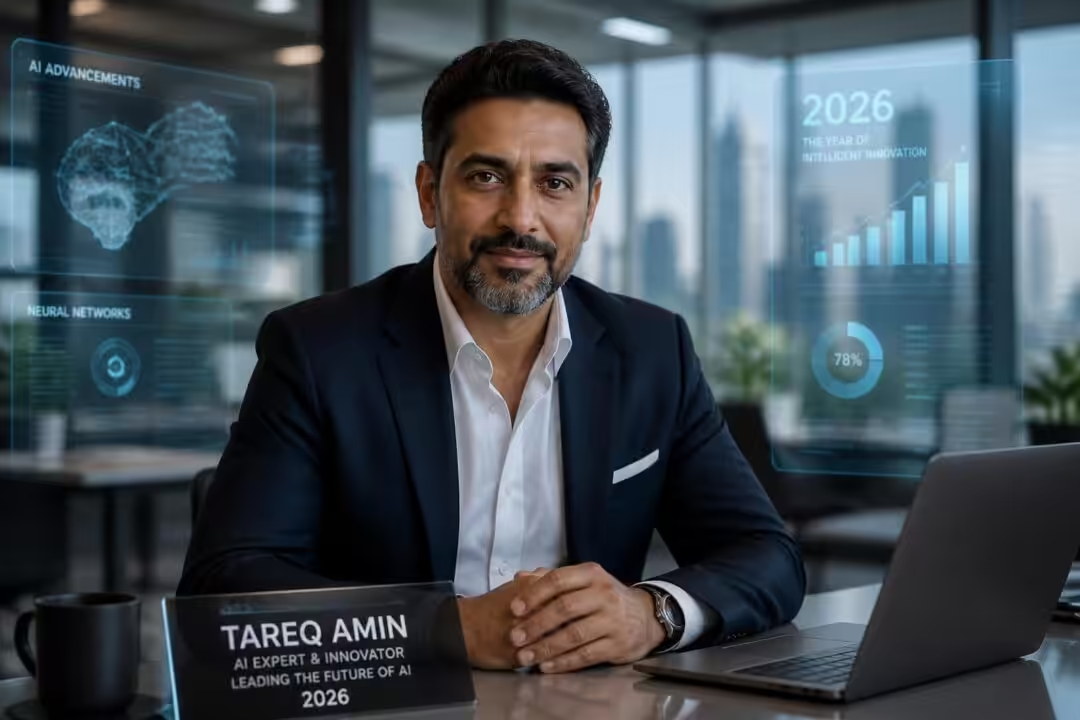
Rankings are usually marketing. This one is still marketing, but it has signal if you read it like an engineer. AI Magazine’s Top 100 AI Leaders list for 2026 places Tareq Amin, CEO of HUMAIN, at #10. That puts him in the same top tier as people steering hyperscale compute, frontier model labs, and platform ecosystems. For teams that ship software, the practical question is simple: what changed in the market if a sovereign AI company executive lands in the top 10?
First, it frames AI as infrastructure, not just apps. the top 10 list spans chips, clouds, frontier models, and deployment leadership. In the 2026 lineup, the names above Amin include leaders tied to OpenAI, NVIDIA, Anthropic, Google DeepMind, DeepSeek AI, Meta, Microsoft AI, plus AWS compute leadership and G42’s regional scale. That cross-section signals where budget and policy have been flowing: into energy, data centers, supply chains, and national capacity planning.
Second, the ranking treats sovereign AI as more than geopolitics. In February 2026 coverage, Amin’s placement was described as the highest top-10 slot for an AI executive based outside the US or China, and the only top-10 entry tied to a sovereign AI company. That matters if you’re choosing where to host sensitive workloads, how to price inference, or how to handle export controls. It suggests more buyers will face a “third option” beyond US hyperscalers and China-based stacks.
To keep this grounded, imagine a mid-size US health-tech firm, “HarborView,” building a generative assistant for clinicians. HarborView can’t move patient data to arbitrary endpoints, but it still needs fast inference and a predictable model roadmap. In 2024, the default would have been a US cloud + a frontier API. By 2026, procurement teams often ask about region-specific hosting, non-US compute clusters, and contract language around model training on customer data. Amin’s ranking is a proxy for how mainstream those questions have become.
Here is the top-10 snapshot as published in social promotion around the list, rewritten in a form that is easier to scan. If you recognize these names, good; the point is seeing where HUMAIN sits among them.
| Rank 🔢 | Leader 👤 | Organization 🏢 | What it signals for 2026 buyers 🧭 |
|---|---|---|---|
| #10 🟦 | Tareq Amin | HUMAIN | Sovereign AI stacks and regional capacity planning enter the top tier 🌍 |
| #9 ☁️ | Peter DeSantis | AWS (Utility Computing Products) | Compute economics and reliability still set the floor for everything ⚙️ |
| #8 🌐 | Peng Xiao | G42 | National-scale builds outside the US/EU keep accelerating 🏗️ |
| #7 🧩 | Mustafa Suleyman | Microsoft AI | Model-to-product integration and distribution matter as much as research 📦 |
| #6 📱 | Mark Zuckerberg | Meta | Open model strategies and consumer scale shape developer expectations 🧪 |
| #5 🧠 | Liang Wenfeng | DeepSeek AI | Cost-performance pressure continues, especially on reasoning workloads 💸 |
| #4 🔬 | Demis Hassabis | Google DeepMind | Frontier research still defines capability ceilings 📈 |
| #3 🧯 | Dario Amodei | Anthropic | Safety cases, governance, and enterprise posture keep rising in priority 🛡️ |
| #2 🧱 | Jensen Huang | NVIDIA | Hardware roadmaps and supply remain the choke point 🔩 |
| #1 🧨 | Sam Altman | OpenAI | API gravity and product packaging remain a central force 🧲 |
One more detail matters: the Top 100 package was promoted “in association with” AWS, NVIDIA, and Schneider Electric. That sponsorship mix is boring in the best way. It tells you where the money sits: cloud capacity, accelerated compute, and data center power/management. Amin’s placement reads like a statement that HUMAIN’s mission sits in that same layer, not in app-store novelty.
The next section gets concrete about what HUMAIN is building and why it looks like a “full-stack” bet rather than a model-only play.
HUMAIN under Tareq Amin: building a sovereign AI backbone with full-stack scope
HUMAIN is positioned as a PIF-backed AI company founded in May 2025, with Tareq Amin leading it since launch. Public descriptions frame it as “full-stack,” spanning data centers and cloud through to generative models and applications. That phrase gets abused in AI. Here, it has a specific meaning: if you control the build-out from power and racks to model deployment and enterprise packaging, you can set latency, cost, and governance defaults for an entire region.
For readers in the US, it can help to map HUMAIN’s stated ambition onto something familiar. Think of three layers: (1) physical infrastructure and energy, (2) cloud primitives and platform services, (3) model training/inference and app distribution. Most startups live at layer 3 and rent everything else. Hyperscalers dominate layer 2 and rent chips. NVIDIA dominates the bottleneck between layers 1 and 2. HUMAIN is signaling it wants a hand in all three, at regional scale, with a sovereign mandate.
The headline partnership to watch is the NVIDIA agreement announced in November 2025 to deploy up to 600,000 of NVIDIA’s newest AI infrastructure over three years. That number is not a spec sheet; it is a supply-chain and facilities plan. If you’ve ever waited on GPUs, you know why. Ordering at that scale implies long-range commitments to power, cooling, network fabric, and staffing. It also changes how enterprises think about “where capacity lives” during crunch periods.
Consider a practical scenario: a media company in Riyadh wants to run daily video localization and captioning with custom speech models. If it relies on overseas compute, it has to manage cross-border data rules, latency spikes, and pricing tied to another market’s peak demand. If regional capacity is deep enough, the same workload becomes a routine platform purchase. That difference turns AI from “special project” to “line item.”
What “sovereign AI” means in procurement terms, not slogans
Sovereign AI tends to get reduced to flags and politics. Procurement teams care about contract terms and operational controls. In practice, the “sovereign” label usually points to a few hard requirements: data residency, audit rights, incident response jurisdiction, and clarity on who can access logs and model telemetry. If a vendor cannot answer those cleanly, the deal slows down.
HUMAIN’s structure—owned by a sovereign wealth fund and chaired at the national leadership level, per regional business reporting—changes the risk model. For some customers, that reduces uncertainty about long-term capital and national priority. For others, it raises questions about oversight and alignment. Either way, it becomes a decision, not an afterthought.
To make this usable, here’s a checklist HarborView (the hypothetical US health-tech firm) would run if it ever considered non-US compute for non-patient workloads, like synthetic data generation or multilingual support content. The same checklist fits US vendors too; the point is consistency.
- 🧾 Data boundaries: What data types can leave the US, and which must stay put?
- 🔐 Access controls: Can the company enforce customer-managed keys and strict operator access?
- 📜 Audit posture: Are SOC reports, pen test summaries, and incident timelines available on request?
- 🧠 Model training policy: Is customer data excluded from training by default, in writing?
- 💰 Unit economics: What is the $/token or $/second inference cost under sustained load?
- 📡 Latency and routing: Where are endpoints, and how is traffic steered during outages?
- 🧯 Exit plan: How fast can data and fine-tunes be moved if priorities change?
These questions are blunt, but they are what founders and product leads need. Amin’s leadership is being credited with moving the region toward answers that are operational, not aspirational. The next section zooms out to show why infrastructure leaders now sit next to model leaders in the same top-10 list.
That shift sets up the compute-and-energy story, because the fastest model in a benchmark still fails if you can’t run it at scale.
With the infrastructure layer set, the next focus is how capacity planning, power, and supply chains shape AI roadmaps more than press releases do.
Why infrastructure leaders like Tareq Amin are being ranked with frontier model CEOs
Putting an infrastructure builder in the same top-10 bracket as frontier model CEOs is a tell. The industry has moved from “who has the smartest model” to “who can run useful systems at scale, on budget, with governance.” That is not a philosophical shift. It’s a response to what engineering teams hit in production: cost blowups, throttled GPUs, flaky latency, and compliance reviews that show up late and block launches.
Start with economics. Model capability rose fast, but the price of serving tokens became the constraint for many products. Inference is not a rounding error. A customer support bot that escalates to an LLM too often can double a SaaS margin problem overnight. That’s why compute leaders like AWS utility computing executives show up near the top; they sit at the layer where cost curves get set.
Now add supply. GPU availability shaped roadmaps across 2024–2026. Teams learned to design around what they could actually reserve, not what they wanted. Long-term capacity commitments—like HUMAIN’s plan to deploy hundreds of thousands of AI systems—change the bargaining position of an entire region. It can pull in integrators, cooling vendors, and network hardware suppliers. It can also attract model labs that want stable training runs without fighting for slots.
How “deployment at scale” changes what counts as leadership
The Top 100 framing around “real outcomes” and “deployment at scale” is more than a slogan if you define outcomes. For a product team, an outcome looks like a feature that ships, stays up, and doesn’t create a compliance incident. For a national program, an outcome might look like standard APIs for identity, logging, and safe model access across agencies and regulated industries.
Imagine a logistics company rolling out a generative planning assistant to dispatchers. It needs real-time data from fleet systems, strict logging, and low-latency inference during weather disruptions. A frontier model may be great, but the deployment fails if the hosting layer can’t guarantee throughput at peak demand. Leadership in that environment looks like procurement discipline, vendor management, and a willingness to invest in boring plumbing.
This is where HUMAIN’s “full-stack ecosystem” narrative matters. If the same organization can shape data center build-outs, cloud primitives, and model serving standards, it can reduce integration friction. That does not make it automatically better. It does mean it can set defaults in ways an API-only vendor cannot.
A practical way to read the top-10 list as an org chart for AI
If you’re deciding where to place bets, treat the top-10 list as a rough map of the AI stack:
- 🧱 Hardware and supply: chips, systems, and the path from fab to rack.
- ☁️ Cloud primitives: network, storage, schedulers, reliability, and billing meters.
- 🧠 Model labs: training runs, evals, safety cases, and release cadence.
- 📦 Distribution: embedding models into products people already use daily.
- 🛡️ Governance: safety, policy, and audit posture that blocks or clears adoption.
Amin showing up at #10 reads as an argument that sovereign infrastructure now belongs on that map. It also hints at more competition for hyperscalers in specific markets, even if US companies remain dominant globally.
For US builders, the immediate takeaway is not “move workloads to Saudi.” It’s that regional capacity outside the usual hubs is growing, and that may change pricing, redundancy strategies, and partner negotiations. The next section takes that into go-to-market realities: what partnerships, standards, and developer experiences will decide whether sovereign AI stacks get adopted by actual teams.
That sets up the final angle: adoption mechanics. Infrastructure is necessary, but developers still need usable APIs, tooling, and contracts they can live with.
What enterprise and developer teams should watch from Tareq Amin and HUMAIN after the Top 100 AI Leaders 2026 spotlight
Rankings create attention, then the market tests whether attention turns into adoption. For Tareq Amin and HUMAIN, the next set of proof points will be less about announcements and more about what engineers can actually build on. Enterprise buyers tend to converge on the same questions: “Can this run in production?”, “Can legal sign it?”, “Can finance predict the bill?”, and “Can security sleep at night?”
Start with developer experience. A sovereign AI stack that wins mindshare usually looks boring on purpose: stable endpoints, predictable quotas, clear error messages, and documentation that matches reality. Teams also want standard auth patterns, simple observability hooks, and enterprise-grade role-based access controls. If the platform forces bespoke integrations, US teams will default back to familiar clouds, even if the compute is cheaper elsewhere.
Consider “HarborView” again. It wants a multilingual triage assistant for clinics in the Gulf region, plus a separate US version under HIPAA controls. A plausible architecture is dual deployment: US workloads stay on US cloud, while Gulf-region deployments run in-region for latency and residency needs. That approach only works if the non-US platform supports the same basic tooling: CI/CD integration, infrastructure-as-code, audit logs, and strong tenant isolation.
Partnership strategy: why the NVIDIA deal is necessary but not sufficient
The November 2025 NVIDIA partnership signals hardware access. Hardware access does not automatically translate to a usable platform. Between “racks of accelerators” and “teams shipping products” sits a mountain of work: scheduler choices, multi-tenant isolation, model serving frameworks, vector databases, content filters, and incident response routines.
To judge progress without relying on hype, watch for concrete artifacts:
- 📄 Public SLAs: uptime targets, support response times, and credits that mean something.
- 🧰 Reference architectures: templates for RAG, fine-tuning, and evaluation pipelines.
- 🔎 Transparent pricing meters: rates for GPU time, storage, and inference that are easy to model.
- 🧪 Evaluation tooling: baked-in model testing for hallucinations, toxicity, and regression checks.
- 🧯 Incident transparency: postmortems that explain root causes and fixes, not hand-waving.
These are the things that earn trust with engineers who have been burned by vague promises. They also align with the “calm middle” posture: no cynicism, no hero worship, just observable behavior.
Governance and responsible deployment: what “real outcomes” should look like
AI Magazine’s framing for the Top 100 leans on outcomes and responsibility. For HUMAIN, “responsible” will likely be evaluated through how it handles model access, content controls, and cross-tenant data isolation. Enterprise buyers will also care about how the platform treats sensitive prompts and whether logs can be minimized or segregated.
A concrete example: a bank building an internal assistant for policy and procedure search. The assistant must never train on employee prompts, must redact account identifiers, and must keep retrieval indexes separate by department. If HUMAIN can make that setup routine—through policy controls, templated pipelines, and audit-ready reporting—that’s an outcome that matters more than a benchmark chart.
In practice, governance also becomes a product feature. The vendors who win in regulated markets bake in retention controls, dataset lineage, and permission boundaries. If a sovereign AI provider can make those defaults strong, it can compete on trust, not just speed.
The ranking attention on Amin signals that global AI leadership is no longer confined to model labs and US cloud giants. The next test is whether HUMAIN can translate infrastructure scale into developer trust and repeatable enterprise deployments, because that is where reputations get earned. 🧭

I’m a Brooklyn tech journalist who spent a decade covering software, cloud and developer tooling. I started this magazine in 2023 to cover generative AI without the hype or the cynicism: testing tools on my own subscriptions and citing primary sources.