
| Topic 🧭 | Our take 🔎 | Read first 📖 |
|---|---|---|
| Emmett Shear: From Twitch to OpenAI’s Interim Chapter 🧩 | Practical profile of a tech operator dropped into an AI governance crisis. | Bio summary 🔗 |
| Why OpenAI picked Shear 🏛️ | Board stability, product operations expertise, and a calming public face. | CNBC recap 🔗 |
| Impacts on AI governance ⚖️ | Short-term signal vs. long-term governance lessons for enterprise buyers. | TIME analysis 🔗 |
Emmett Shear: From Twitch to OpenAI’s Interim Chapter — a profile of leadership and product instincts
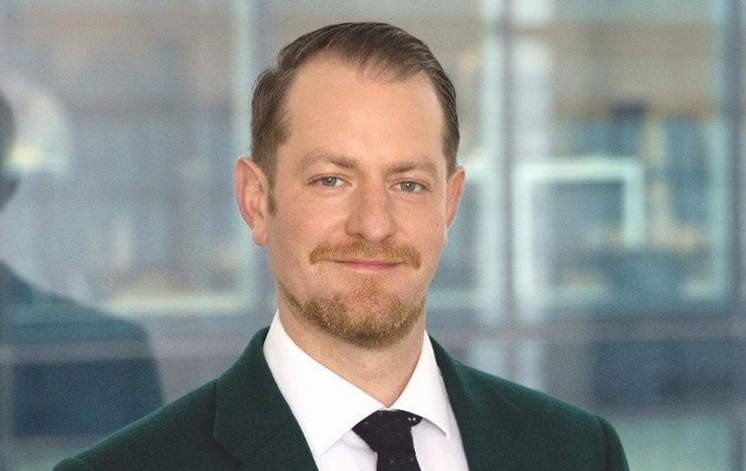
Emmett Shear is best known as the co‑founder and long‑time CEO of Twitch, the live‑streaming platform that transformed how creators, game developers and audiences interact online. That background explains why OpenAI’s board chose him as interim CEO during the November 2023 upheaval: he brings product operations experience at scale, a veteran public profile, and a track record of stewarding a platform during contentious cultural moments.
Career arc. Shear co‑founded Justin.tv in 2007, then led the spin‑out that became Twitch. Under his leadership Twitch grew from hobbyist streams to a multi‑hundred million user product and was acquired by Amazon in 2014. Stakeholders repeatedly tapped his operational judgment when moderation, monetization, and creator rights collided. His departure from the CEO role in 2023 marked the end of an era, but not the end of his relevance.
- 2007
Emmett Shear co-founds Justin.tv in San Francisco.
- 2011
The company pivots to gaming and Twitch is born.
- 2014
Amazon acquires Twitch for roughly $970 million.
- 2023
Shear steps down as Twitch CEO after years of running the platform.
- Nov 2023
OpenAI's board names him interim CEO during the Altman chaos.
Operational strengths and weaknesses
Strengths: Shear’s core strengths are product focus and scaling operations. He understands live infrastructure, latency tradeoffs, and creator economics. Those skills translate to AI products in concrete ways: release cadence, safety guardrails, and incentive design for a two‑sided marketplace (developers vs. end users).
Weaknesses: Shear is not primarily a research leader or a deep machine‑learning theorist. In a company that straddles bleeding‑edge model development and productization, that gap matters. The interim role emphasizes stabilization over research direction, which plays to Shear’s strengths.
Illustration: Aurora Labs
Consider a hypothetical company, Aurora Labs, building a conversational assistant for healthcare. If Aurora’s board suddenly replaced a charismatic ML founder with an operations leader, the immediate priorities—service continuity, compliance posture, partner messaging—mirror what Shear was tasked with at OpenAI. Product roadmaps stay; governance and communication get tightened. Aurora’s experience shows why boards sometimes prefer an operator in a crisis.
Key sources: quick bios and reporting from Wikipedia, CNBC, and TIME provide contemporaneous coverage of the appointment.
Final insight: Shear’s appointment emphasized stability and product operations over lab leadership—a tactical choice that reshaped short‑term priorities at OpenAI.
Emmett Shear background: Twitch, Justin.tv, and product leadership in platform businesses
Understanding why a platform operator like Emmett Shear is a plausible interim leader requires digging into what running Twitch actually entails. Twitch was not just a media company; it was a real‑time social platform with complex incentives: creators, viewers, advertisers, moderators, community norms, and global legal regimes. Each dimension required tradeoffs that are directly relevant to AI products.
From Justin.tv to Twitch — product lessons
Justin.tv began as a single‑stream experiment and scaled into multiple verticals before pivoting to gaming. That pivot is a textbook product decision: follow user engagement signals and double down where network effects are strongest. Twitch’s subsequent monetization playbooks—subscriptions, bits, ads—taught how to design reliable revenue without destroying creator incentives.
Those lessons map to AI commercialization problems: how to charge for models, where to gate features behind enterprise contracts, and how to preserve a developer ecosystem while extracting value.
Moderation and community safety
Twitch’s moderation challenges—real‑time abusive content, copyright, and coordinated harassment—forced investments in tooling and policy. Shear’s tenure included decisions about automated detection, human review workflows, and transparency to creators. For AI companies, similar tradeoffs appear around content filtering, hallucinations, and harmful outputs. Operational experience here matters because it produces concrete artifacts: a playbook for iterative policy enforcement and escalation paths to legal counsel—exactly what a suddenly leaderless AI org needs.
Example case: Aurora Labs, in the middle of rolling out a clinician‑facing assistant, discovers its model hallucinated drug dosages. Leadership must coordinate an immediate product rollback, a communication plan to partners, and long‑term changes to validation. A CEO with platform moderation experience will prioritize incident triage, developer relations, and public messaging—skills Shear developed at Twitch.
Investor and acquirer relations
Under Shear’s leadership, Twitch navigated acquisition by Amazon. That experience teaches how to align product roadmaps and compliance needs with a larger corporate parent. In the OpenAI context—where deep corporate relationships (notably with Microsoft) were front and center—having a leader who understands acquirer dynamics and enterprise integration was a meaningful factor for the board.
Final insight: Shear’s background signals competence in scaling, incident response, and alignment with strategic partners—practical strengths for stabilizing a high‑profile AI company.
Why OpenAI appointed Emmett Shear: board dynamics, crisis management, and public trust
The decision to name Emmett Shear interim CEO happened amid a governance crisis. When a board removes a founder‑CEO, it’s not just about performance; it’s about trust, continuity, and the optics of competence. The board’s calculus likely weighed several factors: who can reassure enterprise customers, who can stabilize engineers, and who can manage investor and partner relationships.
Board priorities in a sudden leadership vacuum
Boards under stress prioritize risk mitigation. That looks like ensuring payroll and cloud contracts remain paid, that product access doesn’t suddenly change, and that legal exposure is minimized. An interim CEO must be a communicator—internally to staff, externally to customers, and publicly to press. Shear’s public track record and relative neutrality in OpenAI’s internal politics made him a low‑friction choice.
Another consideration: boards avoid appointing a research‑centric leader when the immediate problem is operations. Choosing a stabilizer is a signal to partners that the company is not going to chase a new strategic pivot mid‑crisis.
Political optics and regulatory attention
OpenAI sits at the intersection of technology and public policy. When the company’s leadership changes abruptly, regulators and partners ask whether commitments around safety, transparency, and third‑party access will hold. An interim CEO with a public platform and no major entangling equity disputes reduces the chance of further destabilizing headlines. Shear’s appointment addressed the optics problem: a credible public operator promising steady hands.
Example: Aurora Labs faces a contracting partner demanding assurances after a CEO exit. Appointing a leader with solid operations credentials calms the partner, preserves contracts, and buys time to find a long‑term leader. That’s exactly the utility Shear provided to OpenAI.
Final insight: The board’s pick prioritized stability, communication, and risk control over long‑term research vision—an expected tradeoff for an interim leader in crisis.
What Emmett Shear did as interim CEO: communications, product triage, and the limits of temporary stewardship
An interim CEO’s job is transactional: calm the org, secure partners, and set a path to transition. In practice, that meant Shear focused on three domains: public communications, operational continuity, and governance logistics. Each domain requires different muscles, and the temporary nature of the role constrains what can be accomplished.
Public communications and investor relations
Immediate tasks include town halls, Q&A with enterprise customers, and press statements. Messaging emphasizes continuity—services remain online, contracts honored, research continues. For an organization like OpenAI, where enterprise customers and cloud partners are critical, neutral, consistent messaging reduces churn risk.
Aurora Labs analogy: After a sudden CEO departure, the interim CTO‑turned‑CEO holds a developer AMA, issues a partner memo, and posts a public FAQ. Those actions reduce uncertainty and buy two to three weeks of calm—precisely the window an interim needs to operate.
Product triage and safety posture
Operationally, triage is the first priority: freeze risky launches, audit recent model releases, and increase human review on high‑risk flows. An operations leader will prioritize reliability metrics and compliance checklists over fresh feature bets. That conservative posture protects customers and regulators but slows innovation.
Concrete change: instituting a temporary feature freeze, adding a mandatory safety checklist for each release, and routing high‑impact model outputs through additional human evaluation. These measures are not permanent strategy but necessary risk controls during transition.
Governance and transition planning
Finally, the interim coordinates the search for permanent leadership and stabilizes the board relationship. That can mean mediating between founders, designing an interim governance charter, and engaging with major partners to define selection criteria for the next CEO.
Final insight: Interim stewardship buys the organization time, but it cannot substitute for a clear long‑term governance plan; Shear’s role was to create that breathing room and reduce immediate operational risk.
Implications of Emmett Shear’s interim tenure for AI governance, enterprise strategy, and the broader industry
Short‑term leadership moves send signals. Appointing a platform operator like Emmett Shear suggested that OpenAI’s board prioritized product continuity and partner confidence over research realignment. That decision has several practical implications for customers, competitors, and regulators.
For enterprise buyers and procurement teams
Procurement teams at healthcare, finance, and government entities watch leadership moves for continuity risk. A stabilizing interim CEO reduces immediate procurement anxiety but raises questions about the company’s long‑term roadmap. Buyers should ask targeted questions: What SLAs are guaranteed? Who owns safety validation? How will governance evolve? Those answers determine contract language and vendor lock‑in decisions.
For competitors and startups
Competitors interpret such appointments as opportunities. They may accelerate enterprise pitches focused on reliability and predictable roadmaps. Startups should assess whether their differentiation is technical or operational: if operations win trust, platform stability becomes a stronger selling point than marginal model quality.
Actionable checklist for engineering and product teams (emojis for emphasis)
- 🔒 Audit security and compliance — ensure contracts and data flows are intact.
- 🛠️ Implement a feature freeze protocol — reduce release risk during leadership shifts.
- 📣 Prepare clear partner communications — reassure large customers within 48 hours.
- 📋 Document decision rights — who approves safety exceptions and escalations.
Final insight: The Shear episode is a reminder that leadership choices shape how AI companies are perceived—by customers, regulators, and competitors. Practical decisions in the next 30–90 days determine whether the organization recovers trust or invites attrition.
The Twitch CEO Who Stepped In
Why did OpenAI's board pick Emmett Shear, a Twitch guy?
He had steady hands running a massive live platform. Boards in crisis want someone who can handle operations, public scrutiny, and messy moderation calls, not just someone who knows model architecture.
Did he actually do anything during his short time as interim CEO?
Mostly cleanup and stabilization. He kept the product team focused, reassured large customers, and made sure the company did not fall apart while the board worked out Altman's return.
Was Shear qualified to run a frontier AI lab?
Qualified to manage one, sure. He is not a machine learning researcher, so real model direction stayed with the scientists. His skill set is about shipping products, not inventing new architectures.
What happened to Shear after Altman came back?
After Altman returned, he stepped aside quietly. No drama, no lingering board role, and he went back to his own projects.
New to the topic? Welcome, ask anything
Leave a comment
I’m a Brooklyn tech journalist who spent a decade covering software, cloud and developer tooling. I started this magazine in 2023 to cover generative AI without the hype or the cynicism: testing tools on my own subscriptions and citing primary sources.




3 Comments
Interesting interim choice. The real test is whether he can stabilize governance without stalling model iteration.
Great piece, Ellie. But AI governance needs more user-centered design thinking, not just boardroom moves.
Shear’s ops background is solid, but AI governance needs more than product instincts.