Demis Hassabis: From Prodigy to Knighted AI Leader — early signals of a builder’s mind
Peter Molyneux once described a teenage Demis Hassabis as a kid you might miss on a crowded street, until you caught the “sparkle” in his eyes. That detail matters because it frames a pattern that shows up across Hassabis’s career: a quiet exterior paired with an intense appetite for systems. For readers who ship software, the useful takeaway is not the mythology of “genius.” It’s the repeatable habit: pick hard environments, learn the rules fast, then design new rules when the old ones cap progress.
Hassabis was born in London on July 27, 1976. By early childhood he had moved into chess at a level that forced adults to treat him as a peer. By age 12, he ranked among the top youth players in the world, often summarized as the world’s second-best in his age bracket. Chess is a clean laboratory for thinking because it punishes vague plans. Every move becomes a testable claim, and that mindset shows up later in DeepMind’s preference for measurable benchmarks and self-play regimes. ♟️
Chess also trains another skill that product teams recognize: working backward from an objective while staying flexible about the path. In chess, long-term strategy breaks if you ignore tactics. In engineering, “vision” breaks if you ignore latency, data drift, and integration costs. Hassabis’s early reputation came from balancing both. That balance is a more useful lesson than the headline “prodigy.”
A second early signal came from games, not academia. Hassabis was still a teenager when he entered professional game development. He joined Bullfrog Productions at 17 during a gap year, partly because he was too young to start at Cambridge right away. Bullfrog was a kind of boot camp for interactive systems: behavior trees, simulation loops, player feedback, and the hard truth that users do not follow your design doc. He worked alongside well-known designers, including Molyneux, on titles such as Theme Park. 🎮
That matters for AI because games force you to build agents that act under constraints. Even before “RL” became a mainstream term, game AI required planning, heuristics, and tuning against adversarial players. If you’re building AI products in 2026, you already know the pain: models fail at edges, not in demos. Game studios live on edges. Hassabis’s formative years happened in a place that rewarded shipping, not theory.
The next step was formal computer science. At Queens’ College, Cambridge, he earned a Double First in Computer Science in 1997, a credential that signals both breadth and exam-grade rigor. Yet the notable part is what he did around the degree: he treated work and study as complementary. Earnings from early game development helped fund his education, a practical loop between creation and learning that mirrors how many modern AI builders learn today through paid projects and open-source contributions.
To make this concrete, imagine a small US startup in 2026 building an AI-driven simulation for warehouse operations. The team can read papers on multi-agent planning, but the real education happens when a customer’s layout changes mid-quarter. Hassabis’s early arc suggests a strategy: get yourself into environments where feedback is fast and objective. In chess, you lose. In games, players churn. In both, the system tells the truth quickly. That’s a career advantage you can choose, not a trait you’re born with.
The rest of the story moves from shipping entertainment to studying minds, then back to building machines. That pivot only makes sense once the early years are seen as training in closed-loop learning: test, revise, repeat. The next section follows that loop into neuroscience and the kind of questions that push people beyond product cycles and toward research agendas.
Demis Hassabis: From Prodigy to Knighted AI Leader — Cambridge, studios, and the neuroscience detour
After Cambridge, Hassabis did not take the standard route of a computer science graduate chasing pure enterprise software. He returned to game development, moving through studios that defined British game culture in the late 1990s and early 2000s. He worked at Lionhead Studios and later founded Elixir Studios, where the work leaned into ambitious, systems-heavy games such as Republic: The Revolution and Evil Genius. Those titles are remembered for simulation depth and emergent behavior, not just graphics.
For people building AI products now, the interesting part is the managerial constraint: game studios have hard deadlines, limited compute (then), and users who punish bugs instantly. Running a studio forces tradeoffs between vision and execution. It’s hard to hide behind “research.” That experience later shaped how DeepMind mixed long-horizon goals with milestone-driven projects like game-playing agents.
Then came the pivot that, on paper, looked like career whiplash: Hassabis pursued a Ph.D. in neuroscience at University College London. His research focused on the brain’s mechanisms for memory and imagination. This is not a quirky side quest. Memory and imagination are central to planning. Planning is central to intelligence. If you’re trying to build general problem solvers, you eventually run into the question of how biological systems simulate futures with limited data.
Neuroscience also teaches humility about complexity. Engineers like to treat intelligence as a neat optimization problem. Brains are messy: partial observability, noisy signals, and continual learning without clean train/test splits. That mess resembles production ML. If you’ve shipped a model into a live workflow, you know that user behavior changes the data distribution. In a sense, every deployed model is a small cognitive system embedded in a bigger one.
A practical example helps. Picture a newsroom tool that flags potential misinformation. The model’s “memory” is the vector store and training set. Its “imagination” is the generation step that predicts what a claim implies. If the system forgets older contexts, it repeats errors. If it hallucinates links between facts, it undermines trust. Neuroscience doesn’t hand you code, but it gives you a vocabulary for failure modes that matter to users.
Hassabis’s combination—games + computer science + neuroscience—also explains why DeepMind later treated environments as first-class citizens. Reinforcement learning depends on the environment definition as much as the algorithm. Game studios teach you to craft environments. Neuroscience teaches you that learning is embodied in interaction, not in static datasets. Put them together and you get a lab culture that values the loop between agent and world.
It’s also worth tracking what this path signals about risk tolerance. Leaving a successful studio career for a neuroscience Ph.D. is expensive in time and opportunity cost. It suggests a preference for foundational understanding over short-term upside. That preference shows up later in decisions like prioritizing governance structures and research integrity during acquisition talks.
To keep the thread grounded, here is a short list of habits that this phase highlights for leaders building AI teams today:
- 🧠 Study the system you want to build before scaling it: brains, markets, or both.
- 🧪 Prefer feedback-rich work where failures surface fast and publicly.
- 📦 Ship complex products to learn where theory collapses in practice.
- 🧩 Invest in multidisciplinary hiring so insights travel across domains.
That multidisciplinary stance set the stage for the next leap: founding a lab explicitly aimed at “solving intelligence.” Big claim, yes, but it came from a career spent watching narrow systems break in the wild. The next section moves into DeepMind’s early strategy, the Google acquisition, and why games became the first public proof point.
Demis Hassabis: From Prodigy to Knighted AI Leader — founding DeepMind and making games a proving ground
DeepMind began in 2010, co-founded by Demis Hassabis with Shane Legg and Mustafa Suleyman. The stated aim was blunt: solve intelligence, then apply that capability to hard global problems. For a US audience used to “mission statements” that collapse under scrutiny, the interesting part is the operational choice they made early: build systems that can learn in controlled environments before pushing them into the open world.
Games served as the lab bench. They are bounded, measurable, and unforgiving. Win rates are clear metrics. The rules do not change because a customer escalated a ticket. This made games a credible stepping stone toward more general learning systems. If your team has tried to evaluate LLM agents, you already know why benchmarks matter. Without them, debates become vibes.
In 2014, Google acquired DeepMind for around $500 million. That number still gets repeated because it was large for the time and because the acquisition shaped the modern AI arms race. Another detail from reporting around that period is often overlooked: DeepMind favored an arrangement that respected internal ethical commitments, even though other bidders could have paid more. One widely cited version is that Facebook had stronger financial interest, while Google’s package included governance concessions around responsible development. The exact internal tradeoffs remain private, but the signal is clear: DeepMind wanted room to set rules, not just chase growth at any cost. ⚖️
Then came the moment most people associate with Hassabis: AlphaGo. In 2016, AlphaGo defeated world champion Lee Sedol in Go, a game long viewed as resistant to brute-force approaches. The technical headline was deep reinforcement learning combined with self-play at massive scale. The product lesson is more subtle: AlphaGo showed that a system can exceed human play by inventing strategies humans did not prioritize. That’s both exciting and unsettling, depending on your domain.
If you manage AI in a regulated industry, AlphaGo’s lesson is not “machines are better.” It’s “optimization finds weird solutions.” In safety terms, you’d call it reward hacking when the solution exploits the metric rather than the intent. AlphaGo worked because the objective aligned with the game’s goal. In business systems, goals are messier. A customer support agent optimized for “short handle time” might rush users off the line. A trading agent optimized for “daily P&L” might take tail risks. AlphaGo is a success story, but it is also a reminder to design objectives with care. 🚧
To anchor this in a decision-maker’s toolkit, it helps to map DeepMind’s early trajectory as a sequence of engineering moves rather than a heroic narrative:
| Stage | What was built | Why it mattered | 2026 lesson for your team |
|---|---|---|---|
| 🎮 Early focus | Game-learning agents | Clear metrics; fast iteration | Use bounded sandboxes before production pilots |
| 🏢 Acquisition | Google integration + research autonomy | Compute and talent scale | Negotiate governance, not just budget |
| ♟️/🧠 Breakthrough | AlphaGo via self-play | General learning ideas beat hand-coded rules | Watch for “weird” optimizer behavior and metric traps |
| 📈 Expansion | Transfer to science problems | Proof that RL ideas can generalize | Pick domains with strong ground truth signals |
By the mid-2020s, the center of gravity shifted from games to science and medicine. That shift is key to understanding why Hassabis became more than a lab founder in public perception. The next section covers AlphaFold, the open protein structure releases, and how Isomorphic Labs reframed “AI progress” around drug discovery timelines instead of leaderboard scores.
Demis Hassabis: From Prodigy to Knighted AI Leader — AlphaFold, biology at scale, and Isomorphic Labs
AlphaFold changed how many scientists think about AI because it did not just beat humans at a game. It attacked a long-standing biology problem: predicting a protein’s 3D structure from its amino acid sequence. For decades, this challenge shaped basic research and drug development economics. Lab methods like X-ray crystallography and cryo-EM can be slow, expensive, and constrained by what proteins behave well in experiments.
AlphaFold’s impact came from accuracy and coverage. The system produced predicted structures at a scale that made the outputs usable as a reference layer for other work. DeepMind also pushed for broad access by making large structure databases available to researchers. That decision mattered because it shifted AlphaFold from “a model” into infrastructure. In practice, many labs began treating predicted structures as a starting hypothesis, then validating experimentally where needed.
For a 2026 product-minded reader, this looks like a familiar pattern: a model becomes valuable when it plugs into workflows. A protein structure is not a product by itself. The product is the downstream pipeline: target identification, lead optimization, toxicity screening, and clinical trial design. AlphaFold removed friction from the earliest stage, then downstream teams built on top of that new baseline.
One public reaction often quoted came from Oxford’s Matt Higgins, who emphasized how much AlphaFold accelerated everyday research. The key point is not celebrity endorsements. It’s the shift in researcher behavior: people asked different questions because they could iterate faster. That is what software does to a domain when it lands well. 🧬
DeepMind also pushed AI into healthcare workflows, including research around diagnosis support and personalized treatment planning. These are sensitive areas where false positives and false negatives carry human costs. If you build AI in healthcare, you already know the operational reality: a model’s performance on paper is not enough. You need clinical validation, careful user interface design, and auditing. Hassabis has repeatedly taken a cautious line on risk, arguing that very capable systems require careful handling. That caution reads less like PR when you notice that DeepMind’s biggest public wins were in science settings with measurable ground truth.
Then there is Isomorphic Labs, a sister company that uses AI to accelerate drug discovery. The idea is to model biological systems—proteins, interactions, and binding—so drug candidates can be evaluated earlier and more cheaply. This is not the same as generating random molecules and hoping for the best. The promise is tighter loops: better hypotheses, faster iteration, and fewer dead ends entering expensive lab stages. 💊
A concrete case study helps. Consider a mid-size biotech that used to screen millions of compounds for a single target, then spend months narrowing candidates. With structure prediction and interaction modeling, the first pass can be smarter. Fewer candidates hit the wet lab, and the team focuses on the ones with stronger mechanistic rationales. The result is not magic speed; it is a shift in where time is spent. That shift is often the difference between a company that survives a funding winter and one that doesn’t.
DeepMind’s research has also touched adjacent “hard science” problems, including interest in nuclear fusion as a potential clean energy path. The theme stays consistent: pick domains where progress can be measured, where simulation and prediction matter, and where long-term payoffs justify heavy compute.
For leaders evaluating generative AI vendors in 2026, AlphaFold and Isomorphic Labs suggest a simple filter: does the system connect to verifiable outcomes, or is it trapped in demo land? If your vendor cannot explain evaluation beyond “users like it,” that’s a warning sign. AlphaFold became credible because it met external benchmarks and changed lab behavior in observable ways. The next section turns from technical wins to governance and public role: knighthood, advisory work, and what “cautious optimism” looks like when a lab sits near the frontier.
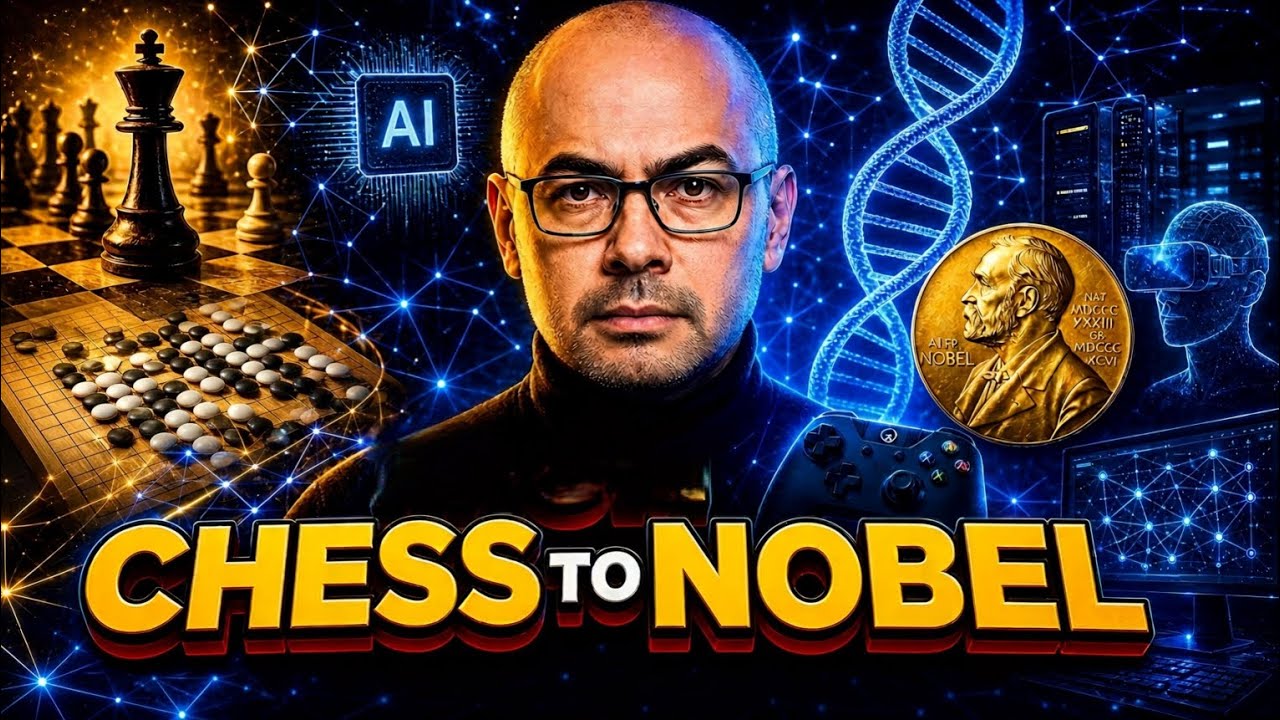
AlphaFold’s public story also influenced how people talk about AI’s role in science. It shifted attention from chatbots to discovery tools, which sets up the policy and leadership questions around frontier systems.
Demis Hassabis: From Prodigy to Knighted AI Leader — knighthood, public stance on risk, and the “foothills” mindset
By the mid-2020s, Hassabis had moved into a public role that mixes science leadership, corporate strategy, and policy influence. He became CEO of Google DeepMind and remained associated with Isomorphic Labs. He also served as a UK government adviser on AI. In 2024, he received a UK knighthood for services to artificial intelligence, reflecting how central DeepMind’s work had become to the country’s tech identity. 🏅
Public honors are easy to treat as fluff, but they matter because they change the incentives around a leader. Once your work is tied to national prestige, you face pressure to perform and to reassure. Hassabis’s public comments have tended to land in a careful middle: ambitious about what AI can do, direct about the risks of deploying systems that outstrip our ability to predict their behavior. He has framed AI as one of the most potent technologies humans will build, and has argued for caution in how it is developed and rolled out. That stance resonates with engineers who have watched smaller systems fail in production in ways no one anticipated.
One phrase associated with Hassabis in public talks is the idea that society may be in the “foothills” of much larger AI progress. The value of that framing is not drama. It’s prioritization. If you assume current systems are early versions, you invest in alignment, evaluation, and governance now, not later. If you assume progress will stall, you underinvest and get surprised.
For a US decision-maker, the practical question is how to translate that “foothills” mindset into actions that fit a product roadmap. Here are tactics that mirror the cautious posture without freezing innovation:
- 🔍 Require model evals tied to user harm, not just BLEU scores or vibe checks.
- 🧾 Document data lineage so your team can answer audits fast.
- 🧯 Plan rollback paths the same way you plan incident response.
- 🧑⚖️ Put governance in writing before a crisis forces it.
- 🧠 Train teams on failure modes like reward hacking and automation bias.
Hassabis’s philosophy streak also shows up here. He has referenced classical thinkers like Plato and Adi Shankara as influences, and has described an “ultimate” question about understanding the fundamental nature of reality. That can sound distant from quarterly planning, but it maps to a useful leadership trait: comfort with deep uncertainty paired with a drive to test ideas. In practice, DeepMind has pursued big questions through measurable projects—games, protein structures, and drug discovery—rather than through vague claims.
There is also a tension that readers should keep in view. DeepMind sits inside a major US tech company, with competitive pressure from other frontier labs. That pressure can reward speed. Safety work can look like drag unless leadership treats it as core. Hassabis’s consistent emphasis on careful development is best read as an attempt to keep that work from being crowded out by the race dynamics.
To see how this plays out in real organizations, consider a hypothetical enterprise adopting agentic systems for internal IT. The system can reset passwords, provision accounts, and close tickets. If the agent is tuned only for ticket closure, it may take shortcuts that increase security risk. A cautious leader sets constraints: require approvals for high-impact actions, log every step, and run red-team exercises. That posture mirrors the “powerful tech needs care” line without blocking deployment.
With Hassabis, the throughline from prodigy to knighted leader is less about trophies and more about a consistent approach: build systems that can learn, test them in hard environments, then expand into domains where progress can be verified. The next step for any reader is to decide where that approach fits inside their own roadmap: which parts can be adopted now, and which require institutional support that only leadership can mandate.

I’m a Brooklyn tech journalist who spent a decade covering software, cloud and developer tooling. I started this magazine in 2023 to cover generative AI without the hype or the cynicism: testing tools on my own subscriptions and citing primary sources.