

Cloud Migration Strategies 2026: Assessment and Preparation for Business Impact
Defining migration as business transformation
Treat cloud migration as a strategic change, not just an IT move. When a team treats it as a hardware swap, costs often rise and expected gains do not appear. The real shift touches release cadence, security posture, team workflows, and product architecture all at once.
Consider the fictional mid-size company BrightRoute. Its CTO, Maya, faced slow releases and a costly data center. The board wanted faster feature rollout and global reach. The move to cloud started only after the team linked technical choices to clear business outcomes.
Assessment must answer three simple questions. Which workloads should move? Why must they move? What must change so the business actually benefits?
Practical readiness checks
Begin with a workload inventory. List every app, database, integration, and dependency. Rate each by business criticality, compliance sensitivity, and migration complexity. This creates a map that guides sequencing.
Build an ROI case. Capture current annual IT costs and compare to projected cloud spend. Factor in one-time migration investments, training, and expected savings from operational changes. Use realistic assumptions for data transfer and storage.
Security and compliance must be scored early. For each system, document regulatory constraints such as GDPR, HIPAA, PCI. Map controls to cloud features, and record any gap that requires design work.
Stakeholder alignment and change management
Cloud migration spans finance, product, security, and operations. Create a steering group with clear owners. Define success metrics in business terms. For example, target “reduce time-to-deploy by 50%” or “achieve 99.95% uptime for checkout.” Assign owners and timelines.
Training matters. Teams need practice with IaC, CI/CD, and cloud security. BrightRoute scheduled fortnightly workshops. The company also ran pilot migrations for a non-critical app to surface gaps before risking customer systems.
Data strategy and migration method
Not all data moves the same way. For large datasets, plan a hybrid approach with bulk transfer and delta sync. For transactional systems, design a delta period to minimize cutover downtime. Backups and validation are mandatory steps in the plan.
Decide on retention and archiving rules. Classify data by sensitivity and business value. Archive low-value data to lower-cost tiers. Keep high-value or sensitive data under strict encryption and access controls.
Example checklist to start
- 🔍 Inventory: catalog apps, databases, integrations.
- 📊 Business case: baseline costs, migration investment, ROI timeline.
- 🔐 Security plan: IAM, encryption, logging.
- 🧪 Testing plan: function, performance, DR.
- 👥 Change plan: owners, training, communication.
Each item above must link to an owner and a deadline. That prevents migration from becoming a vague IT task. BrightRoute used this checklist to cut unexpected blockers in half during its first wave.
Key insight: start with an assessment that treats cloud migration as a controlled business program. That reduces surprises and ties the move to measurable impact.
Cloud Migration Strategies 2026: Choosing the Right Path with the 6 Rs and 7 Rs
How to pick the correct migration approach
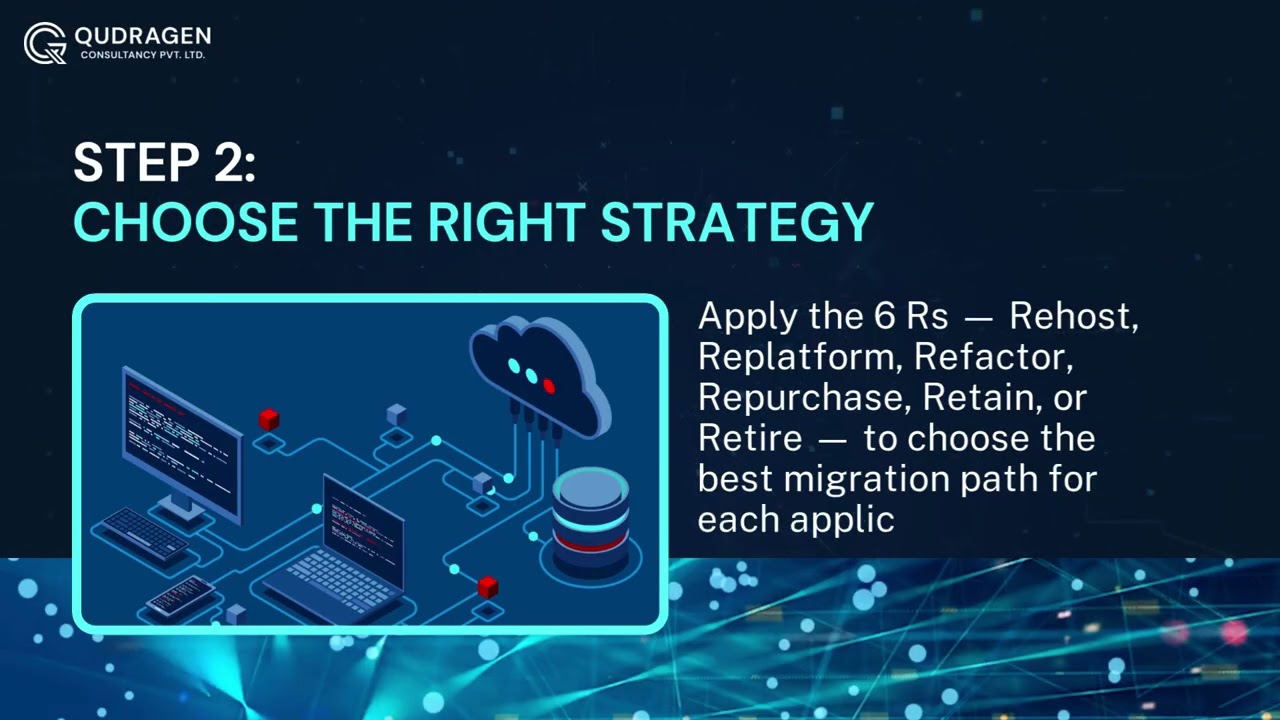
Every workload demands its own strategy. The common frameworks are the 6 Rs and the broader 7 Rs. They help you classify paths from minimal change to full rebuild.
Here are the options in plain terms.
- 🚚 Rehost (lift-and-shift): move with minimal code change.
- 🔧 Replatform: make small optimizations during migration.
- 🧩 Refactor: adjust architecture to use cloud-native services.
- 🏗️ Rebuild: rewrite the app for the cloud.
- 🛒 Repurchase: replace with SaaS when it is non-differentiating.
- 🗑️ Retire: remove unused or redundant systems.
- 🔀 Relocate: move between cloud providers with minimal changes.
Decision flow with examples
Start with business value. If a system no longer delivers value, retire it. If regulation or latency blocks movement, retain or plan a hybrid solution. For low-risk apps, rehost to gain quick wins. For core products that must scale, choose refactor or rebuild.
Example: BrightRoute had a legacy analytics pipeline. It moved initial ETL to cloud VMs (rehost) for speed. Later the team refactored to managed data services to enable faster queries and lower operational load.
Trade-offs and timing
Rehosting is fast. It gets you out of a data center quickly. But rehosted systems rarely gain full cloud benefits. Refactoring yields performance and velocity gains. It costs more time and engineering resources.
Repurchasing to SaaS cuts maintenance time. It can cause vendor dependency. Decide which systems are core to your product. Keep those under your control.
Comparison table of strategies
| Strategy | Best for | Risk | Impact |
|---|---|---|---|
| Rehost | Fast exits from data centers 🕒 | Low ⚠️ | Quick migration, limited cloud gain 📉 |
| Replatform | Improve ops with small changes 🔧 | Medium ⚖️ | Moderate gains, faster than refactor 📈 |
| Refactor | Scaleable core products 🧭 | High 🔥 | High long-term velocity and cost efficiency 🚀 |
| Rebuild | Outdated, fragile systems 🏗️ | Very High 🚨 | Clean architecture, slower time-to-market 🛠️ |
| Repurchase | Non-differentiating tools 🛍️ | Medium ⚖️ | Reduced ops, vendor dependence 🔒 |
| Retire | Redundant systems 🗑️ | Low ✅ | Immediate cost reduction 💸 |
| Relocate | Cloud-to-cloud moves 🔀 | Medium ⚠️ | Cost or service fit improvements 🔍 |
Use the table to align each app to its path. Tag each workload with a recommended R and an owner. That reduces rework during execution.

Key insight: match strategy to business goals. Quick wins matter. So does long-term architecture. Balance both with a clear roadmap.
Cloud Migration Strategies 2026: Security, Compliance, and Risk Management
Shared responsibility and security-by-design
Cloud platforms secure the infrastructure. You secure what runs on it. That model defines the shared responsibility boundary. Misconfigurations are the most common cause of breaches.
Start by mapping responsibilities. Document who manages encryption, who rotates keys, and who reviews access logs. Make those roles part of the migration plan.
Design controls before migration
Security must be part of the blueprint. Define identity rules, network segmentation, and logging before you move sensitive data. If controls come later, remediation becomes costly and disruptive.
Use automation to enforce policy. Scripts and IaC can create repeatable, auditable deployments. That reduces configuration drift and speeds audits.
Compliance examples and trade-offs
GDPR demands data residency and deletion controls. HIPAA requires encryption and audit trails for PHI. PCI needs segmented cardholder environments and strict access controls. Each law adds architectural constraints.
BrightRoute negotiated a hybrid design for a regulated client. Core patient records stayed in a private cloud; analytics ran in a public cloud under controlled pipelines. This reduced compliance risk while enabling modern analytics on anonymized datasets.
Disaster recovery and resilience planning
Cloud can improve RTO and RPO if designed correctly. Design backups, cross-region replication, and automated failover. Test recovery regularly. A backup that was never restored is a false comfort.
Plan for partial failures. Use circuit breakers and graceful degradation. For APIs, include rate limits and retry logic. That avoids cascading outages during traffic spikes.
Common risks and mitigation list
- 🔒 Misconfiguration: enforce templates and automated checks.
- 🔑 Poor secrets management: use managed secrets stores and rotate keys.
- 🧾 Insufficient logging: send logs to centralized, immutable storage.
- 📡 Network exposure: apply private subnets and secure endpoints.
- 🧠 Skills gap: run focused upskilling and controlled pilot projects.
Testing and validation practices
Testing must cover function, load, security, and recovery. Create a test matrix that runs against production-like data. Include penetration tests that mirror threats your business faces.
Run tabletop exercises for incident response. These build muscle memory. They also reveal gaps in communication and escalation paths.
Key insight: treat security as architecture. When security is designed in, audits become repeatable and risk drops sharply.
Cloud Migration Strategies 2026: Cost Control, FinOps, and Operational Readiness
Real cost drivers and common traps
Cloud shifts costs from capex to opex. That hides risk for teams used to fixed budgets. Unchecked usage can blow monthly spend within weeks.
Common traps include idle VMs, oversized instances, over-retention of data in hot tiers, and high cross-region transfer. Tagging helps track spend by product, team, and environment.
FinOps practices that work
Adopt a simple FinOps cadence. Set budgets, create alerts, and run monthly cost reviews. Assign cost owners for each tag group. Use reserved capacity where steady usage exists.
Rightsizing often yields the fastest wins. Query patterns reveal overpowered resources. Automate scheduled shutdowns for dev and test environments to cut waste.
Example numbers and outcomes
BrightRoute ran a pilot with three web services. Initial cloud spend was $15,000 per month. After rightsizing, auto-scaling, and storage tiering, spend dropped to $9,500 per month. That cut matched a 37% reduction in monthly costs.
Track KPIs. Key metrics include infrastructure cost per active user, time-to-deploy, and percentage of spend covered by committed discounts. These metrics tie cost work back to product outcomes.
Operational readiness and runbooks
Operational readiness means your team can own the cloud day-to-day. Build runbooks for incidents, backups, and deployments. Automate repetitive tasks so humans can focus on exceptions.
Document escalation paths and maintain a runbook repository. Regularly rehearse incident scenarios to shorten mean time to recovery.
List: Quick FinOps checklist
- 📌 Tagging policy: enforce tags on every resource.
- ⏱️ Schedule non-prod shutdowns: auto-power off during nights/weekends.
- 📈 Monthly cost review: track anomalies and trends.
- 💾 Storage tiering: move cold data to cheaper tiers.
- 🤝 Commit discounts: evaluate reserved instances or savings plans.
Key insight: cost control requires culture change. Make finance a partner in engineering decisions. Small automation moves often deliver the biggest savings.
Cloud Migration Strategies 2026: Execution Roadmap, Partner Selection, and Post-Migration Optimization
Five-phase migration roadmap and sequencing
Use a phased approach that moves from low-risk wins to critical systems. A clear roadmap reduces downtime and keeps stakeholders aligned.
Phases to follow:
- Phase 1: Assessment and pilot builds trust and reveals hidden costs.
- Phase 2: Platform setup and security foundations establish a repeatable baseline.
- Phase 3: Wave-based migrations reduce blast radius for production cutovers.
- Phase 4: Operate and monitor ensures your team owns the new stack.
- Phase 5: Optimize and innovate focuses on cloud-native improvements.
Partner evaluation and governance
Some projects need outside help. Pick partners who balance architecture depth with practical migration experience. Look for a partner that can assess, plan, execute, and upskill your team.
Governance must cover cost, security, and operations. Create a simple governance board. Meet regularly to approve major infra changes and to review cost and security reports.
Avoiding vendor lock-in while making pragmatic choices
Vendor lock-in is a trade-off, not a taboo. Managed services can speed development and cut ops. Still, document dependencies and keep an exit plan for critical components.
Use containers and clean API boundaries where portability matters. For analytics or AI workloads, pick providers that match your technical needs and business rhythm.
Post-migration optimization and innovation
Migration ends when the team runs stable operations and starts to innovate. Shift focus to performance tuning, cost sweeps, and developer experience improvements.
Adopt cloud-native tools that match business needs. Consider serverless for spiky workloads and managed databases for standard CRUD services. Build a backlog of refactors that unlock growth.
Final practical checklist before go-live
- ✅ Final sync and validation: verify data integrity and transactional consistency.
- ✅ DR test: run a failover and confirm RTO and RPO.
- ✅ Security audit: validate IAM, secrets, and logging policies.
- ✅ Communication plan: notify users and support teams of cutover windows.
- ✅ Rollback steps: confirm immediate rollback if critical issues arise.
BrightRoute used phased canary releases. That limited user impact. The team iterated between waves. Each wave improved the next one.
Key insight: execution succeeds when planning, governance, and teams align. A steady cadence of waves produces real business change while keeping risk under control.

I’m a Brooklyn tech journalist who spent a decade covering software, cloud and developer tooling. I started this magazine in 2023 to cover generative AI without the hype or the cynicism: testing tools on my own subscriptions and citing primary sources.