
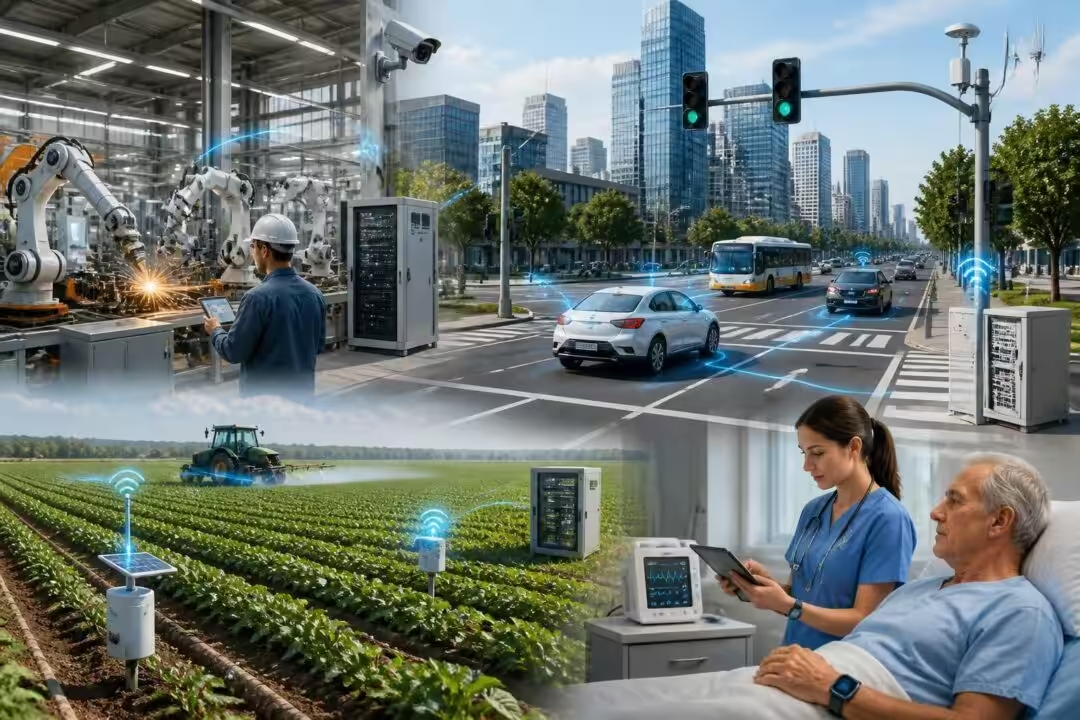
Edge Computing Use Cases: Architecture & Core Concepts for Practical Deployment
Edge computing moves compute and storage closer to sensors and devices. That reduces transit delays and cuts repeated data transfers. For teams making product choices, it changes where work happens and who owns it.
At the core, the edge model splits work across three layers. Devices do immediate sensing and basic processing. Gateways or on-prem servers handle aggregation and inference. The cloud keeps heavy analytics and long-term storage.
Types of edge nodes and where they sit in a stack
Device edge runs on sensors, cameras, and phones. These nodes handle short, quick tasks such as simple filtering or TinyML inference. Gateway or edge boxes, like single-board computers or Intel NUC appliances, collect many device streams and run richer processing workloads.
On-prem edge servers host local data histories and act as a sync point to public clouds. Telco near-edge, often called MEC, colocates compute with radio access to cut network hops. Each node type has trade-offs in power, cost, and manageability.
Core enabling technologies
Hardware choices range from tiny MCUs to GPUs in rugged racks. For on-device ML, TPUs and FPGAs can cut inference time. Software stacks use containers and lightweight orchestrators like K3s or microK8s to keep deployments consistent.
Connectivity includes 5G, Wi‑Fi, Ethernet, and low-power wide-area networks such as LoRaWAN. Remote device management and secure OTA updates are essential for fleet health. Observability tools must show device states, logs, and model versions.
Key trade-offs to set expectations
Edge reduces latency and saves on wide-area bandwidth. That helps interactive AR, local control loops, and real-time safety. However, many edge nodes have limited CPU, memory, and storage. That forces careful planning of model size and data retention.
Management complexity rises with node count. Each remote device increases the attack surface and the need for strong identity. Power and cooling add recurring costs. Expect different cost curves than cloud-centric projects.
Introducing a thread: Harbor Logistics
Consider Harbor Logistics, a mid-sized coastal carrier. The firm runs port terminals and a regional trucking fleet. Tests on a few docks proved that local inference cut decision time for container handling. Later sections follow their path as they scale edge from pilot to operations.
For architects, the takeaway is clear: match node type to the problem. Pick device, gateway, or MEC based on latency, resilience, and regulation. Design for intermittent links and secure identities as defaults. This choice sets cost and risk for the entire project.
Key insight: Choose the right node type first—latency, resilience, and compliance drive architecture choices.
Edge Computing Use Cases: Industrial Predictive Maintenance and Asset Monitoring
Factories and remote sites are prime edge use cases. They produce steady telemetry and need fast action on anomalies. Predictive maintenance shares the same pattern: sensor streams, local inference, and targeted alerts.
Harbor Logistics installed vibration and temperature sensors on container cranes and refrigerated trailers. Gateways ran lightweight anomaly detectors near each crane. When a bearing vibration spiked, the gateway flagged the issue within seconds.
Problem, solution, and measurable results
Problem: delayed detection caused long downtimes and emergency repairs. Solution: move anomaly detection to the gateway and trigger local control actions. Results: fewer unscheduled stops and lower spare part carry costs.
On one berth, local inference reduced mean time to detect by over 90%. Transfers that once required data trips to the cloud now conclude on-site. The operation saved both labor and shipping delays.
Architecture patterns
Typical setup uses PLCs and sensors feeding an edge gateway. The gateway runs containerized models for anomaly detection. Periodic summaries and compressed event logs are sent to the cloud for trend analysis and model retraining.
For extremely remote sites, rugged appliances hold data historians and sync only during planned windows. That keeps operations working even when satellite links stall.
Technology choices and trade-offs
OPC UA is common for industrial integration. TinyML models fit on constrained hardware for fast inference. FPGA-accelerated appliances help in high throughput cases. Choose the smallest compute that meets SLA.
Security needs hardware-backed keys and mutual TLS between edge nodes and the backend. Over-the-air updates must support rollbacks and staged rollouts to avoid bricking critical gear.
Case study nuance and human element
At Harbor Logistics, maintenance techs were skeptical at first. A pilot targeted the top three cranes. Engineers showed weekly dashboards with event reductions. After two months, technicians trusted the alerts and adjusted maintenance plans.
Operational change management matters. Push training and clear escalation paths. Automation should reduce friction, not add noise.
Key insight: Edge-based predictive maintenance converts telemetry into immediate action, cutting downtime and repair cost.
Edge Computing Use Cases: Retail Analytics, Smart Surveillance, and In-Store Automation
Retail stores need quick decisions and clear privacy boundaries. Video analytics and cashier-less checkouts are common edge cases. Processing video locally reduces bandwidth and keeps sensitive footage in-store.
Harbor Logistics’ sister company, Harbor Retail, piloted cashier-less checkout and in-store personalization. Cameras and POS sensors fed edge boxes that ran people detection and simple recommendation logic. The boxes only sent event summaries to the cloud.
Privacy and compliance
For retail, mask and face-blur techniques help maintain privacy. Local inference that emits anonymous event records is easier to reconcile with privacy laws. Secure storage and audited access control are mandatory.
Retail teams must document what data leaves the store and what remains local. That reduces audit friction and keeps regulators calm.
Managing model drift and scale
Models degrade with new layouts, lighting, and shopper behavior. Edge deployments need a model lifecycle plan. The store should collect edge-labeled events alongside cloud retraining pipelines.
Harbor Retail used weekly model versioning and canary rollouts. Small stores got updates first. That limited customer impact when models showed failures.
Concrete examples and metrics
A pilot reduced checkout time by two-thirds and cut network egress. Staff redeployment followed, focusing on upsell and loss prevention. Video compute stayed local and only event hashes left the site.
Store managers used heat maps generated on the edge for shelf placement. That drove immediate merchandising changes and measurable uplift in conversions.
Operational checklist for stores
Plan for local hardware racks or NUCs where compute sits. Use MQTT for lightweight telemetry and local databases like InfluxDB for short-term storage. Ensure PCI/DSS compliance if payments touch edge nodes.
Key insight: Retail edge projects must balance fast local inference with strict privacy controls to sustain customer trust.
Edge Computing Use Cases: Telco Edge, 5G MEC, and Low-Latency Services
Telcos move functions to the network edge to support low-latency services. Virtualized RAN and Multi‑access Edge Computing (MEC) place compute near base stations. That shortens round-trip time for latency-sensitive apps.
Harbor Logistics tested MEC for coordinated truck platooning near a major port. Roadside units hosted local control logic, handling V2X messages without cloud hops. The platoon could react to braking and speed changes within milliseconds.
vRAN and MEC architectures
vRAN splits radio functions and runs them on COTS servers. MEC hosts VNFs and application containers at cell sites. Orchestrators and NFV stacks manage lifecycle and scale.
Operators must enforce strict SLAs and network slicing to isolate workloads. Latency budgets and monitoring rules become operational drivers.
Use cases that need telco edge
Autonomous vehicle coordination, AR overlays, and real-time analytics all benefit. Gaming and cloud rendering also win when MEC reduces lag. The telco edge enables new pricing and partnership models for industries.
Harbor Logistics partnered with a regional operator for a private slice, prioritizing port traffic during peak hours. That ensured predictable latency for automated cranes and truck platooning.
Operational risks and mitigations
Running compute at cell sites raises cooling and maintenance challenges. Operators must standardize on remote management and hardware health telemetry. Energy costs grow as sites add compute.
Security at the telco edge demands hardware roots of trust and strict access control. Contracts need clear SLAs and responsibilities for software updates.
Key insight: MEC and vRAN turn network real estate into a platform for low-latency industry services, but they require tight SLAs and ops discipline.
Edge Computing Use Cases: Deployment Checklist, Platforms, and Starter Projects
Getting into edge requires concrete steps. Start with a focused pilot that mirrors production constraints. Harbor Logistics began with one berth and two trucks. That small scope revealed real-world operational friction.
Below is a concise checklist to guide pilots and early rollouts. Each item maps to a key risk area that commonly trips teams.
- 🔒 Identity & Security: hardware-backed keys, mutual TLS, and ACLs
- ⚙️ OTA & Lifecycle: staged updates and rollback paths
- 📡 Connectivity plan: fallback sync windows and intermittent mode
- 🧪 Model lifecycle: retrain cadence and canary deployments
- 📊 Observability: centralized logs, metrics, and device health
Practical starter projects include camera analytics on a Raspberry Pi, and a sensor pipeline to an MQTT broker. The camera project reduces cloud egress by sending only event summaries. Harbor Logistics used the same pattern for cooler-fleet door-open events.
Platform comparison table
| Platform | Strengths | Best fit |
|---|---|---|
| Azure IoT Edge | 🔗 Enterprise integration | 🏭 Hybrid industrial sites |
| AWS IoT Greengrass | 🔐 Secure local execution | 🛒 Retail & remote monitoring |
| Open-source K3s | 🛠️ No vendor lock-in | ⚙️ Custom clusters and PoCs |
Before production, harden devices and narrow data scopes. Decide which data stays local and which moves to the cloud. Test OTA in controlled groups and validate rollback behavior.
Starter Dockerfile patterns work well for quick proofs. Monitor energy draw and temperature in real environments. That prevents surprises when scaling beyond the lab.
Key insight: Run a focused pilot with clear rollback plans, then scale using staged updates, observability, and strict identity controls.

I’m a Brooklyn tech journalist who spent a decade covering software, cloud and developer tooling. I started this magazine in 2023 to cover generative AI without the hype or the cynicism: testing tools on my own subscriptions and citing primary sources.





2 Comments
Interesting how devices mimic biological reflexes—quick local responses before the brain (cloud) gets involved. Makes me think of ecosystem layers.
Loved the layer breakdown—so crucial for designing resilient experiences where latency isn’t just a metric but a feeling.
Les commentaires sont fermes.