
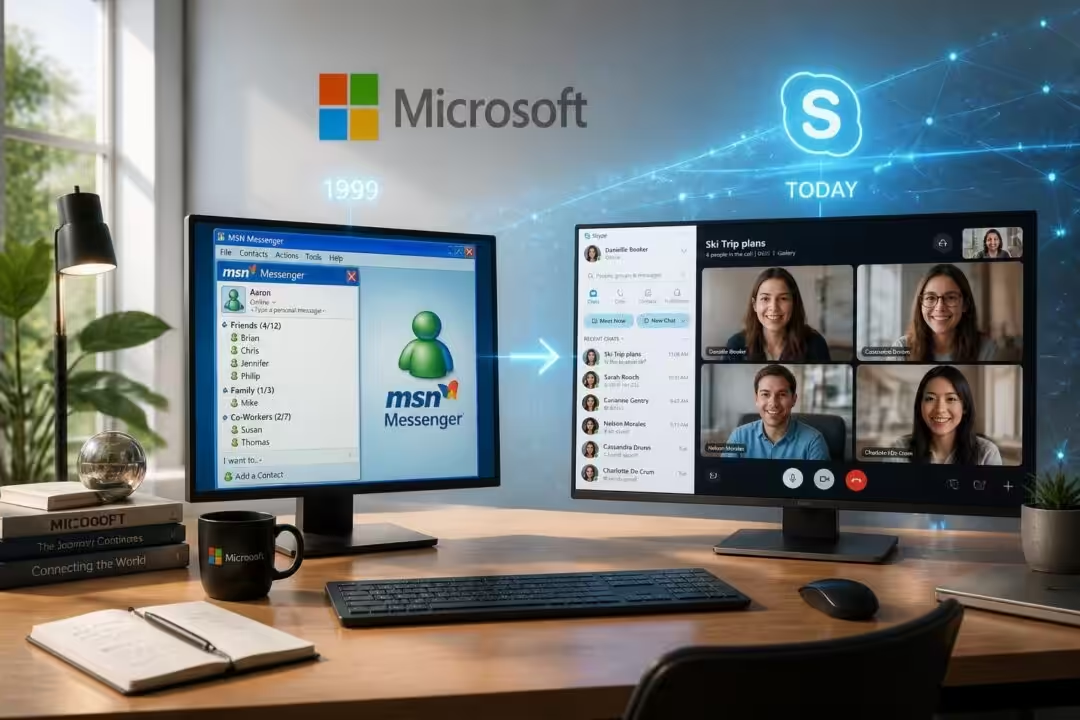
MSN Skype history and Microsoft acquisition explained
The history of Skype links early 2000s peer-to-peer ingenuity with later corporate consolidation. The app launched in 2003 from a small team of Estonian engineers and two serial entrepreneurs. Their design used peer nodes to route voice traffic, cutting costs versus traditional carriers.
Early adopters saw Skype as a cheap way to call overseas numbers. Creatives and small teams relied on it to stay in sync across time zones. For example, a fictional post-production shop called North Bay Studios used Skype in 2008 to route director calls, review edits, and send short files. That real-world use case captures what made Skype sticky.
Founding, funding, and early features
The core code came from four Estonian developers. The brand name combined “sky” and “peer-to-peer” before being shortened to Skype. Early releases included text chat, voice calls, and later video.
Growth followed rapidly. In 2005, eBay bought Skype for around $2.6 billion. That deal aimed to add direct communication between buyers and sellers. Market fit was partial, and eBay later sold most of Skype in 2009 to a group led by private equity and venture investors.
Skype’s user model used accounts and Skype IDs. Users could buy calling credit to reach landlines. Group calls, screen sharing, and a directory made cross-border work practical. These features shaped how teams and families communicated over the next decade.
Microsoft acquisition and the integration push
Microsoft purchased Skype for about $8.5 billion in 2011. The motive was clear: bring voice and video into Windows, Xbox, and Office workflows. Microsoft then began folding Skype into its consumer and enterprise products.
After the acquisition, the company replaced Windows Live Messenger with Skype in many markets. Microsoft also launched Skype versions for Windows 8 and later tied Skype chat into Office Online. The transition created mixed results for users, who saw features shift and UX rewritten several times.
Architecture changed too. Skype evolved from a hybrid peer-to-peer model to centralized Microsoft-managed servers. That switch altered latency profiles, data storage, and how the service scaled. It also moved the product away from a purely decentralized identity model.
For teams like North Bay Studios, the change was practical. Calls became more reliable, and file handling grew easier. For privacy-conscious users, the switch raised questions about data control and lawful intercepts. Those debates would grow louder after surveillance disclosures later in the decade.
By the mid-2010s, Skype had a broad footprint across platforms. It ran on desktop, mobile, gaming consoles, and some smart TVs. The presence was wide, but competition and shifting business priorities would reshape the product’s fate.
Key insight: Skype’s path shows how a technical lead and broad adoption do not guarantee a stable product roadmap once a large platform owner aims to consolidate services into a unified ecosystem.
MSN Messenger to Microsoft Teams: Skype integration and retirement timeline
Microsoft used acquisition as a lever to merge communication layers. That strategy moved multiple products toward a narrower portfolio. The company retired Windows Live Messenger in favor of Skype in 2013. Later, focus shifted again toward Microsoft Teams.
Skype for Business replaced Lync around 2015. That product combined enterprise features with Skype branding. Yet Teams launched with tighter Office 365 ties and more collaborative tools. The shift began to affect customer choices.
Consumer and enterprise migration chronology
Enterprises started moving as Teams added meeting and document workflows. By 2023, Teams grew rapidly inside companies. In public clouds, users could chat, call, schedule, and co-edit documents inside one window. That convergence made Teams a natural successor for organizations.
Microsoft announced the retirement of Skype for the consumer market on 5 May 2025. Users were told they could sign into Teams with their Skype credentials. The company also allowed data export for those who did not want to move immediately.
Originally, users had until January 2026 to export data. Then Microsoft extended that deadline to June 2026. That change eased migration timelines for individuals and small organizations that lacked engineering support.
Teams handled several migration scenarios. For small teams, migration meant downloading a free Teams client and linking contacts. For enterprises, IT admins used tenant-to-tenant migration tools and identity federation. The latter required planning for single sign-on and policy alignment.
Consider a mid-size publisher, North Bay Studios, again. The publisher kept Skype for global freelancers for years. When Teams arrived, the studio had to train contractors, move large content, and set new access policies. The team staged the migration over weeks. They kept a dial-pad web tool for recurring paid outbound calls. That approach reduced disruption.
Microsoft’s messaging stressed modernization. Teams centralizes chat, calls, and meetings but also introduces dependency on the Office ecosystem. For some users, that was an upgrade. For others, it meant losing lightweight, standalone features they had relied on in Skype.
Key insight: Migrations driven by platform strategy can lower long-term cost, but they raise short-term friction. Plan timelines, keep an export path, and test identity flows before switching users.
Technical evolution of Skype: P2P to Azure, codecs and security
Skype’s technical record reads like a case study in scaling and trade-offs. The product moved from peer-to-peer supernodes to centralized servers. That migration changed latency, reliability, and control. It also reshaped how developers could extend the platform.
Early Skype used a hybrid P2P model similar to file-sharing networks. That model helped traverse NATs and reduce operator costs. Later, Microsoft replaced supernodes with managed servers. By 2017, most services ran on Azure. Central servers simplified storage and feature rollout.
Codecs and media
On audio, Skype introduced the SILK codec and later contributed to the Opus standard. Opus combined voice and high-fidelity audio techniques. On video, Skype used VP7 early and later H.264 for HD streams. These choices affected bandwidth use and client compatibility.
A technical example: a remote music class using Skype in 2019 could blur backgrounds with software alone. That feature used AI-based image processing on client devices. The same client-side processing later influenced live effects in conference apps.
Security, surveillance, and encryption
Security evolved under public pressure. Early claims of “end-to-end” cryptography lacked public verification. That gap prompted criticism from privacy groups. After the 2013 surveillance disclosures, debates about lawful intercept and data access intensified.
Microsoft introduced server-side controls and later added opt-in end-to-end encryption in 2018. Still, the product’s architecture left metadata and some messages stored in the cloud. That storage made forensic access easier for law enforcement with valid orders.
| Year 📅 | Change 🔧 | Impact ⚡ |
|---|---|---|
| 2003 📌 | Peer-to-peer launch | Low cost, high decentralization ✅ |
| 2005 💰 | eBay acquisition | Commercialization, integration experiments 🔁 |
| 2011 🏢 | Microsoft purchase | Platform integration, UX rewrites 💼 |
| 2012–2017 ☁️ | Move to Microsoft servers and Azure | Centralized storage, faster rollouts, privacy questions 🔒 |
| 2018 🔐 | Optional end-to-end encryption | Improved confidentiality for some chats ✅ |
| 2025 🗃️ | Service retired, Teams successor | Data export paths and dial-pad web retained for paid calls 📤 |
The timeline shows trade-offs. Centralization increased control and release speed. It also made data retention policies necessary. For engineering teams, those policies require audit trails and compliance checks.
Network teams faced choices too. Skype originally relied on IPv4. IPv6 support remained weak for a long time. That forced carriers and enterprises to add translation layers or to plan dual-stack deployments.
From a product lens, codecs and protocol choices shaped user experience. Lower latency codecs improve voice clarity. High-efficiency video codecs cut bandwidth for HD calls. Decisions on codecs then influenced compatibility with third-party devices.
Key insight: Moving from decentralized nodes to centralized cloud systems trades lower operating cost for greater control and a heavier compliance burden. Plan for that trade-off early.
User trends, competition and the decline of Skype explained
Traffic patterns reveal how fast user habits can shift. In early 2010s, Skype logged hundreds of billions of call minutes each quarter. The service peaked around large concurrent online counts during mobile adoption.
During the 2020 pandemic, Skype saw a usage spike. Monthly and daily active users climbed as remote work surged. However, other products moved faster to meet enterprise needs. That gap cost Skype market share.
Competition and market dynamics
Zoom focused on ease of joining and scaling meetings. Teams emphasized integrated collaboration inside Office. Mobile-first messaging apps like WhatsApp captured casual video calls. These rivals addressed use cases that Skype did not prioritize strongly enough.
By 2023, daily Skype users had fallen to about 36 million. Teams reached roughly 300 million active users in mid-2023. Those numbers show where organizations chose to centralize communications.
For individual users, switching costs rose when contacts and businesses moved platforms. A freelancer who matched clients on Teams or Zoom found little reason to keep Skype. That network effect accelerated decline.
Lessons from user data
- 🔁 Network effects matter: Users follow where contacts cluster.
- 📱 Mobile UX wins: Apps that minimized friction on phones grew faster.
- 🏢 Enterprise alignment: Deep Office integration pulled corporate budgets to Teams.
- 🔒 Privacy clarity: Transparent encryption policies influence trust.
- 🧭 Migration tools: Clear export paths reduce churn when platforms retire.
North Bay Studios once used Skype for client calls. When most clients moved to Teams, the studio adopted a hybrid approach. They kept a dial-pad for legacy paid calls. They also trained staff on Teams’ meeting and document flows. That shift shows how operational habits change with client demands.
Microsoft’s official retirement of Skype on 5 May 2025 marked the end of a long transition. The company left a path for paid call credit via a dial-pad web application. For many users, the final step was exporting chat history and contacts.
Key insight: Even large-scale products can fade if rivals capture the dominant workflows. Your users stay only as long as their contacts and tools match their daily needs.
Product lessons: migration playbook for communication apps and teams
Teams, engineers, and founders must plan migrations with care. Messaging and calling products tie into identity, billing, and compliance. That entanglement raises risk during transitions.
Design a migration playbook that covers access, data, and user support. Use the story of North Bay Studios as a template. They staged a move from Skype to Teams in three phases: audit, pilot, and rollout. Each phase had specific checkpoints.
Checklist for a safe migration
- 🔍 Audit identities and contacts. Map accounts and aliases to real users.
- 📦 Snapshot data retention. Catalog what must be exported and for how long.
- 🧪 Run a pilot with power users. Test SSO, calendar links, and meeting joins.
- 📣 Communicate timelines. Give users clear export windows and help links.
- 🛠️ Provide fallback tools. Keep a dial-pad or gateway for critical paid calls.
- 📊 Monitor adoption. Track daily active users and error rates post-migration.
For engineering teams, the technical tasks matter. Ensure TLS across endpoints and key rotation. Confirm compliance logging meets audit standards. Prepare role-based access control so admins can restrict external meetings. These actions lower operational risk.
On the product side, minimize friction. Offer contact importers and one-click calendar invites. Build a short, searchable FAQ for common issues. Offer live chat help during the first two weeks after migration. These steps reduce support tickets.
For executives, weigh consolidation benefits against user disruption. Consolidation reduces vendor sprawl. But it can alienate users who value lightweight tools. Use metrics to decide: track retention, session length, and meeting success rates.
Finally, treat data export as a first-class feature. Keep export windows reasonable. Offer documented APIs so power users can automate data retrieval. That approach builds trust and reduces churn during platform sunsetting.
Key insight: A clear migration playbook balances technical checks, user training, and legal safeguards. Treat export paths and fallbacks as core product features rather than afterthoughts.

I’m a Brooklyn tech journalist who spent a decade covering software, cloud and developer tooling. I started this magazine in 2023 to cover generative AI without the hype or the cynicism: testing tools on my own subscriptions and citing primary sources.