
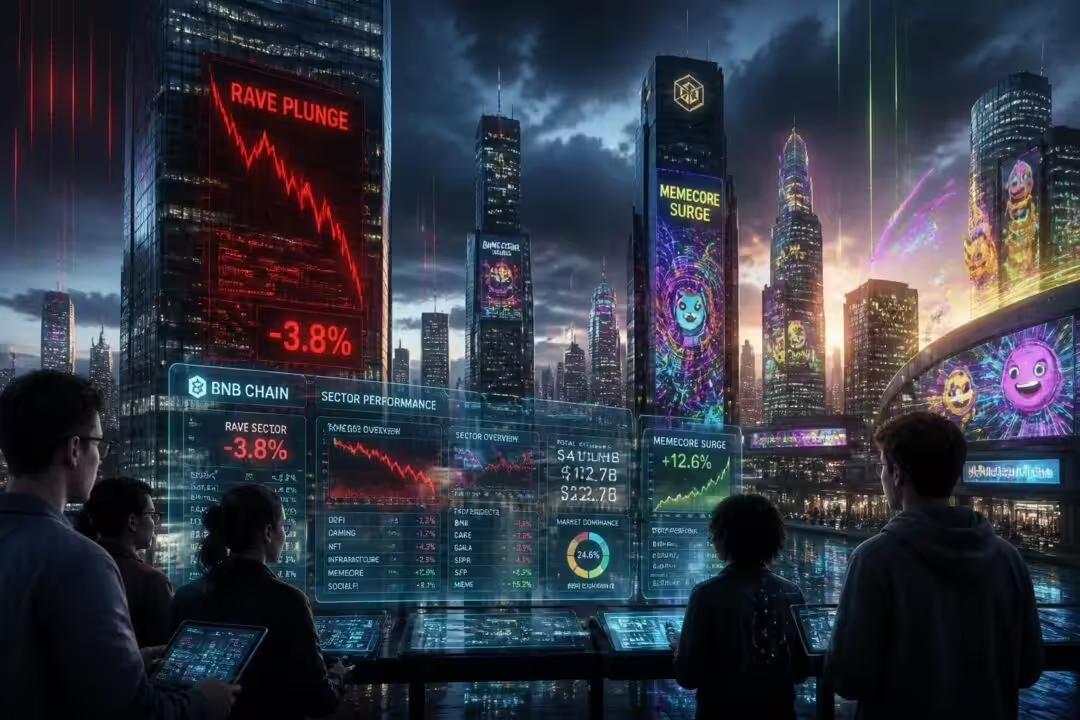
BNB Chain’s token basket slid 3.8% in the latest read, even as a few names ripped higher and soaked up attention. RaveDAO (RAVE) cratered about 90% in a day, wiping roughly $5.7B from its market cap, while MemeCore (M) jumped ~49% on fresh meme-rotation flows 📉📈. The net effect: a sector that looks “down” on paper, but still shows pockets of aggressive risk-taking.
BNB Chain sector market update: why a 3.8% drop still hid a risk-on tape
Macro mood helped set the backdrop. Bitcoin reclaimed ~$78K and the Crypto Fear & Greed Index rose back to “Greed” (~63) for the first time in about six months 🔥.
If you’re shipping products around trading, listings, or on-chain analytics, this kind of split tape matters. Broad sentiment can flip positive while single-token blowups still detonate portfolios, and BNB Chain delivered both in the same week.
Price and flow snapshot: BNB up weekly while the wider basket slipped
BNB gained about 4.2% week-over-week and traded near $644, staying in an uptrend across the one-, three-, and six-month windows ✅. That strength didn’t prevent a sector-level pullback, since baskets get dragged by outsized losers.
A simple mental model: one large-cap implosion can outweigh a dozen mid-cap pumps. That’s the practical takeaway for anyone building indexing logic, portfolio rebalancers, or “top movers” feeds.
| 📌 Metric | What happened | Why it mattered |
|---|---|---|
| 📉 Sector move | -3.8% (latest update) | Sector weakness masked a still-speculative micro tape |
| 💥 RAVE move | ~ -90% in a day; ~$5.7B market cap erased | Single-name shock dominated basket math and social chatter |
| 🟢 BNB move | ~ +4.2% WoW, near $644 | Chain “blue chip” held up despite ecosystem volatility |
| 😈 Sentiment | Fear & Greed ~63 (Greed) | Risk appetite returned fast after deep lows earlier in the year |
| 🏦 RWA value | > $3.5B on BNB Chain | Infrastructure stayed sticky while tokens swung hard |
Next up is where the gains actually landed, because that’s what determines what users click, trade, and copy.
RAVE plunge on BNB Chain: what the selloff says about token risk in 2026
RaveDAO’s token (RAVE) fell roughly 91% week-over-week, and the conversation quickly shifted from price to accountability ⚠️. The team published a multi-part thread denying involvement in the move, saying it was “not engaged in, nor responsible for, recent price action”.
The detail product teams should zoom in on: the thread also confirmed plans to liquidate unlocked tokens to fund operations. That statement can be rational for runway, but it also re-prices supply risk in real time, especially when on-chain observers already suspect concentrated wallets.
How a token-unlock narrative turns into a liquidity event
Here’s the pattern that tends to repeat: traders see talk of unlocked tokens, spreads widen, and liquidity thins. Then forced selling (or panic selling) hits a thinner book, so price gaps down instead of sliding.
For a concrete case study, picture a small US-based trading desk running automated strategies on BNB Chain. If its risk engine keys off 1-minute volatility, RAVE’s cascade can trigger auto-deleveraging that sells into the drop, amplifying the move. The insight: mechanical risk controls can turn “information” into “price action”.
What to watch next if you’re building around BNB Chain markets
- 🧾 Token unlock schedules and how teams communicate sales to fund ops
- 🧠 Wallet concentration signals (clusters, exchange deposits, and linked entities)
- 💧 Liquidity depth across top pools and CEX order books before and after headlines
- 🧯 Forced selling triggers from copytrading, leverage, and liquidation engines
If the same wallet clusters keep showing up near large red candles, the market will price that risk faster next time.
MemeCore surge and BNB Chain gainers: memes and AI tokens took the oxygen
While RAVE pulled the sector lower, several names printed outsized green candles. MemeCore (M) rose ~49.3% as meme liquidity rotated into a new ticker 🚀.
Other movers had more idiosyncratic stories. Pieverse (PIEVERSE) ran ~148.2% to fresh highs with no clear public catalyst, the kind of move that often shows up when a thin float meets aggressive momentum trading.
Top movers and plausible catalysts (what traders actually acted on)
- 😂 MemeCore (M): +49.3% — meme rotation brought new flows
- 🔗 Sky (SKY): +15.5% — steady grind tied to ecosystem integrations
- 📈 Pieverse (PIEVERSE): +148.2% — unclear catalyst; momentum pushed an all-time high
- 🐳 Aster (ASTER): +4.9% — copytraders followed a whale’s 5x leveraged long
That last point is a reminder: on-chain “social trading” has made whale positioning a first-class market signal. If you’re building alerts, treat leverage disclosures like breaking news.
Trending list skew: AI tokens ran alongside memes
Beyond the headline names, the trending list leaned hard into AI-branded tokens plus meme tickers. Examples from the same window: Highstreet (HIGH) +141.2%, Solidus Ai Tech (AITECH) +106.0%, and ETHGas (GWEI) +58.8% 📊.
The interesting question for 2026: are traders betting on “AI utility,” or on the label? In practice, short-term flows often follow the label, while real product traction shows up later in retention, fees, and developer activity.
BNB Chain infrastructure and RWA: steady plumbing under a volatile token tape
Under the market noise, BNB Chain’s real-world asset (RWA) value stayed above $3.5B 🏦. That matters because RWAs tend to be stickier than meme liquidity; they move slower, but they can stabilize usage metrics.
The chain also hosted a Hong Kong RWA Demo Day (April 19–21) with AWS, including a technical session centered on AI-powered DeFi tooling. For teams building compliance-aware DeFi apps, that pairing is the signal: cloud partnerships plus RWAs usually mean more emphasis on auditability, monitoring, and uptime.
Osaka/Mendel hard fork: the operational deadline node operators can’t ignore
The upcoming Osaka/Mendel hard fork includes a clear ops requirement: node operators need to upgrade by April 28 🛠️. If you run infra or depend on third-party RPCs, treat this like a change-management event, not a footnote.
A practical way to handle it is to stage upgrades early in a canary environment, then monitor block propagation, reorg rates, and RPC error budgets. The final insight: most user-facing outages during forks come from dependency chains, not from the core client itself.
Governance drama on BNB Chain: WLFI lock proposal, token burns, and why communities push back
Another thread that grabbed attention: World Liberty Financial (WLFI) posted a governance proposal to lock 45.2B team, advisor, and partner tokens under a two-year cliff, followed by a three-year linear vest 🧾. Opting in would also trigger a mandatory 10% burn, implying about 4.5B WLFI permanently destroyed.
Even with those mechanics, community response leaned negative. The reason is familiar: holders often see late-stage lock fixes as “damage control,” especially after volatility elsewhere. The closing thought: good token design is judged less by the PDF and more by timing, trust, and on-chain behavior.

I’m a Brooklyn tech journalist who spent a decade covering software, cloud and developer tooling. I started this magazine in 2023 to cover generative AI without the hype or the cynicism: testing tools on my own subscriptions and citing primary sources.