

Innovation
Audio Joi: how this innovative platform is revolutionizing music collaboration in 2025
Audio Joi and AI Co-Creation: Redefining Music Collaboration in 2025
Audio Joi places collaborative music creation at the center of its design, combining AI composition, secure versioning, and frictionless sharing to turn scattered ideas into release-ready tracks. The platform treats collaboration as a first-class object: every project contains roles, access scopes, and auditable histories so contributors—from producers and topliners to mix engineers—can work in parallel without stepping on each other’s edits. This isn’t another isolated app; it is an online music platform built to orchestrate real work across studios, bedrooms, and tour buses.
At its core, Audio Joi runs on a graph of takes, stems, and arrangement states mapped to digital audio events. That means latency-resilient collaboration is not a bolted-on feature; it’s how the engine thinks. A vocalist can record harmonies while a beatmaker reshapes drums, and both receive synchronized snapshots. Conflict resolution borrows from modern software development: branches, diffs, and smart merges that preserve the best performance while surfacing what changed and why.
AI support behaves like a pragmatic co-producer rather than a ghostwriter. Melody suggestions appear as non-destructive layers. Lyric drafts arrive with rhyme density, syllable counts, and emotional valence explained for quick edits. Sound design recommendations come with provenance tags that show which reference palettes informed the choices. The result is music innovation that keeps creators in command.
Real-time co-production that respects intent
Real-time isn’t just about low latency; it’s about predictable intent. Audio Joi uses intent locks for critical edits so a mastering engineer can freeze loudness targets while others keep arranging. A session can flip into “Proposal Mode,” where contributors propose changes that the project owner batch-accepts, speeding group decision-making while keeping a single source of truth.
Imagine a cross-continental team polishing a pop single overnight. The bassist records DI at home, the producer nudges swing on hi-hats, and a topliner tests two bridges. Audio Joi threads those moves into a digestible change log, complete with AI-suggested A/B comparisons so the team hears differences instantly before committing.
Security, rights, and clarity by default
Collaboration fails when ownership feels vague. The platform bakes in creator IDs, track-level contributions, and share splits set at the stem or region level. Smart policies prevent accidental oversharing and watermark previews to deter leaks. When it’s time to export, Audio Joi packages stems with contributor attributions and declared licenses, minimizing back-and-forth at the final mile.
- 🔒 Granular permissions: per-stem, per-take, per-bus access control
- 🧠 Explainable AI: why a chord change or EQ move was suggested
- 🧩 DAW-friendly: AAF/ADM/MIDI 2.0 exports for hybrid workflows
- 📈 Session analytics: who contributed what, and when, for better split decisions
- 🎯 Context-aware prompts: AI reads tempo maps, key centers, and arrangement markers
| Role 👤 | Audio Joi Assist 🤖 | Outcome 🎵 |
|---|---|---|
| Producer | Groove Variants and drum humanization with safe A/B lanes | Tighter feel without overwriting original intent ✅ |
| Topliner | Lyric Explorer with rhyme, meter, and emotion sliders | Hook options aligned with theme and vocal range 🎤 |
| Mix Engineer | Reference Match to target spectral curves and dynamics | Competitive polish in minutes, editable by hand 🛠️ |
| Composer | Chord Voicing AI with voice-leading constraints | Richer harmony that still fits the melody 🎼 |
By aligning AI support with human roles, the platform turns collaboration from a bottleneck into a multiplier.
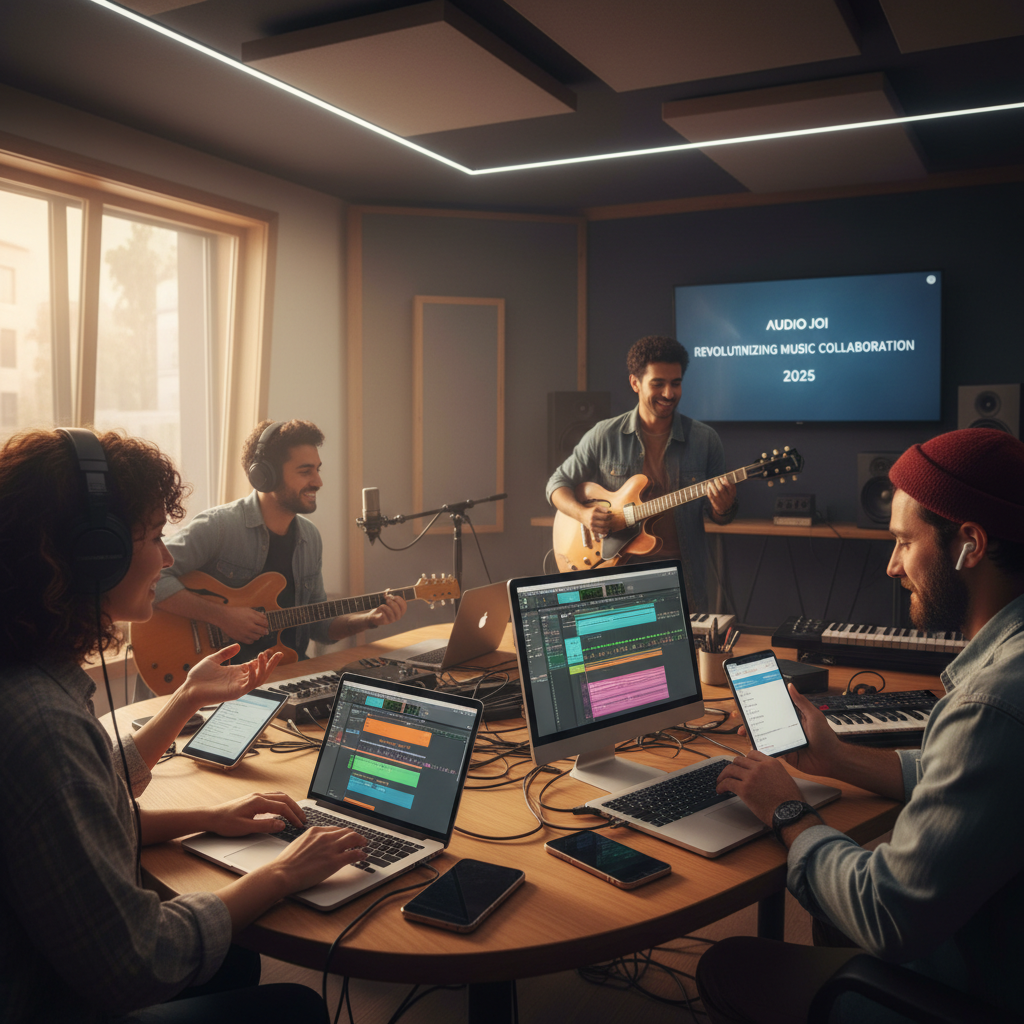
Workflows at Scale: From Spark to Release on an Innovative Platform
Audio Joi isn’t a monolith; it’s a modular pipeline. Teams move from ideation to delivery through linked stages: prompt-to-prototype, arrange-to-perform, revise-to-release. Each stage can be automated or handcrafted. If a singer wants to replace a synthetic demo vocal with a live take, the system preserves the phrasing map so timing edits and harmonies still line up.
A case from an indie collective illustrates the tempo. Atlas Lab, a five-person outfit based across Nairobi, Lisbon, and Seoul, used the platform to turn a text brief—“moody drum & bass with neo-soul chords and reflective lyrics”—into a charting single. The AI proposed three harmonic beds, the group chose one, and vocals were iterated with emotion-aware comping that highlighted micro-dynamics worth keeping. The final mix matched a set of references without over-compressing the vocal. The entire cycle took 36 hours.
Pipeline designed for creative speed
Each step is instrumented for clarity. Lyric drafts include reading-age and theme coverage metrics. Arrangement assists show tension arcs with suggested contrast points. Mastering recommendations cite the reference curve and loudness range, with a toggle to maintain headroom for vinyl or club play.
Developers and power users extend the workflow with an SDK and automation hooks. Trigger a bounce when reviewers approve a version, or generate alternate-language lyric sheets for global releases. For teams building companion tools, the new apps SDK reference shows how conversational agents can nudge sessions forward—without breaking creative flow.
- ⚡ Prototype in minutes: text prompt ➝ stems ➝ structured session
- 🧭 Arrangement compass: intensity graphs and fill suggestions
- 🧪 A/B lanes: safe experiments for drops, bridges, and codas
- 🌐 Localization: phoneme-aware lyric translation with rhyme preservation
- 📦 One-click delivery: distributor-ready packages with splits and credits
| Stage 🚀 | What Audio Joi Adds 🧩 | Typical Time ⏱️ |
|---|---|---|
| Ideation | Prompt Composer with style moodboards | 5–15 minutes |
| Arrangement | Form Assistant and motif continuity checks | 1–2 hours |
| Vocal Production | Emotion-aware comping and harmony scaffolds | 1–3 hours |
| Mix & Master | Reference Match, loudness, and translation tests | 30–90 minutes |
For creators who learn visually, watching side-by-side takes and A/B sequences in context accelerates trust.
With transparent reasoning at every step, the platform becomes a coach and a co-pilot, not a black box.
Legal, Ethical, and Economic Guardrails for Collaborative Music Creation
As AI reshapes production, trust hinges on clear consent, provenance, and compensation. Audio Joi addresses the hardest parts of collaboration head-on. A built-in consent manager tracks voice likeness permissions, stem licenses, and model usage. If a session loads a vocal timbre model, the system verifies consent and displays usage scope. No approval, no render.
Provenance travels with every asset. Stems carry cryptographic fingerprints linking to the project log: who recorded, who edited, which model suggested what, and where training references came from. When teams export, these fingerprints anchor downstream claims—a practical answer to questions about originality and authorship.
Copyright clarity when it matters most
The platform’s rights module supports hybrid authorship, reflecting how modern songs are made. If an AI suggested a chord progression but a composer reharmonized it, the split engine quantifies human dominance to guard eligibility for protection where human contribution is required. For label deals, a policy template reduces redlines by aligning attributions and royalty routes upfront.
Industry agreements in late 2025 signaled a maturing stance on AI in music, where collaboration frameworks and consent take center stage. That momentum validates Audio Joi’s approach: empower creators with visibility and choices before the first bounce, not after a takedown.
- 🧾 Consent-first voice models with revocation support
- 🔗 Provenance trails for every clip, edit, and render
- ⚖️ Policy templates for splits, licenses, and downstream sync
- 🪪 Attribution automation that writes the credits for you
- 🧭 Risk dashboards highlighting potential conflicts before release
| Risk ⚠️ | Guardrail 🛡️ | Creator Benefit 💡 |
|---|---|---|
| Unauthorized voice cloning | Consent verification + watermarking | Protects identity and brand trust ✅ |
| Ambiguous authorship | Contribution ledger with edit diffs | Fair splits and clear credits 🧮 |
| Training data disputes | Model disclosure and opt-out tracking | Transparency for licensors 🔍 |
| Sync clearance delays | License presets and export packages | Faster approvals and fewer legal loops ⏩ |
For teams exploring immersive concerts or tokenized royalties, market developments help contextualize choices. Current XR and VR news signals rapid growth in virtual stages, and blockchain-native payouts are gaining traction, especially for micro-royalties across short-form content.

Connected Ecosystem: Audio Sharing, Social Discovery, and XR Shows
Collaboration doesn’t end when the mix prints. Audio Joi treats distribution as an extension of creation, pushing tracks into communities where feedback loops are fast and respectful. The platform’s audio sharing surface supports private circles, invite-only critique rooms, and open showcases. Comments are time-coded, and reviewers can attach alternative mix snapshots for side-by-side listening.
Discovery flows reflect how modern audiences browse. Short-form clips auto-generate from stems, so creators post performance-ready bits without extra editing. To enrich promo, many teams pair their songs with lightweight visuals or AI-assisted vignettes using resources like the curated rundown of top AI video generators in 2025. Visual velocity plus musical quality drives traction.
From group sessions to global stages
Audio Joi’s group rooms let collaborators brainstorm in real time, route stems, and vote on takes. Structured conversation matters here; facilitation techniques borrowed from product sprints help sessions finish decisions, not just start debates. For teams practicing remote facilitation, a practical group chat guide offers framing that transfers neatly to creative rooms.
Audience experiences are evolving as well. XR showcases use spatial audio bounces and crowd-reactive stems to build intimacy in virtual venues. Artists planning immersive releases track platform updates through ongoing XR and VR news, then export show-ready assets from Audio Joi with positional metadata. The result: a set that feels live, even when everyone is remote.
- 📣 Showcase hubs: release teasers and gather track-by-track feedback
- 🪄 Auto-clips: stem-aware shorts for socials in seconds
- 🧑🤝🧑 Group rooms: voting, take-starring, and timeboxed decisions
- 🌐 XR-ready stems: spatial exports for virtual stages
- 🧰 Promo kits: credits, splits, and press notes bundled
| Channel 📡 | What Works Best 🎛️ | Audio Joi Assist 🤖 |
|---|---|---|
| Short-form socials | Hooks, drops, and behind-the-scenes clips | Auto-clipping with beat-safe cuts 🎬 |
| Fan communities | Early demos and remix contests | Rights-safe share links 🔗 |
| XR concerts | Spatial stems and reactive loops | Spatial bounce presets 🌌 |
| Sync libraries | Instrumental edits and alt-mixes | Delivery packs with cue sheets 📦 |
Teams sometimes assemble reference reels to guide art direction. When assets are properly licensed, utilities that help download YouTube videos can accelerate moodboard creation; Audio Joi’s rights panel flags what can and cannot be used to keep workflows compliant.
With sharing built in and compliance surfaced early, creators move confidently from studio to stage.
Future of Music Technology: Benchmarks, Interop, and Personalization on Audio Joi
The industry’s arc points to smarter tools that still leave room for human surprise. By mid-year, analysts noted that over 30% of new tracks on major platforms had AI in the production chain—co-writing lyrics, shaping arrangements, or handling reference-matched mastering. Audio Joi leans into that reality with measurable performance, not hype: lower time-to-first-draft, fewer revision loops, and higher listener retention on hooks.
Interoperability matters. The platform speaks MIDI 2.0, AAF, ADM, and common stem formats so creators can move between favorite DAWs and cloud sessions. AI companions understand tempo maps and key changes, but they respect manual overrides. If a chorus intentionally pushes beyond key for effect, the assistant explains its recommendation and steps back.
Personalization without spam
Personalization should amplify artistry, not flatten it. Audio Joi’s audience tools create micro-variations—radio edit, club mix, acoustic take—while keeping the song’s identity intact. The recommendation engine suggests versions based on listener contexts like workout, commute, or focus, sending the right cut to the right ear without fragmenting the brand.
Creators also want seamless visual pipelines. For teasers and lyric videos, production teams scan an evolving landscape via reviews including the guide to AI video generators in 2025. Audio Joi embeds beat markers and lyric timing files that visual tools can import directly, compressing the path from session to video.
- 🔌 Open standards: reliable imports/exports for hybrid projects
- 📉 Measurable gains: time-to-draft and revision counts tracked
- 🎧 Contextual cuts: versions tailored to listener moments
- 🧭 Human-in-the-loop: explainable choices and easy overrides
- 🧱 Model safety: transparent training policies and opt-outs
| Benchmark 🎯 | Typical Baseline ⏳ | With Audio Joi ⚡ |
|---|---|---|
| First usable demo | 1–2 days | 30–60 minutes 🚀 |
| Revision cycles to approval | 5–7 passes | 2–3 passes thanks to A/B lanes 🔁 |
| Credit & split prep | Half a day | Under 15 minutes with auto-attribution 🧮 |
| Promo asset generation | Several hours | Minutes with beat-aware auto-clips 🎬 |
Education and onboarding remain vital. Teams rolling out collaborative studios often pair Audio Joi rooms with conversational assistants configured via the apps SDK, while moderators adopt patterns from this practical group chat guide to keep sessions productive.
As tools grow sharper, the winners will be the teams that combine discipline with play—measuring what matters while leaving space for happy accidents.
Case Files: How Audio Joi Unlocks Music Collaboration for Different Teams
Different creators ask different things of their tools. A film composer wants tempo-locked stems and cue sheets. A rapper wants beat flips and instant ad-libs. A brand wants safe, royalty-clear music at scale. Audio Joi adapts patterns to each use case without forcing anyone into a single workflow.
Consider a boutique game studio building adaptive scores. With the platform’s motif continuity checks and loop-safe exports, their composer shipped layered stems that react to gameplay. Testers reported higher immersion, while the composer shaved days off integration. For teams running virtual showcases, spatial bounces mapped perfectly to the venue’s renderer, removing last-minute conversions.
Indie labels, content teams, and educators
Indie labels appreciate delivery packs that include lyrics, instrumentals, clean edits, and credits. Content teams lean on auto-clips and safe licensing presets for rapid campaigns. Educators use explainable AI sidebars to teach harmony, arrangement, and mixing decisions, illustrating not only what to try but why it works.
When creators plan immersive launches, they scan XR/VR updates and coordinate visuals with music. If a project needs footage for moodboards, teams ensure rights compliance and, where allowed, use utilities that can download YouTube videos as reference material—always tracked in the platform’s rights panel.
- 🎮 Games: adaptive stems, loop-safe exports, motif tools
- 🎬 Film/TV: cue sheets, reference match, dialogue-safe mixes
- 📱 Creators: auto-clips, safe sharing, remixable stems
- 🏷️ Brands: licensing presets, rapid alternate mixes
- 🏫 Education: explainable harmony and form assistants
| Team Type 🧑💼 | Key Need 🎯 | Audio Joi Feature ⭐ |
|---|---|---|
| Indie label | Fast delivery with clean credits | One-click packs + split automation 📦 |
| Game studio | Adaptive, loopable music | Motif continuity and loop-safe bounces ♾️ |
| Content team | Shorts for multiple platforms | Auto-clipping with beat detection 🎥 |
| Educator | Transparent reasoning | Explainable AI sidebars 📚 |
For teams pairing music with visuals, guidance such as this digest of top AI video generators closes the loop, ensuring content ships on time and on brand.
From garage bands to global labels, the throughline is the same: fewer blockers, tighter feedback loops, and more moments that sound unmistakably human.
How does Audio Joi keep collaborators aligned without slowing them down?
The platform uses intent locks, proposal mode, and a contribution ledger. Edits become proposals that owners can accept in batches, while the ledger tracks who changed what and when. This keeps momentum high and credits clear.
Can Audio Joi handle XR concerts and spatial audio?
Yes. Sessions export spatially tagged stems with positional metadata. These bounces drop into common XR render pipelines, enabling crowd-reactive arrangements and immersive shows.
What safeguards exist around AI vocals and likeness?
Consent is verified before rendering any likeness models. Usage scopes are enforced, previews are watermarked, and a provenance trail records decisions. Revocation is supported to respect artist control.
Will Audio Joi replace a traditional DAW?
It complements, not replaces. Interop with MIDI 2.0, AAF, ADM, and stems ensures creators can move between favorite DAWs and cloud sessions. Core editing remains flexible and human-directed.
How does the platform improve release-readiness?
Reference-matched mastering, automated credits and splits, and distributor-ready delivery packs reduce last-mile friction. Teams reach approval in fewer revision cycles with consistent quality.

Max doesn’t just talk AI—he builds with it every day. His writing is calm, structured, and deeply strategic, focusing on how LLMs like GPT-5 are transforming product workflows, decision-making, and the future of work.



Your card doesn’t support this type of purchase: what it means and how to solve it
Understanding the “Unsupported Type of Purchase” Error Mechanism When the digital register slams shut with the message “Your card does...


Understanding dominated antonyms: definitions and practical examples
Ever found yourself stuck in a conversation or a piece of writing, desperately searching for the flip side of control?...


claude internal server error: common causes and how to fix them in 2025
Decoding the Claude Internal Server Error in 2025 You hit enter, expecting a clean code refactor or a complex data...


Choosing Your AI Chat Companion in 2025: OpenAI’s ChatGPT vs. Google’s Gemini Advanced
Navigating the AI Chat Companion Landscape of 2025 The artificial intelligence landscape has shifted dramatically by mid-2025, moving beyond simple...


2025 Showdown: A Comparative Analysis of OpenAI and Cohere AI – The Top Conversational AIs for Businesses
The artificial intelligence landscape in 2025 is defined by a colossal struggle for dominance between specialized efficiency and generalized power....


Choosing Your AI Research Companion in 2025: OpenAI vs. Phind
The New Era of Intelligence: OpenAI’s Pivot vs. Phind’s Precision The landscape of artificial intelligence underwent a seismic shift in...


OpenAI vs Tsinghua: Choosing Between ChatGPT and ChatGLM for Your AI Needs in 2025
Navigating the AI Heavyweights: OpenAI vs. Tsinghua in the 2025 Landscape The battle for dominance in artificial intelligence 2025 has...


OpenAI vs PrivateGPT: Which AI Solution Will Best Suit Your Needs in 2025?
Navigating the 2025 Landscape of Secure AI Solutions The digital ecosystem has evolved dramatically over the last few years, making...


ChatGPT Faces Extensive Outages, Driving Users to Social Media for Support and Solutions
ChatGPT Outages Timeline and the Social Media Surge for User Support When ChatGPT went dark during a critical midweek morning,...


Discover 1000 innovative ideas to inspire your next project
Discover 1000 innovative ideas to inspire your next project: high-yield brainstorming and selection frameworks When ambitious teams search for inspiration,...


Top Free AI Video Generators to Explore in 2025
Best Free AI Video Generators 2025: What “Free” Really Means for Creators Whenever “free” appears in the world of AI...

OpenAI vs Jasper AI: Which AI Tool Will Elevate Your Content in 2025?
OpenAI vs Jasper AI for Modern Content Creation in 2025: Capabilities and Core Differences OpenAI and Jasper AI dominate discussions...


Exploring the Future: What You Need to Know About Internet-Enabled ChatGPT in 2025
Real-Time Intelligence: How Internet-Enabled ChatGPT Rewrites Search and Research in 2025 The shift from static models to Internet-Enabled assistants has...


All You Need to Know About ChatGPT’s December Launch of Its New ‘Erotica’ Feature
Everything New in ChatGPT’s December Launch: What the ‘Erotica’ Feature Might Actually Include The December Launch of ChatGPT’s new Erotica...


How i somehow got stronger by farming redefines the isekai genre in 2025
How “I’ve Somehow Gotten Stronger When I Improved My Farm-Related Skills” turns agronomy into power and redefines isekai in 2025...


Discovering moronga: origins, preparation, and why you should try it in 2025
Discovering Moronga Origins and Cultural Heritage: From Pre-Columbian Practices to Modern Tables The story of moronga reaches back to practices...


Jensen Huang collaborates with China’s Xinhua: what this partnership means for global tech in 2025
Xinhua–NVIDIA collaboration: how Jensen Huang’s outreach reframes the global tech narrative in 2025 The most striking signal in China’s tech...


Free for all fight nyt: strategies to master the ultimate battle
Decoding the NYT “Free-for-all fight” clue: from MELEE to mastery The New York Times Mini featured the clue “Free-for-all fight”...


Psychologists Raise Alarms Over ChatGPT-5’s Potentially Harmful Guidance for Individuals with Mental Health Issues
Psychologists Raise Alarms Over ChatGPT-5’s Potentially Harmful Guidance for Individuals with Mental Health Issues Leading psychologists across the UK and...

Audio Joi: how this innovative platform is revolutionizing music collaboration in 2025
Audio Joi and AI Co-Creation: Redefining Music Collaboration in 2025 Audio Joi places collaborative music creation at the center of...
-

 Open Ai1 month ago
Unlocking the Power of ChatGPT Plugins: Enhance Your Experience in 2025
-
 Open Ai1 month ago
Comparing OpenAI’s ChatGPT, Anthropic’s Claude, and Google’s Bard: Which Generative AI Tool Will Reign Supreme in 2025?
-

 Ai models1 month ago
GPT-4 Models: How Artificial Intelligence is Transforming 2025
-

 Open Ai1 month ago
Mastering GPT Fine-Tuning: A Guide to Effectively Customizing Your Models in 2025
-

 Open Ai1 month ago
ChatGPT Pricing in 2025: Everything You Need to Know About Rates and Subscriptions
-

 Ai models1 month ago
The Ultimate Unfiltered AI Chatbot: Unveiling the Essential Tool of 2025
Liora Verner
1 December 2025 at 16h39
Really impressive how Audio Joi blends tech innovation with real user needs. Excited to see this changing music collaboration!
Céline Moreau
1 December 2025 at 16h39
Really inspiring to see how Audio Joi makes teamwork in music so smooth. Love the focus on collaboration!
Solène Verchère
1 December 2025 at 19h49
Love how Audio Joi blends creativity and tech—makes collaboration feel both human and effortless. So inspiring!
Bianca Dufresne
1 December 2025 at 23h07
Max, love how Audio Joi links creative minds across borders! Inspiring to see music co-creation made truly seamless.
Élodie Volant
1 December 2025 at 23h07
Love how Audio Joi makes remote creation feel like sharing moodboards—fresh and inspiring for collaborative music!
Éléonore Debrouillé
1 December 2025 at 23h07
Love how Audio Joi blends creativity and tech! Wish my past collabs had these smart tools…
Zira Wendallis
2 December 2025 at 9h08
Super innovant ce Audio Joi, on sent que ça va changer la façon de bosser la musique !