
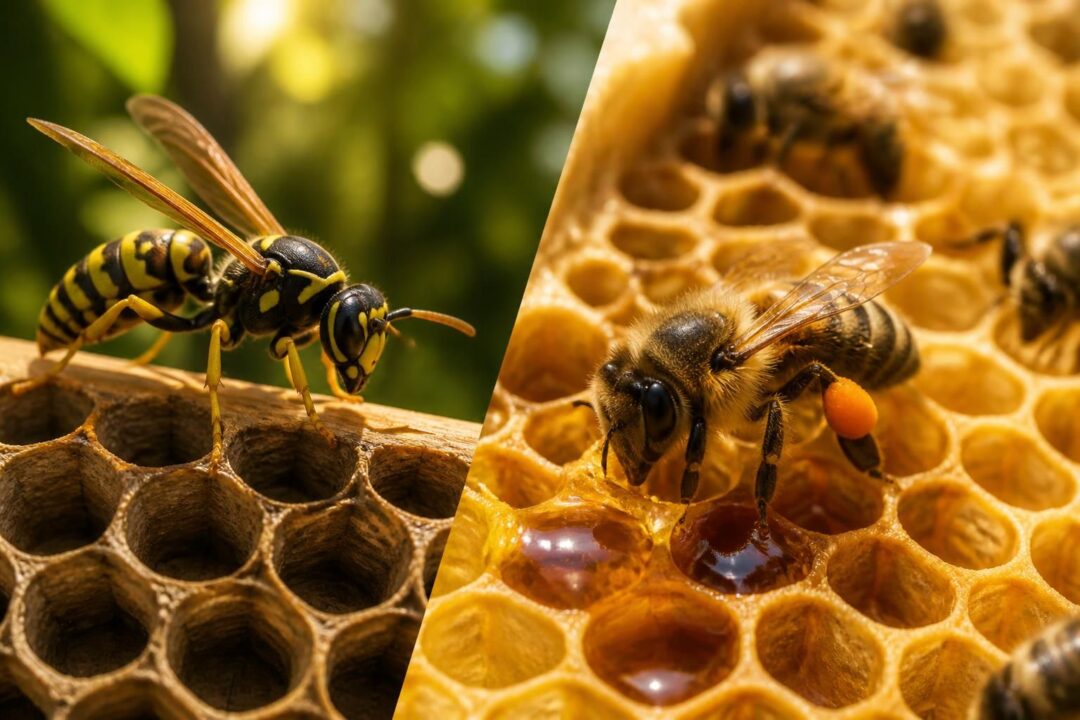
Wasp Honey vs Bee Honey: The Mistake People Keep Making 🐝🟡
Spot a yellowjacket on a flower and the brain fills in the rest: stripes, buzzing, nectar, honey. That shortcut is understandable, and it’s wrong in almost every backyard case in the United States. A honeybee colony is basically a long-running storage business built around converting nectar into a shelf-stable fuel. A typical social wasp colony is more like a seasonal strike team that burns resources fast, then disappears.
The confusion starts with visual similarity. Many wasps and bees share warning colors because predators learn to avoid yellow-and-black patterns. That shared signal does not mean shared biology. Bees evolved as plant-focused foragers that need carbohydrates at scale. Most wasps evolved as hunters whose young need protein, not sugar.
For anyone shipping products, there’s an analogy that sticks: honeybees are optimized for “cold-start resilience.” They stockpile a dense energy buffer, then run in a low-input mode when the environment goes quiet. Most temperate wasps optimize for “burst throughput.” They ramp up quickly in spring, build a workforce, feed larvae with captured prey, then the whole org shuts down by fall.
That lifecycle difference is the first big reason honey usually doesn’t show up in wasp nests. Honey storage is expensive. It takes time, labor, and infrastructure. Bees pay that cost because their colony must survive winter as a group. Many wasp species do not. When only newly mated queens overwinter, the colony’s stored food would mostly die with the workers.
This isn’t a moral ranking of “good” insects. It’s about incentives. Bees have a reason to convert watery nectar into a stable concentrate. Most wasps have no reason to do that at meaningful volume. adult wasps still sip nectar for quick energy, the way a cyclist grabs a gel packet. But that sugar goes into flight and hunting, not into long-term storage cells.
The thread to pull next is simple: what makes honey “honey” at a chemical level, and why most wasps lack the right toolkit. That’s where the story gets less folk-wisdom and more biochemistry. 🧪
Why Most Wasps Don’t Make Honey: Larval Diet, Colony Design, and Nest Physics 🧬
If honey is the output, the input is the brood. Honeybee larvae get fed “bee bread,” a mix of pollen and honey. That diet locks a colony into a supply chain that is heavy on floral carbs. When nectar slows down, stored honey keeps larvae growing and adults warm.
Most social wasps raise their young on meat. Workers hunt caterpillars, flies, spiders, and other insects, chew them into a protein paste, and feed that to developing larvae. The larvae, in return, exude sugary secretions that adults lick up, a kind of internal barter system. The key point: the next generation is built on protein throughput, not carbohydrate warehousing.
| Feature | Honeybee | Social Wasp (most species) |
|---|---|---|
| Colony lifecycle | Perennial – colony overwinters as a group | Annual – colony dies in fall; only queen overwinters |
| Larval diet | Pollen and honey (bee bread) | Protein from captured prey (insects, spiders) |
| Honey storage | Core survival strategy – large honey stockpiles | Rare or absent – no need for long-term storage |
| Winter strategy | Cluster together and burn stored honey | Queen hibernates alone; workers die |
| Body type | Fuzzy with pollen-collecting hairs and honey stomach | Smooth, sleek – built for speed and hunting |
Annual colonies remove the need for a big pantry 🗓️
In much of North America and Europe, many wasp colonies are annual. A single queen starts the nest in spring. Workers expand it during summer. By late fall, the colony collapses. Only newly fertilized queens survive winter in sheltered spots like bark crevices or soil cavities.
That strategy changes the math on storage. A honeybee hive stays alive as a superorganism across seasons. Thousands of bees maintain a warm cluster through cold months, burning honey as fuel. A paper wasp colony doesn’t plan to keep the whole team alive through winter. So why build a warehouse full of sugar that won’t be used?
Body design: smooth hunters vs fuzzy collectors 🪶
Honeybees have branched hairs that trap pollen. They also have specialized structures for carrying it. Wasps tend to be smoother and sleeker. That’s great for speed, maneuvering, and hunting. It is not great for gathering pollen efficiently, which matters because pollen is the protein side of the bee food system that pairs with honey storage.
Bees also have a crop often described as a “honey stomach.” It’s built for transporting nectar and mixing it with enzymes during the repeated regurgitation steps that mature nectar into honey. Wasps can store some liquid temporarily, but most species don’t run the same high-throughput enzymatic pipeline.
Nest material: wax tanks vs paper sponges 🏗️
Honey storage is as much civil engineering as biology. Bees build wax comb. Wax is water-resistant and forms durable cells that can hold liquid without turning the nest into a damp, moldy mess. Wasps build paper nests from chewed wood fibers mixed with saliva. That paper is porous.
Try to store large volumes of liquid in paper and the structure fails. Even if a wasp could make honey, it would need a way to keep that honey from soaking the walls, fermenting, or collapsing the comb layers. That’s why “wasps don’t make honey” is partly chemistry, partly materials science.
Next comes the deeper reason nectar doesn’t automatically become honey: the enzyme chain that turns sugar water into something shelf-stable. 🍯
Honey Chemistry: Enzymes, Water Removal, and Why Nectar Isn’t Enough 🧪🍯
Nectar is mostly water plus sugars, and it spoils fast. Honey is concentrated, acidic, and hostile to many microbes. That stability comes from processing steps that bees do at scale: enzyme conversion plus water evaporation.
In the bee pipeline, nectar is collected and stored in the crop, then passed mouth-to-mouth among workers. Each transfer is a chance to add enzymes. Invertase breaks sucrose into glucose and fructose. Glucose oxidase converts some glucose into gluconic acid and hydrogen peroxide, adding acidity and antimicrobial effects. Then bees fan their wings to drive water off until moisture drops low enough that fermentation becomes unlikely.
Why most wasps don’t run this pipeline 🧫
Adult wasps do drink nectar, sap, and fruit juices. That’s the “fast carbs” path that fuels flight muscles and hunting trips. But most species metabolize those sugars directly instead of converting them into a stored product. They also do not typically coordinate mass evaporation behaviors inside the nest to thicken nectar, because their nests are not designed as long-term food vaults.
Engineers will recognize a systems constraint: you can’t scale a process without both the code and the hardware. Honeybees have the biochemical “code” in enzyme concentrations and the behavioral “orchestration” for repeated handling and fanning. They also have the “hardware”: wax comb that holds viscous liquid safely.
A quick field test: what’s in a yellowjacket nest? ⚠️
If someone insists there must be honey in a yellowjacket nest, the reality is less appetizing. You’ll find larvae, pupae, adult wasps, and insect remains. There may be some sugary droplets or nectar traces in the digestive tracts of workers, but not a harvestable reserve like a beehive’s capped comb.
Here’s a practical checklist that matches what pest control teams and extension services see in real homes:
- 🟡 Bee hive: wax comb, capped cells, stored honey, stored pollen, steady traffic patterns.
- 🟠 Paper wasp nest: open paper cells, visible larvae, little to no stored liquid, heavy defensive behavior near the nest.
- 🔴 Yellowjacket nest: often underground or in cavities, heavy predation activity, protein remains, aggressive defense.
To make the comparison concrete for decision-makers, the differences fit cleanly into a side-by-side table. 📊
| Feature 🧩 | Honeybees (Apis mellifera) 🐝 | Mexican honey wasps (Brachygastra mellifica) 🟡 | Common wasps (yellowjackets, paper wasps) ⚠️ |
|---|---|---|---|
| Honey production 🍯 | High, scalable | Low, traditional harvest | None |
| Nest material 🏗️ | Secreted wax | Masticated paper | Masticated paper |
| Larval diet 🧫 | Pollen + honey | Insects + nectar | Mostly insects/protein |
| Colony lifespan 🗓️ | Perennial (years) | Perennial | Often annual |
| Enzyme activity 🧪 | High invertase activity | Moderate invertase activity | Low/trace |
| Ecological role 🌱 | Primary pollinator | Pest control + some pollination | Pest control + secondary pollination |
The table hides the twist: there is a wasp that really does make honey in a way humans can notice. Understanding that exception makes the rule clearer. 🧭
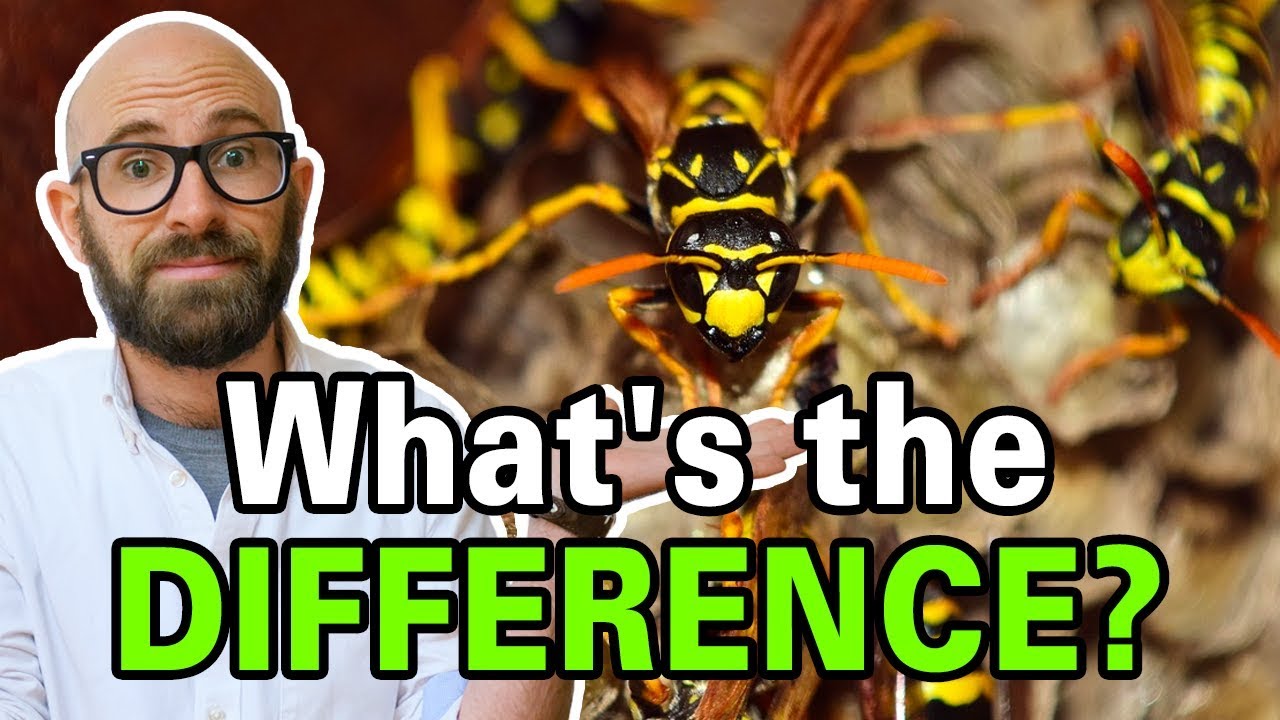
The next section follows that outlier and shows what had to change for a wasp lineage to cross into honey-making territory.
Mexican Honey Wasp Honey: The Rare Exception That Stores Nectar Like a Bee 🟡🍯
The Mexican honey wasp, Brachygastra mellifica, is the species that keeps this debate alive. It lives in parts of Mexico and Central America, and it can be found near the southern tip of Texas in the right habitats. This isn’t a “maybe honey” situation. Mature nests can contain several pounds of honey-like stores under favorable conditions.
What changed? Start with climate and seasonality. In regions where flowers are available for longer stretches, long-lived colonies become more viable. A perennial colony can justify storage. A nest that lasts multiple seasons can treat honey as insurance instead of wasted effort.
Colony architecture: perennial, large, and polygynous 👑
Unlike many temperate wasps, these colonies can persist. They can also run a polygynous setup, meaning multiple fertile queens share the same nest. Reports from field studies describe nests with a very high queen count. That matters because egg-laying capacity sets the upper bound on worker numbers, and worker numbers set the upper bound on foraging volume.
More workers changes everything. With enough labor, a colony can gather nectar beyond immediate needs, then concentrate it. The honey isn’t produced with the same industrial consistency as managed honeybee hives, but it’s real storage built from the same raw material: flower nectar.
Paper nest engineering that can hold liquid 🧱
Brachygastra nests are still made of paper. Yet the internal geometry and the concentration level of stored honey make storage workable. Think of it like shipping a liquid: the container design and viscosity both matter. A thicker, more concentrated store is less likely to soak and spread.
People who’ve seen these nests describe big, gray, football-like structures hanging from trees. Inside are layered combs. Those layers create many small compartments, which limits catastrophic leaks. It’s not wax, but it’s a workable compromise.
Harvest practices: closer to foraging than farming 🧺
In parts of rural Mexico and Brazil, wasp honey harvest is a known tradition. It does not look like modern beekeeping with removable frames. One method involves cutting a portion of the nest to drain honey while leaving the rest intact so the colony can rebuild. Some practitioners even relocate small nests closer to homes for both honey and pest control.
That said, in the United States this is not a mainstream, regulated product. It shows up as a regional curiosity, not as a consistent supply chain. If a jar claims “wasp honey” on a random marketplace listing, skepticism is justified. 🧾
There’s one more reason the exception stays niche: safety depends on local plant ecology, not just insect species. That’s the next constraint. ⚠️
With the biology mapped, the final piece is risk and real-world value: what wasp honey tastes like, why it crystallizes fast, and why wasps matter even when they make zero honey.
Wasp Honey Safety, Taste, and the Real Value of Wasps (Even Without Honey) ⚠️🌿
People who have tried wasp honey describe it as darker and more earthy than common clover honey, with notes closer to molasses or maple. Texture can be thinner than typical honeybee honey, and it often crystallizes sooner. That tracks with what is known about sugar ratios and processing differences. If the glucose-to-fructose balance shifts, crystals can form faster.
Nutrition is broadly similar at a high level because the primary sugars still land in the glucose/fructose neighborhood. What differs is the context: bees pack pollen into the hive on purpose, and pollen can end up in the final product. Wasps do not target pollen as a main input, so the pollen load can be lower.
The toxicity risk: “mad honey” isn’t only a bee story ☠️
The biggest practical warning is plant-derived toxins. Mexican honey wasps forage opportunistically. If they pull nectar from toxic plants like Datura (jimsonweed or angel’s trumpet), tropane alkaloids such as atropine and scopolamine can end up concentrated in the honey.
Those compounds can cause hallucinations, rapid heart rate, confusion, and in severe exposures, dangerous breathing issues. The wasps tolerate these chemicals far better than humans do. So the safety model is not “wasps made it, it must be safe.” The safety model is “what plants fed into this batch?”
This is why wild-harvested wasp honey demands local knowledge. It also explains why it does not scale well into general commerce. Food products need repeatability. Uncontrolled foraging plus variable toxic flora is the opposite of repeatability. ⚠️
Why your backyard wasps still matter 🧠
Judging wasps only by honey is like judging a database only by its UI. The core value is elsewhere. Social wasps are major pest controllers. Over a summer, a colony can remove a large mass of herbivorous insects from gardens and farms. That can reduce pressure on crops and reduce the need for spraying.
Wasps also pollinate, even if they are less consistent than honeybees. As they move between flowers for nectar, pollen still transfers. In mixed landscapes with wild plants, orchards, and suburban gardens, that “secondary pollination” can support biodiversity.
There’s a grounded way to think about coexistence if you’re managing property:
- 🌼 If the nest is far from people, leaving it alone often means fewer caterpillars and flies later.
- 🏡 If the nest is in a high-traffic spot, relocation or removal can be the safer call.
- 🧤 If someone is tempted to harvest “honey” from common wasps, the correct move is to not do that.
Seen through that lens, “wasps don’t make honey like bees” stops being a trivia fact. It becomes a clean summary of different evolutionary priorities: bees built storage and stability, while wasps built hunting efficiency and seasonal speed. That trade-off is the insight that holds up even after the buzz fades. 🧩
Finally, clear answers 💡
Do any wasps make honey at all?
A few tropical species like the Mexican honey wasp (Brachygastra mellifica) do produce small amounts of honey, but it's rare and not like the concentrated stuff we buy.
Why do people keep thinking wasps make honey?
Mostly because of the yellow-and-black warning colors. We see those stripes and our brain fills in 'bee', but that shared pattern is a predator deterrent, not a sign of shared diet.
Can you eat wasp honey?
You can, but good luck finding any at the store. The amount is tiny, and the flavor is different—more like a thin syrup. Local foragers in Mexico sometimes harvest it, but it's nowhere near mainstream.
What do wasps eat if not nectar?
Adult wasps sip nectar for quick energy, but they feed their young meat. They hunt caterpillars, flies, and spiders, chew them up, and feed that protein paste to the larvae. The larvae even exude sugary droplets that adults lick up.
Ring a bell? Share your experience below
Leave a comment
I’m a Brooklyn tech journalist who spent a decade covering software, cloud and developer tooling. I started this magazine in 2023 to cover generative AI without the hype or the cynicism: testing tools on my own subscriptions and citing primary sources.