Humanoid Robots in Supply Chains: Why the Reality Check Matters for 2026 Buyers
Humanoid robots keep winning the headline war. The photos are always similar: a human-shaped machine carrying a tote, folding a shirt, or doing a careful pick-and-place. The short clip ends before the shift gets messy. In supply chain ops, the messy part is the point. You deal with mixed SKUs, damaged cartons, surprise replenishment, blocked aisles, last-minute wave changes, and safety rules that shift with every new process change.
That gap between demo and deployment shows up in Gartner’s latest outlook. The firm expects that through 2028, fewer than 100 companies will push humanoid proofs of concept beyond experimentation, even though there are close to 200 efforts in motion today. More pointed: fewer than 20 companies are expected to run humanoids in production for supply chain and manufacturing use cases in that window. That is not a moral judgment. It is an estimate of friction: hardware maturity, integration drag, safety validation, and the economics of uptime.
To keep this grounded, imagine a mid-market 3PL in Ohio, “Ridgeway Logistics,” running two shifts, 120,000 SKUs, and a mix of pallet in/out plus each-pick. Ridgeway’s leadership is not anti-robot. They already run AMRs for pallet moves and have a few fixed cobots in kitting. What Ridgeway wants from a humanoid is simple on paper: cover labor gaps on peak weeks, flex between tasks, and reduce training time by “working like a person.” The reality check starts on day one: the building was not designed for bipedal navigation, the cases are not always clean, and the best workers rely on micro-decisions that are hard to label in a dataset.
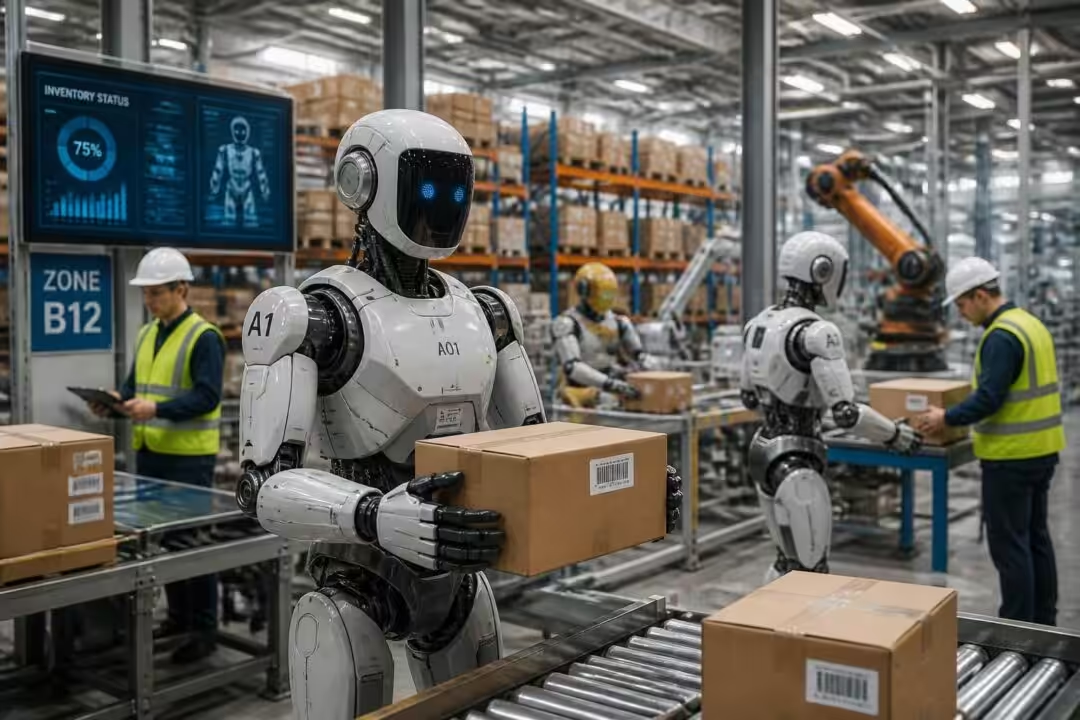
Humanoids do have a compelling idea behind them: a body plan that matches human tools and spaces. A humanoid can, in theory, use standard ladders, carts, and workstations without a full redesign. Most models share the same anatomy: a head-like sensor stack with cameras, arms with grippers, and legs for locomotion. The problem is that supply chain value is measured in throughput and availability, not vibes. If the robot needs frequent resets, careful supervision, or special “robot lanes,” you have not bought labor. You have bought a new system that demands its own caretakers. ⚠️
That is why Gartner’s supply chain analysts have been blunt about maturity and cost-effectiveness. The market is early. Many deployments, for now, stay in tightly controlled environments. Think staged demos, curated aisles, or low-traffic areas where a slow cycle time does not ripple into dock schedules. If you run high-velocity picking with narrow SLAs, the bar is higher. The first question is not “Can it lift 35 pounds?” It is “Can it hit rate for eight hours while staying safe and predictable?”
Those constraints set up the rest of the buying conversation: if humanoids will be rare in real operations through 2028, what should a pragmatic team do now? That leads directly to the real friction points: dexterity, integration, cost, and energy—each one a quiet project that can sink a flashy pilot.
Humanoid Robot Deployment Barriers in Supply Chains: Dexterity, Safety, Integration, and Battery Reality
Start with the tasks people cite in investor decks: mixed-SKU picking, trailer unloading, and exception handling. Those are some of the hardest workflows in a warehouse because they are not stable. Labels tear. Cartons crush. Units shift in a trailer. A human adjusts grip, stance, and plan in seconds. Today’s humanoids can do parts of that, but doing it at scale is where programs stall.
Technological limitations show up as “almost good enough” behavior. A robot can grasp a case in a clean demo, then fail when shrink wrap reflects light or when a barcode is half covered. That failure is not just one miss. It triggers a cascade: an operator intervenes, the robot blocks an aisle, the WMS inventory state goes out of sync, and the supervisor loses trust. In Ridgeway’s hypothetical pilot, the first week might look fine, then week two brings a new vendor carton with glossy tape. Suddenly the grasp model degrades and the robot slows down. 📉
Dexterity is not only about fingers. It is about the whole manipulation loop: perception, planning, contact, and recovery. supply chain floors punish weak recovery. If a gripper slips and drops a case, the robot needs a safe “what now” routine. Humans solve this in a way that is hard to encode: move the feet, clear the hazard, check for damage, and decide whether to rework or send it on. A machine that freezes is not safe, and a machine that improvises without guardrails is not safe either.
integration complexity is the next trap. Even a strong robot needs hooks into your WMS, safety stack, and operational rhythms. It must understand tasks, locations, exceptions, and priorities. It must share space with pickers, lift trucks, and AMRs. That means LIDAR or vision-based detection, zone control, and clear handoff rules. Many teams underestimate how much “integration” is really change management: new SOPs, new training, and a new incident response playbook. If your site already struggles with RF gun compliance, you will struggle with “robot compliance.”
Then there is cost, where hype gets punished fast. Gartner’s view is that humanoids can cost multiple times more than task-focused systems while delivering lower throughput and uptime at current maturity. Even if you can raise money, you still face basic math: dollars per pick, hours per intervention, and the opportunity cost of engineering attention. If the same capex could fund more AMRs plus a conveyor upgrade, the robot has to beat that combined ROI, not an imaginary baseline.
Energy constraints are less glamorous but constant. A bipedal platform that walks, balances, and lifts burns power. Batteries add weight; weight raises energy use; energy use reduces runtime. If a robot needs frequent charging or swapping, you lose the thing you were buying: steady production. Some teams try to solve this by restricting walking, which creates a weird outcome: a humanoid that behaves like a stationary arm most of the day. That can be useful, but it undermines the “general worker” pitch.
To make this concrete, a pilot plan should treat these barriers as test cases, not surprises. That means defining success around measurable thresholds and “bad day” behavior.
- 🧪 Dexterity test: mixed cartons, reflective tape, damaged packaging, and awkward grab points on purpose.
- 🦺 Safety test: unplanned human crossings, dropped items, and forced stops to validate recovery routines.
- 🔌 Integration test: real WMS tasks, real exception codes, and real inventory reconciliation.
- 🔋 Battery test: runtime across a whole shift pattern, including peak walking and peak lifting windows.
- 📊 Ops test: measure interventions per hour, not just average cycle time in a clean lane.
The takeaway is not “never buy.” It is “buy like an ops person.” If these barriers are treated as engineering details, a pilot will look good until it meets production. That is why many teams are now comparing humanoids to a different category: polyfunctional robots that skip the human shape and focus on warehouse work.
With those constraints clear, the next question is practical: if you still want flexibility, what form factors and architectures are already closer to earning their keep on a warehouse P&L?
Polyfunctional Robots vs Humanoid Robots: The Throughput-Per-Dollar Test in Warehouse Automation
Gartner’s most useful reframing is simple: stop treating “human-shaped” as the default path to flexibility. A warehouse does not care if a machine looks like a person. It cares if the machine can move, sense, and manipulate with high uptime and predictable maintenance. That is where polyfunctional robots get an edge. They are designed for multiple tasks, but they are not constrained by human anatomy.
A common example is a wheeled mobile manipulator: a stable base with wheels, a sensor mast, and a telescopic arm. That layout can move cases, scan inventory, handle light picking, and do inspection passes. The wheeled base saves energy and reduces balance complexity. The arm can be optimized for reach and payload, not for looking like a human forearm. The sensors can be placed for visibility, not for aesthetics. In practice, that means fewer falls, simpler safety modeling, and often longer runtime per charge. ✅
Back at Ridgeway Logistics, a polyfunctional robot can be dropped into a “boring but valuable” workflow: nightly cycle counts in a slow zone. The robot drives aisles, scans locations, flags mismatches, and leaves a list for a human to reconcile. That is not science fiction. It is also not a single demo trick. It is repeatable work that reduces error and frees people for tasks that actually require judgment. The robot’s “flex” value grows over time: cycle count tonight, label audit tomorrow, pick assist next month.
Humanoids can do some of those jobs too. The issue is the cost of getting there. A biped platform must solve walking, balance, fall safety, and foot placement in clutter. Those are hard problems that are not directly tied to your KPI. If your goal is “scan more locations” or “reduce touches,” you might not want to fund someone else’s walking research with your production budget.
Here is a buyer-oriented way to compare the categories. The numbers will vary by vendor and site, but the decision criteria stay stable:
| Factor | Humanoid robots 🤖 | Polyfunctional robots 🛞 |
|---|---|---|
| Best-fit environments | Controlled zones, staged workflows, low variability areas ✅ | Dynamic aisles, mixed tasks, long patrol routes ✅ |
| Throughput per dollar | Often lower early, due to supervision and tuning 💸 | Often higher, due to stability and simpler motion loops 📈 |
| Energy use | Higher for walking and balance 🔋 | Lower for wheeled travel, longer duty cycles 🔋 |
| Integration burden | High: safety, exceptions, and novel workflows 🧩 | Moderate: clearer task boundaries and movement patterns 🧩 |
| Human factors | High attention risk: people gather, film, and intervene 👀 | Lower novelty factor, easier normalization over time 👷 |
The “human factors” row sounds soft, but it becomes real in pilots. Humanoids draw crowds. That changes behavior and can skew results. People help the robot, or they avoid it, or they treat it like a mascot. A polyfunctional machine tends to blend into the fleet faster, which gives you cleaner data.
None of this means humanoids are pointless. It means the path to ROI is narrower. If you have a building designed around human tools and you cannot change it, a humanoid form factor might reduce retrofits. If your tasks demand vertical reach in tight spaces, legs can be useful. But the burden of proof is on the deployment plan, not on the marketing video.
With that comparison in mind, the next step is procurement reality: what happens after the PO, when you need service, parts, and predictable operations?
Once you start thinking like a buyer, the robot’s “supply chain” becomes the story: lead times, repair loops, and the vendor’s ability to keep units running on your floor.
Humanoid Robot Procurement Reality Check: Lead Times, Repair Networks, Spare Parts, and Vendor Risk
Most humanoid conversations start with capability. Mature procurement starts with supportability. If a robot is down, the cost is not just the robot. It is the blocked process, the supervisor time, the safety review, and the loss of trust that makes operators work around the system.
For a decision team, the first set of questions should feel almost boring. That is good. Boring questions keep pilots from turning into expensive theater.
Service model: who fixes it, how fast, and with what parts
Ask the vendor to describe the repair loop in plain terms. Does the vendor have a US-based field service team? What is the SLA for on-site response? Which failures require shipping the unit back, and how long does that take? If the answer is “we’ll figure it out,” that is a risk you own.
Ridgeway’s operations lead might accept a slow repair loop for a lab demo. In production, even a 48-hour delay can blow up a weekly plan. If the humanoid is assigned to unload trailers, downtime backs up appointments and creates detention fees. If it is assigned to pick assist, downtime creates labor scramble and overtime. 🧯
Spare parts and battery reality
Battery packs, actuators, grippers, cameras, and compute modules fail. Some failures are random; others are wear. You need to know which parts are stocked domestically, what the replacement procedure is, and whether swapping parts requires vendor presence. If batteries degrade faster than expected under warehouse temperature swings, the “cheap” operating cost becomes a replacement schedule that hits budgets mid-year.
Energy constraints also feed into facility planning. Charging stations take space and power. Battery swaps require safe handling and inventory control for packs. If the vendor has only one battery form factor, you are locked in. If you can standardize packs across a mixed robot fleet, you reduce headache.
Software updates, safety certification, and change control
Supply chain software lives on change control. Robots bring that discipline to the physical layer. A perception update can change how the machine reacts to reflective tape. A navigation update can change how close it drives to pedestrians. You need a release process that matches your EHS program, including rollback plans.
That also connects to integration. A robot that depends on cloud connectivity needs a clear story for network outages and segmentation. A robot that processes video needs a data retention policy that legal and HR can live with. A robot that logs every near-miss needs a process for triage, or the logs become noise.
Geopolitical exposure and supplier concentration
Humanoid value chains are global, and the risk is not abstract. Components like sensors, batteries, and compute can face export controls, sudden lead time spikes, or vendor consolidation. If a startup has a single-source actuator supplier, your uptime depends on a relationship you do not control. Procurement teams should map “single points of failure” the same way they map single-source packaging suppliers.
Gartner’s forecast—few deployments reaching full production scale through 2028—also hints at a market shakeout. Some vendors will merge, pivot, or run out of runway. That is not drama; it is normal for new hardware categories. Your contract should plan for it: escrow for critical software, documentation access, and rights to keep operating if the vendor changes hands.
One practical tactic is to treat a humanoid as a program, not a product. That means budgeting for spares, training, safety validation, and integration work from the start. If the vendor pushes back, that is signal.
With procurement risk on the table, the next move is how to run pilots that generate hard evidence, not pretty clips. Gartner’s guidance here is useful: pilot, partner, monitor, and target outcomes instead of vague “headcount reduction.”
How to Run a Humanoid Robot Pilot in Supply Chains: Metrics, Governance, and Outcome-Driven Automation
A pilot succeeds when it answers a narrow question with data you can defend. It fails when it tries to prove a worldview. Gartner’s advice to CSCOs lines up with what good engineering teams already do: test feasibility first, collaborate with the vendor, monitor performance, and iterate. The difference is that robotics pilots touch safety and labor dynamics, so governance needs to be tighter.
Pick the bottleneck, not the headline
Many companies start with a vague goal like “reduce labor.” That makes the pilot political and hard to measure. Instead, pick a specific bottleneck: carton induction backlog, repetitive inspection, putaway scans, or exception sorting. If the robot helps that bottleneck, the win is clear even if headcount stays the same.
At Ridgeway, the pilot target might be “reduce cycle count variance in Zone D” or “cut rework touches for mislabeled cartons.” Those metrics tie directly to chargebacks and customer satisfaction. They also avoid the trap of claiming the robot will replace a full associate role on day one. 🎯
Define success metrics that include the ugly stuff
Cycle time is not enough. A robot that is fast but needs constant babysitting is not a production asset. Build a scorecard that includes:
- 📦 Throughput: units per hour in normal traffic, not after-hours.
- ⏱️ Uptime: percent of scheduled time doing productive work.
- 🧑🔧 Interventions: human assists per hour, categorized by root cause.
- 🦺 Safety: stop events, near-misses, and recovery correctness.
- 💰 Cost per task: labor minutes saved minus added tech labor minutes.
If a vendor prefers “engagement metrics” like how many tasks were attempted, push back. Attempted work does not ship orders.
Collaborate with emerging providers without becoming their QA team
Gartner suggests working with newer vendors to influence product direction. That can be smart, but only with guardrails. Set clear boundaries: what feedback you will give, what fixes you need before the next phase, and what data you will share. If the vendor needs your site to debug basic locomotion, that is not a partnership. That is unpaid testing.
Ask for a structured iteration loop: weekly defect review, prioritized backlog, and a release plan. Treat it like a software rollout with staged gates. If the robot is supposed to handle mixed cartons, require evidence that the grasp model improved against your specific packaging set, not against a generic benchmark.
Continuous monitoring that supports operations, not just analytics
Monitoring should drive action on the floor. Dashboards need to flag “robot is stuck in aisle 12” and “battery health trending down,” not just aggregate KPIs. Set up alerting that routes to the right on-call role, with clear escalation paths.
This is also where culture matters. Gartner talks about fostering a culture that supports experimentation and calculated risk-taking. In practice, that means training supervisors to treat early failures as data, while still enforcing safety and process discipline. Operators should know how to pause the robot, how to report issues, and how to avoid unsafe improvisation.
Controlled environments can be valid—if the business case matches
Gartner expects most humanoid deployments in the near term to stay in controlled environments rather than high-throughput chaos. That can still be valuable. A controlled environment might be a dedicated kitting cell, a returns triage lane, or a clean-room adjacent packaging area. If that lane is stable and high cost, a humanoid can make sense even if it never roams the whole building.
The key is honesty in the scope: a robot in a controlled lane is not a general worker. It is an automated station with legs. If the numbers work and the safety case is clean, that is fine. If the vendor sells it as “full warehouse coverage next quarter,” that is where buyers get burned.
For teams making decisions now, the realistic playbook is straightforward: run pilots that measure intervention rate and uptime, compare against polyfunctional alternatives using throughput-per-dollar, and treat serviceability as a first-class requirement. The next step after a solid pilot is not a press release. It is a procurement and rollout plan that can survive peak season.
Save the date for RoboBusiness 2026 if your roadmap includes robotics vendors and real-world case studies; the floor conversations often reveal more than the stage demos. 📅

I’m a Brooklyn tech journalist who spent a decade covering software, cloud and developer tooling. I started this magazine in 2023 to cover generative AI without the hype or the cynicism: testing tools on my own subscriptions and citing primary sources.