Tech
Queued meaning in Gmail: what does it mean and how to fix it?
Queued meaning in Gmail: what it means, how it differs from Outbox, and why it happens
The Queued label in Gmail indicates a message is neither a draft nor successfully sent; it is a message that the client will re-attempt to deliver when conditions allow. Think of it as a traffic light turning red just before your car enters the intersection. The engine runs, you’re in gear, but the road isn’t clear. In practice, this state appears most often on the mobile app, particularly on Android, when the app cannot immediately reach Google’s mail servers, the app cache is corrupted, or the device blocks background data. On desktop, it’s less common but can occur with offline mode or temporary network interruptions. Understanding this state helps prevent overreacting, like force-closing apps or repeatedly tapping Send, which can create duplicates or errors.
Why does Gmail queue messages in the first place? The client is designed to preserve user intent even when the environment is imperfect. Rather than throwing an error and discarding your content, it preserves the message and retries. That resiliency is good, but it means the queue can build when network reliability, authentication, or attachment processing isn’t cooperative. For example, a large photo from a recent Samsung camera upload might trigger a Google Drive conversion, and the upload may stall on a weak signal, leading to a queued state. Similarly, daily sending limits, especially on newly created accounts, can cause queued behavior until limits reset.
Key distinctions users often miss
Misunderstandings around status labels cause unnecessary troubleshooting. Clear distinctions keep actions focused and safe.
- ✅ Queued: Gmail will retry sending automatically; don’t panic 😊
- 📦 Outbox: Temporary holding area where queued messages usually sit
- ✏️ Draft: Editable content not pending send; safe to modify 📝
- 📤 Sent: Message accepted and dispatched by the server
- 🛑 Bounced/Failed: Delivery rejected; needs address or policy fix
It helps to compare language across email ecosystems. Many users juggle Outlook, Yahoo Mail, and legacy Hotmail addresses in addition to Gmail, and each uses slightly different UI cues for similar states. The table below maps the mental model across providers.
| Status concept 🚦 | Gmail (Google) 📧 | Outlook (Microsoft) 🟦 | Yahoo Mail 🟣 | Hotmail (legacy) 📨 |
|---|---|---|---|---|
| Waiting to send | Queued in Outbox ⏳ | Outbox with sync pending 🔁 | Outbox with retry 🔄 | Outbox pending ⌛ |
| Editable but not sending | Drafts 📝 | Drafts 📝 | Drafts 📝 | Drafts 📝 |
| Confirmed sent | Sent 📤 | Sent Items ✅ | Sent ✅ | Sent ✅ |
| Delivery blocked | Bounced/Failed 🚫 | Undeliverable ❌ | Delivery failure ⚠️ | Delivery failed ❗ |
Consider “Jordan,” a product manager preparing a last-minute proposal to a client. On the commute, the phone switches between 5G, 4G, and café Wi‑Fi. A 28 MB PDF triggers Drive upload, the network blips, and the email becomes queued. Jordan assumes the message is gone and resends repeatedly, later realizing the client got three copies. Clarity about Queued would have saved time and avoided confusion. The lesson: queued is a sign to stabilize connectivity, confirm attachment behavior, and let the system retry rather than spamming Send.
Insight: Treat Queued as a safety net, not an error—then focus on environment checks instead of quick-fix guesswork.

Before trying fixes: a smart checklist to diagnose Gmail queued issues fast
Systematic triage solves most queued messages in minutes. Start with the environment and account conditions, then move toward app-level resets. This avoids needless data loss and respects how Google apps coordinate across devices like Android, iPhone, and desktop browsers. The aim is to preserve your content, confirm that Gmail can reach the mail server, and ensure nothing external—like daily limits or device storage—blocks the process.
Rapid pre-checks to run
- 📶 Connectivity: Test a webpage or speed test; switch between Wi‑Fi and cellular if needed 🌐
- 🗄️ Storage: Free at least 1–2 GB on the device to allow caching and uploads
- 🧩 App version: Update the Gmail app on Android and iPhone to the latest build 🛠️
- 📎 Attachments: Over 25 MB triggers Drive upload—confirm upload completes or share via Drive link 📁
- 📈 Daily sending limits: If usage spiked, wait for reset or reduce batch sends ⏲️
- 📴 Offline mode (web): Ensure it’s disabled if you need immediate send
- 🔒 Background data: Allow Gmail background data and disable Data Saver for the app on mobile
- 🧹 Cache health: Corrupted cache often causes stuck queues
When large projects and distributed teams depend on email, capacity and network quality matter. In cities rolling out dense IoT and public Wi‑Fi, reliability can fluctuate at peak times. For context on how modern infrastructure influences connectivity, see this summary of innovative AI and smart-city connectivity initiatives. While not directly about Gmail, it illustrates why even robust apps can stall when the last-mile network is saturated.
| Symptom 🧩 | Probable cause 🔎 | Quick check ✅ | Action 🚀 |
|---|---|---|---|
| Queued for hours | Poor network or background data off | Open a live map or stream 🎥 | Enable background data; switch network |
| Stuck with large file | Attachment >25 MB, Drive upload stalled | Check Drive recent files 👀 | Insert Drive link or compress |
| Sudden spike of sends | Hitting daily limits | Try sending a short test ✉️ | Wait for limit reset or stagger |
| Desktop only | Offline mode enabled | Gmail settings → Offline ⚙️ | Disable offline, refresh |
| Mobile only | Cache corruption | New message hangs 🕒 | Clear cache/data, relogin |
Teams exploring AI to streamline communication workflows often maintain playbooks for edge cases like queued mail. If that’s on the roadmap, this practical overview of case applications is a helpful framework to formalize triage steps and escalation paths. And for leaders focusing on well‑being in high‑pressure inbox environments, a brief note on mental health benefits of AI‑assisted communication adds a humane dimension to process design.
Insight: Most queued messages resolve when the environment is stabilized—fix the conditions first, then the app.
Step‑by‑step fixes: five proven methods to unstick queued emails in Gmail
With the pre‑checks complete, move to controlled interventions. Preserve content first: open the queued message, select all text, and paste it into Notes or Docs. If the email includes intricate formatting or multiple recipients, consider pasting into a temporary Google Doc and copying addresses into a safe place. The goal is avoiding data loss if cache clearing or account re‑auth is needed.
Method 0: Back up content before changes
- 🧷 Copy message body and subject to a safe note
- 👥 Copy all recipients (To/Cc/Bcc) 📨
- 📎 Save attachments locally or in Drive
- 🔐 Prepare to re‑authenticate after cache clear
Method 1: Toggle Gmail sync
On Android: Gmail → Settings → your account → Data usage → uncheck Sync Gmail → reboot → re‑check Sync Gmail. On iPhone, ensure Mail sync is enabled in iOS Settings → Mail → Accounts → Gmail and in the Gmail app. This refreshes the client’s scheduler and often immediately drains the Outbox.
Method 2: Clear Gmail cache (and data if needed)
On Android: Settings → Apps → Gmail → Storage → Clear cache. If issues persist, select Clear data, then sign in again. This removes corrupt temporary files that commonly cause the queue to stall. On iPhone, reinstalling Gmail achieves a similar reset because iOS restricts direct cache access. Ensure content is backed up first.
Method 3: Allow background data and disable Data Saver for Gmail
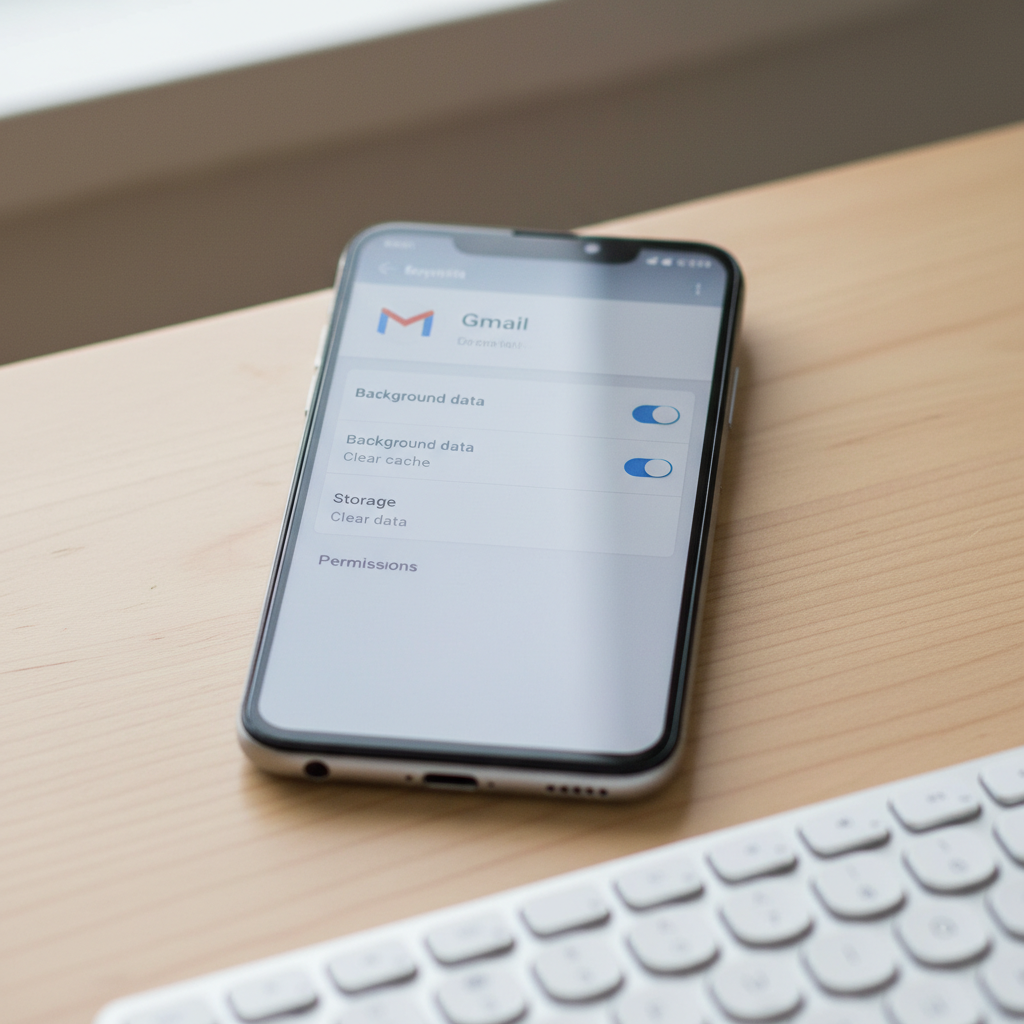
Android: Settings → Apps → Gmail → Mobile data → enable Allow background data usage and Allow app while Data saver on. When Data Saver is active, uploads and retries pause in the background, which practically guarantees queuing when the screen locks.
Method 4: Disable Gmail offline mode on the web
Desktop browser: Gmail gear icon → See all settings → Offline → make sure Enable offline mail is unchecked. If you must keep offline for travel, send critical messages while connected and confirm in Sent before disconnecting.
Method 5: Remove and re‑add the account
Android: Settings → Accounts → select Google account → Remove → reboot → re‑add. This resets tokens and sync metadata that might be stuck. On iPhone, remove the Gmail account from Settings → Mail → Accounts, then add it again via Google. After re‑addition, the Outbox should be clear and normal sending restored.
| Method 🛠️ | Risk ⚠️ | Time ⏱️ | Typical success rate 🎯 |
|---|---|---|---|
| Toggle Sync | Low 🙂 | 1–2 min | High for light glitches ✅ |
| Clear Cache/Data | Medium (requires login) 😅 | 3–5 min | High for persistent queue 💪 |
| Enable Background Data | Low 🙂 | 1 min | High when Data Saver on 📶 |
| Disable Offline (Web) | Low 🙂 | 1 min | Medium; desktop‑only 🖥️ |
| Re‑add Account | Medium (re‑sync) 😬 | 5–10 min | Very high for auth/sync issues 🏁 |
Device brands sometimes add nuances. On Samsung phones, adaptive battery or vendor data saving can also throttle Gmail; ensure Gmail is excluded from aggressive optimization. In mixed ecosystems—say an Apple Mac, an Android phone, and a Windows laptop—remember that stale credentials in one place can propagate sync anomalies. A full refresh after password changes keeps the queue from reappearing.
Insight: Work from least invasive to most invasive; the majority of cases resolve by toggling sync or clearing cache.

Platform-specific playbooks: Android, iPhone, and desktop Gmail, plus Outlook/Yahoo Mail comparisons
Different platforms expose different levers to fix queued email. Understanding where each control lives reduces time to resolution. The following playbooks distill the most reliable steps for Android, iPhone, and desktop web. A brief comparison with Outlook, Yahoo Mail, and legacy Hotmail helps teams who operate in mixed environments standardize responses.
Android actions that matter most
- 📶 Switch networks quickly (Wi‑Fi ↔ mobile) to kickstart retries
- 🔁 Toggle Sync Gmail as a first move
- 🧹 Clear cache; escalate to Clear data only after backup
- 📱 Exempt Gmail from battery optimization on Samsung devices 🔋
- 📁 Replace large attachments with Drive links when >25 MB
iPhone essentials
- 🔧 Ensure Mail sync is on for the Gmail account in iOS Settings
- 🧩 Update Gmail via the App Store; reinstall to refresh cache
- 📡 Test send via cellular if Wi‑Fi is flaky
- 📎 Use Files or Drive app to pre‑upload large attachments
- 🧭 Confirm time/date auto‑set; incorrect clocks can block auth 🔐
Desktop Gmail troubleshooting
- 🛰️ Disable Offline in Gmail settings
- 🧪 Try an incognito window to rule out extensions
- 🧰 If using enterprise SSO, re‑auth to refresh tokens
- 📤 Send a tiny test email first to check path health
- 🧯 If stuck, download the draft, then relaunch browser
| Platform 🧭 | Top fix 🔧 | Where to tap/click 📍 | Extra note 📝 |
|---|---|---|---|
| Android | Toggle Sync Gmail ✅ | Gmail app → Settings → account → Data usage | Also enable background data 📶 |
| iPhone | Reinstall Gmail ↻ | App Store → Gmail → Reinstall | Re‑enable account sync in iOS Settings 🔐 |
| Desktop | Disable Offline 📴 | Gmail web → Settings → Offline | Try incognito to rule out extensions 🕵️ |
| Outlook (Microsoft) | Work Offline toggle 🔄 | Send/Receive → Work Offline | Large PST/OST files can delay sends 🗄️ |
| Yahoo Mail | Attachment size check 📎 | Compose → Attach | Prefer cloud links for big files ☁️ |
| Hotmail | Credential refresh 🔑 | Account → Security | Legacy accounts hit throttles faster ⏲️ |
Organizations that embed AI into communication workflows often codify these steps in tooling. For leaders evaluating change management around these routines, this short primer on case application frameworks can help formalize rollouts. And because network capacity impacts delivery timing, the broader context of smart-city network evolution remains relevant for distributed teams working in dense urban centers.
Insight: Each platform has a “fast lever”—know it, and you cut troubleshooting time by half.
Prevention strategies: keep Gmail from queuing messages in the future
Prevention reduces urgent fire drills and protects relationships. The most common root causes—weak connectivity, oversized attachments, throttling, and stale app versions—are preventable with small habits and lightweight policies. For critical communications, prefer a stable network and desktop compose for reliability; reserve mobile for quick responses or messages that do not carry large attachments.
Practical habits that pay off
- 📡 Send important emails on trusted Wi‑Fi or strong cellular; avoid elevators, subways, and crowded event Wi‑Fi
- 📎 Convert large attachments to Drive links; keep under 25 MB when possible
- 🆕 Keep Gmail updated on Android and iPhone; enable auto‑updates
- 🗃️ Maintain 1–2 GB free space to accommodate caching and uploads
- 🕒 Schedule send during non‑peak hours if the network is crowded ⏲️
- 🧭 Verify time/date auto‑sync to prevent token issues
- 🧪 Test with a small email before sending big launches or attachments
Team policies for reliability at scale
- 🏷️ Standardize attachment guidance: when to link vs. attach
- 📶 Publish a “network hygiene” checklist for travel and field events
- 🔄 Encourage lightweight retries; discourage multi‑send spam 😅
- 📚 Offer quick training snippets for Android, iPhone, and desktop Gmail
- 🛡️ For regulated teams, align with Microsoft 365 and Apple MDM policies to prevent over‑aggressive app throttling
| Preventive step 🛡️ | Impact 📈 | Tooling 🧰 | Tip 💡 |
|---|---|---|---|
| Use Drive links for big files | Fewer stalled uploads ✅ | Google Drive, Files 📁 | Pre‑upload on Wi‑Fi 🌐 |
| Keep app updated | Bug fixes and stability 🧩 | Play Store/App Store 🆕 | Enable auto‑update ⚙️ |
| Reserve stable networks | Higher first‑pass send rate 🚀 | Speed tests, hotspot 📶 | Avoid event Wi‑Fi crowds 👥 |
| Free device storage | Reliable caching 🗄️ | Storage manager 🗂️ | Target 1–2 GB free 📊 |
| Schedule send | Smoother server throughput ⏲️ | Gmail schedule 📅 | Use off‑peak hours 🌙 |
A brief scenario underscores the value. Jordan’s team at a robotics startup ships a last‑minute demo invite to partners using Gmail. They pre‑upload the video to Drive, schedule the send during a less congested window, and validate connectivity on both Android and iPhone test devices. The result: zero queued messages, immediate confirmations, and clean analytics. For leaders shaping policy and wellness, this perspective on AI‑supported communication and burnout reduction suggests that better process isn’t just faster—it’s healthier.
Curious how macro trends inform micro practices like these? This overview of urban connectivity and AI rollouts offers useful context for teams navigating variable network reliability across cities.
Insight: Make reliable sending the default with a few small rules—then queues become rare edge cases rather than weekly headaches.
Edge cases and advanced diagnostics: when Gmail keeps queuing despite fixes
Occasionally, queued messages persist after standard remedies. That’s the moment to consider deeper factors: account-level throttling, security policies, attachment type restrictions, and domain reputation issues. In hybrid environments where Outlook and Gmail coexist, mail transfer agents and security gateways can temporarily defer delivery. Although these usually affect server‑side delivery after “Sent,” misconfigurations can manifest as client retries, especially if authentication or token refresh fails on a specific device.
Advanced areas to examine
- 🧱 Daily or hourly throttling: New accounts or sudden bursts can hit limits; stagger sends
- 🔐 2FA and token expiry: Re‑authenticate across all devices after password changes
- 🧷 MIME/attachment issues: Certain file types trigger scanning; compress or change format
- 🏢 Enterprise MDM: Over‑aggressive data/battery policies throttle Gmail on managed Android/iOS
- 🔄 POP/IMAP conflicts: Avoid legacy POP with frequent mobile switching; prefer IMAP
- 🌐 VPN/proxy: Some VPNs throttle uploads; test without VPN
| Edge case 🧠 | Diagnostic step 🔎 | Resolution ✅ | Note 🗒️ |
|---|---|---|---|
| Throttling | Send tiny test; check timing ⏲️ | Stagger or wait for reset | New accounts more sensitive ⚠️ |
| Token expired | Forced sign‑out/sign‑in 🔐 | Re‑auth all devices | Change passwords everywhere 🔁 |
| MDM policy | Check device profile 📱 | Whitelist Gmail from optimization | Common on Samsung enterprise 🔋 |
| VPN blockage | Try without VPN 🌐 | Allowlist mail endpoints | Uploads often throttled 🐢 |
| Attachment type | Scan logs; test zip 📦 | Change format or link via Drive | Executable‑like formats flagged 🚫 |
Some teams codify these diagnostics into playbooks supported by internal AI copilots. For leaders evaluating such rollouts, a structured guide like this case application resource helps turn ad‑hoc fixes into repeatable workflows. Balanced with team care, insights on communication load and mental health ensure troubleshooting doesn’t become a chronic stressor. To keep perspective on network evolution that shapes these edge cases, the digest on AI‑driven connectivity remains a relevant backdrop.
Insight: Persistent queues usually point to policy, security, or network constraints—solve the root, not just the symptom.
Does a queued email in Gmail eventually send on its own?
Yes. Queued means Gmail will retry automatically when conditions allow. If it stays queued for more than 10–15 minutes on a stable connection, run the sync toggle and cache steps to accelerate delivery.
Will clearing the Gmail cache delete my emails?
No, cache clearing removes temporary files. If you also clear data or reinstall, you’ll need to sign in again, but server-stored emails remain safe. Always back up the draft text before making changes.
Why do large attachments cause queued states?
Gmail converts attachments over 25 MB to Google Drive links. If the upload stalls—due to poor connectivity, Data Saver, or VPN—sending pauses and the message remains queued until the upload completes.
Is Outlook less likely to queue emails than Gmail?
Not necessarily. Outlook, Yahoo Mail, and even legacy Hotmail can queue messages under poor connectivity, large attachments, or policy restrictions. The root cause is usually the environment rather than the client brand.
What single action fixes most queued problems on Android?
Toggling Sync Gmail off and back on, then enabling background data for the app, resolves the majority of Android cases without data loss.

Max doesn’t just talk AI—he builds with it every day. His writing is calm, structured, and deeply strategic, focusing on how LLMs like GPT-5 are transforming product workflows, decision-making, and the future of work.



international entrepreneur rule update: what changes in 2025 mean for global startups
Navigating the 2025 International Entrepreneur Rule Update The landscape for global startups looking to breach the American market has shifted...


Shortcut to size pdf: how to access and use the guide for muscle growth
Decoding the Architecture of Muscle Growth In the world of physical optimization, efficiency is the primary metric. The concept of...


Unlocking the power of iconography pdfs: essential guide for 2025
Unlocking the Strategic Value of Visual Communication in 2025 In today’s statistical-first world, effective communication often happens in milliseconds. Users...


San Francisco Startups: Key Trends to Watch in 2025
AI-Native Momentum in San Francisco Startups: Foundation Models, Agents, and Safety Across San Francisco, the most visible shift in 2025...


how to apply a promo code on study.com: step-by-step guide for august 2025
Navigating Education Savings with Study.com in August 2025 As the academic landscape continues to evolve, finding cost-effective solutions for online...


The best bond movies ranked: a definitive guide for 2025
The Future of Espionage and the Legacy of 007 in 2025 As we navigate through 2025, the cinematic landscape is...


Best male hairstyles for round faces: top trendy looks for 2025
Optimizing Facial Symmetry: The Logic Behind Haircuts for Round Faces Finding the optimal aesthetic for a round face shape is...


Explore the Top 5 Free NSFW AI Chatbots to Try in 2025
The Rise of Unfiltered Digital Companions in the 2025 Landscape The digital horizon has expanded significantly, and the way humans...


OpenAI vs Quora: Choosing Between ChatGPT and Poe for AI Tools in 2025
Navigating the AI Ecosystem: The 2025 Showdown In the rapidly evolving landscape of Artificial Intelligence, the year 2025 has brought...


Mini blocks: creative building ideas and tips for beginners in 2025
Mastering Mini Blocks: A Tactile Renaissance in 2025 In an era dominated by augmented reality and digital interfaces, the tactile...


Super claude code: how to maximize your coding efficiency in 2025
It’s no longer about simply having access to the most powerful AI; it’s about how you wield it. As we...


Essential ap world term flashcards pdf for effective 2025 exam prep
Streamlining Your 2025 AP World History Strategy with Digital Tools Success in the AP World History exam isn’t just about...


Tp test paper explained: key points, uses, and expert tips in 2025
Navigating the Teleperformance Assessment Ecosystem in 2025 The recruitment landscape has evolved significantly, with data-driven evaluations becoming the standard for...


Must-Watch AI Movies to Look Forward to in 2025
The Evolution of Cinema: Why AI Films Are Dominating 2025 The landscape of visual storytelling has shifted dramatically over the...


Notion AI vs. ChatGPT: A 2025 Feature Showdown to Supercharge Your Productivity
The digital landscape of 2025 has become crowded with intelligent assistants, each promising to revolutionize how work gets done. While...


Ftfy meaning explained: what does ftfy stand for in 2025 internet slang?
Decoding the FTFY meaning in modern digital language Navigating the complex landscape of internet slang requires more than just a...


Top words that start with tu: expand your English vocabulary
Unlocking the Potential of “TU” Vocabulary in Professional Communication Mastering a precise vocabulary is akin to optimizing code; the right...


How to use an ap spanish score calculator for accurate results in 2025
Optimizing Your Strategy with an AP Spanish Score Calculator Achieving a top tier result on the AP Spanish Language and...


A look at interesting things that start with ai
Unveiling the Hidden Layers of Modern Intelligence The landscape of technology has shifted dramatically by 2025. Artificial Intelligence is no...


sim failure explained: common causes and quick fixes in 2025
Your iPhone is your lifeline to the digital world, handling everything from urgent emails to streaming the latest podcast. So,...
-

 Open Ai2 months ago
How to Effortlessly Access Your Archived Conversations on ChatGPT in 2025
-

 Open Ai2 months ago
A Comprehensive Guide to Sharing Your ChatGPT Conversations: 2025 Edition
-

 Tools1 month ago
How to download and use open subtitles for movies and TV in 2025
-

 Ai models2 months ago
MIT Researchers Introduce ‘SEAL’: A Game-Changer in the Evolution of Self-Enhancing AI
-

 Actualités1 month ago
Ontario Man Claims ChatGPT Prompted Psychosis During ‘World-Saving’ Quest
-

 Actualités2 months ago
OpenAI Reports That Hundreds of Thousands of ChatGPT Users May Experience Symptoms of Manic or Psychotic Episodes Weekly

